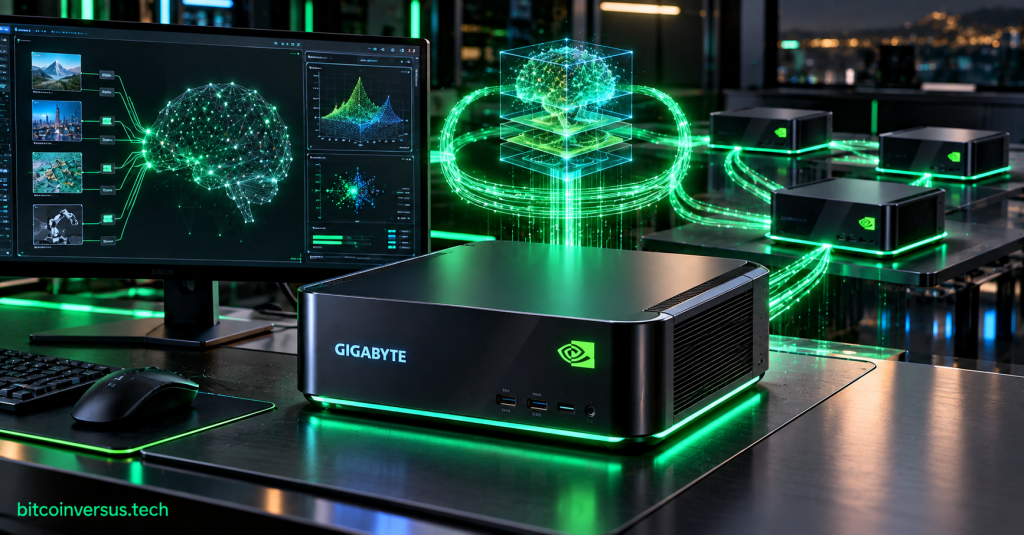
GIGABYTE is adding a 64 GB unified-memory version of its AI TOP ATOM desktop AI system, giving developers a smaller-memory entry point into the NVIDIA DGX Spark platform while keeping local inference, RAG, prototyping and agentic-AI workflows on the desk instead of in the cloud.
In its October 2 launch announcement, GIGABYTE said the new 64 GB configuration will be available October 23 and retains the AI TOP ATOM hardware design built around NVIDIA’s DGX Spark platform.
Desktop AI is becoming its own hardware category
The interesting part is not simply that GIGABYTE removed half the memory from the existing 128 GB configuration. It is that the company now sees enough demand for local AI development to split the product line by workload size, letting teams choose between smaller proof-of-concept jobs and more memory-intensive model work without changing platforms.
BitcoinVersus has been tracking the same move toward compact local compute through Seeed Studio’s fanless industrial edge-AI computer, where inference and computer-vision workloads are pushed closer to the machine instead of automatically being sent back to centralized cloud infrastructure.
The AI TOP ATOM is a much more powerful class of box. It is based on NVIDIA’s GB10 Grace Blackwell architecture and includes ConnectX-7 networking so multiple systems can be linked together. GIGABYTE says developers can cluster as many as four units with NVIDIA Sync for larger memory pools and additional compute.
Unified memory is the real feature
For local AI, memory capacity often matters as much as raw accelerator throughput because model weights, context and intermediate data all have to fit somewhere. Unified memory gives the CPU and GPU access to the same memory pool instead of forcing every workload through a conventional split between system RAM and dedicated graphics memory.
StorageReview’s hands-on testing of the existing 128 GB AI TOP ATOM found the platform built around a 20-core Arm CPU, integrated Blackwell acceleration and a compact roughly one-liter chassis. Its testing also showed why this category is more workstation than ordinary mini PC: the platform is designed around sustained local inference, GPU-direct storage and high-speed networking rather than general desktop use.
That same memory-centric logic is visible in other local-AI experiments. BitcoinVersus recently covered four Mac Studios running a trillion-parameter model over Thunderbolt 5, where pooling memory across multiple systems became the key to running a model too large for a single machine.
The software stack is designed for local workflows
GIGABYTE says the 64 GB model keeps support for the NVIDIA CUDA-accelerated AI software ecosystem and its own AI TOP Utility. The utility includes model downloading, inference, retrieval-augmented generation and machine-learning tools intended to make local experimentation easier for developers, researchers and enterprise teams.
The official AI TOP ATOM trailer below predates the new 64 GB configuration and shows the original 128 GB system, but it demonstrates the same GB10 platform, local-AI software stack and compact desktop design that the new model inherits.
Local AI reduces the distance between data and compute
Running models locally changes more than latency. Teams can keep proprietary documents, test data and retrieval databases inside their own environment instead of sending every experiment through an external cloud service. That can matter for engineering, research, education and regulated enterprise workflows.
BitcoinVersus has also followed that trend on more conventional desktops through Apple’s M6 Mac mini local-AI hardware push, another example of compute moving closer to the user as models become practical to run on smaller systems.
The new 64 GB AI TOP ATOM does not replace GIGABYTE’s 128 GB configuration. It widens the range. Smaller local models, RAG systems, agent prototypes and data-analysis workflows may not need the larger memory pool, while heavier workloads can still move up to the 128 GB system or scale across connected nodes.
That is what makes this launch interesting: personal AI supercomputers are starting to look less like one-off developer kits and more like a real product category with memory tiers, clustering options and software designed around day-to-day local AI work.
BitcoinVersus.Tech
Advertisement
Editor’s Note:
We volunteer daily to ensure the credibility of the information on this platform is Verifiably True. If you would like to support to help further secure the integrity of our research initiatives, please donate here: 3C9o19EH5HSiwEPyCTmEKzxhNCbo2X6TTb
BitcoinVersus.tech is not a financial advisor. This media platform reports on financial subjects purely for informational purposes.


Leave a Reply