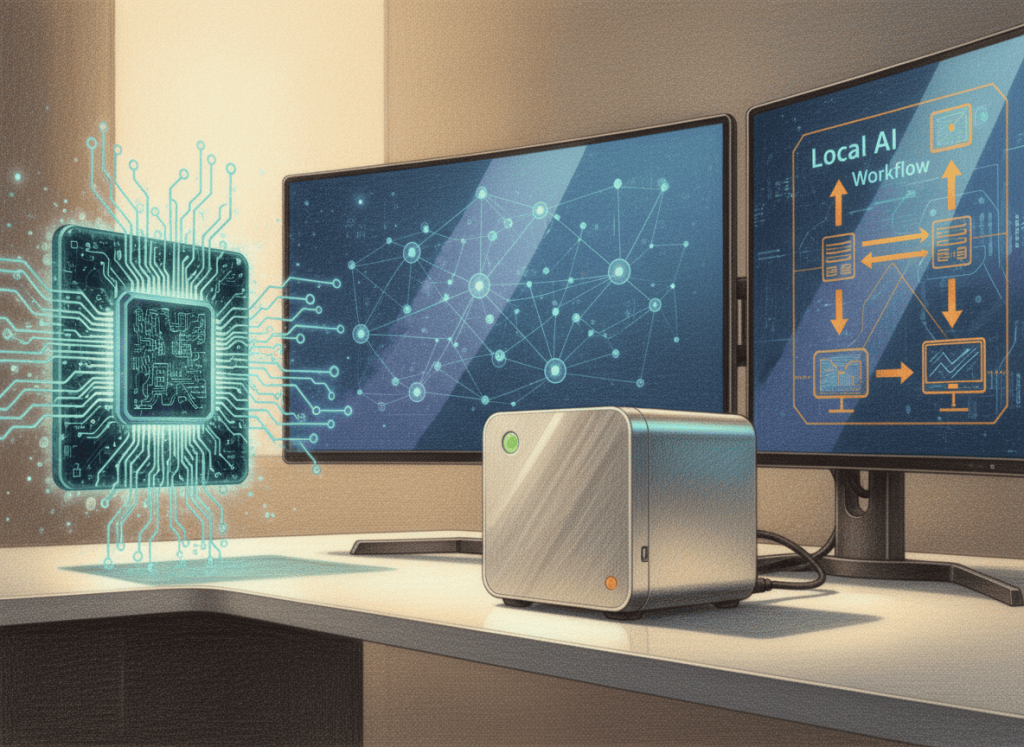
Apple’s new Mac mini begins arriving to customers on September 22 with the M6 chip, giving the company’s smallest desktop a much larger role in its artificial-intelligence strategy. Apple is pitching the machine not only as a conventional desktop, but also as an always-on system for local AI and agentic workloads.
The M6 is Apple’s first 2-nanometer chip. It combines a 12-core CPU, a 12-core GPU with Neural Accelerators in every GPU core, a Dual 16-core Neural Engine and as much as 170 GB/s of unified-memory bandwidth. Apple says the M6 Mac mini can deliver up to four times the AI performance of the M4 model. Those figures come from Apple’s own testing and should be treated as company performance claims rather than independent benchmarks.
Why Local AI Needs Different Hardware
Large AI systems are commonly associated with racks of GPUs inside data centers, but smaller models and AI agents can increasingly run directly on a workstation. That changes the hardware problem. Instead of paying for every unit of remote cloud compute, a developer can purchase a machine once and repeatedly use its local CPU, GPU, Neural Engine and memory.
Memory is especially important. Apple’s unified-memory architecture allows different compute blocks to work from a shared memory pool instead of constantly copying data between separate CPU and GPU memory. The M6 Mac mini supports up to 32 GB of unified memory. That does not turn a compact desktop into a hyperscale AI server, but it can make smaller local models and development workflows practical.
Apple Is Selling AI Compute by the Desk
The strategy extends beyond the Mac mini. Reuters reported that Apple is pitching its new high-end Macs to businesses as a way to perform more AI work locally and reduce dependence on usage-based cloud computing. Apple recently demonstrated four Mac Studios connected together running a trillion-parameter AI model while operating from a single wall outlet.
That demonstration does not mean a group of Macs can replace every GPU cluster. Training frontier-scale models remains a data-center problem. But inference, coding agents, model experimentation and other repeatable local workloads create a different market where power efficiency, memory architecture, noise, footprint and purchase price can matter as much as maximum raw compute.
The Hardware Competition Is Expanding
Apple is entering a local-AI hardware race that also involves Nvidia, Microsoft and traditional PC manufacturers. The important engineering question is no longer simply which company has the fastest processor. It is how effectively the CPU, GPU, AI accelerator, memory, networking, operating system and developer tools work together.
For hardware engineers, this is another example of AI spreading outward from centralized data centers. The same workloads that drove enormous accelerator clusters are now influencing desktop processors, memory bandwidth, networking and software frameworks. The M6 Mac mini is small, but the design direction is significant: more AI compute is moving closer to the person or application using it.
BitcoinVersus.Tech Editor’s Note:
We volunteer daily to ensure the credibility of the information on this platform is Verifiably True. If you would like to support to help further secure the integrity of our research initiatives, please donate here: 3C9o19EH5HSiwEPyCTmEKzxhNCbo2X6TTb
BitcoinVersus.tech is not a financial advisor. This media platform reports on financial subjects purely for informational purposes.


Leave a Reply