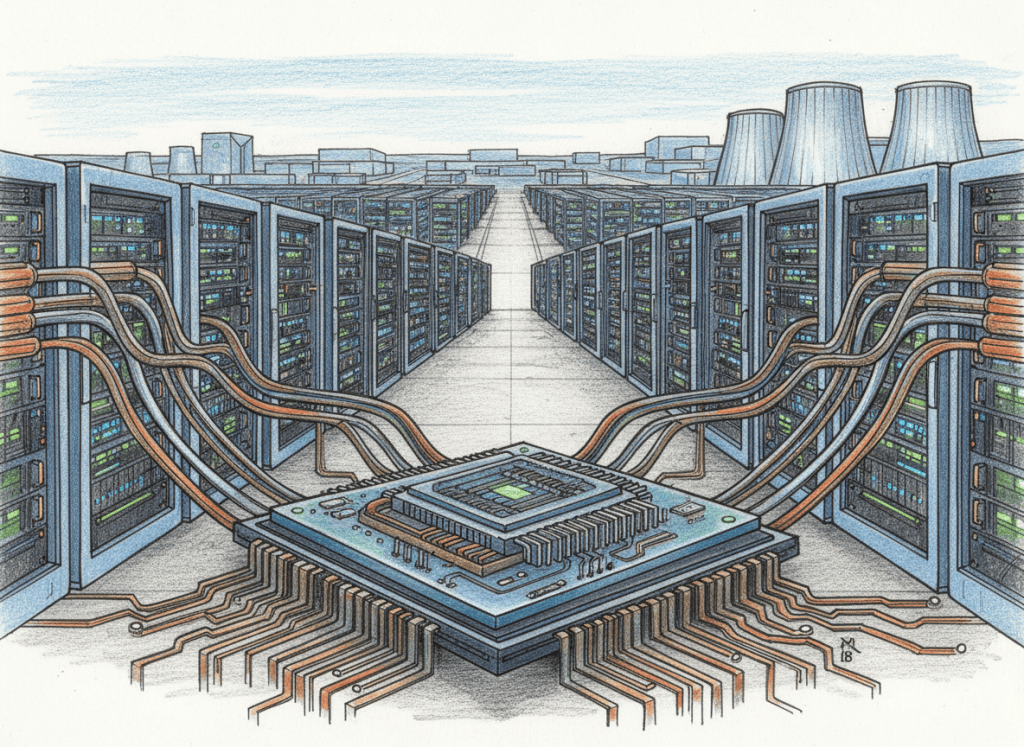
Alibaba has introduced the Zhenwu V900, a new artificial-intelligence accelerator developed by its T-Head semiconductor unit, as the company expands deeper into chips, servers and the data-center infrastructure required to run increasingly large AI systems.
At Alibaba Cloud’s Apsara conference on September 22, CEO Eddie Wu said the V900 delivers about three times the performance of the previous Zhenwu M890. Alibaba says the accelerator can be connected in clusters containing as many as 500,000 chips. The company expects mass production and commercial release in the first quarter of 2027. Those performance and scale figures are company claims; independent V900 benchmark results were not included in the announcement coverage.
The Hardware Is Getting Bigger Than a Single Chip
The V900 matters because Alibaba is describing it as one piece of a much larger computing system rather than simply a faster processor. Modern AI training and inference increasingly depend on the connection between accelerators, memory, networking, servers, cooling and electrical infrastructure. A fast chip can still be limited if thousands of processors cannot exchange data efficiently.
Alibaba has already been developing that broader stack. Its earlier Zhenwu M890 platform was paired with the company’s ICN Switch 1.0 networking chip and Panjiu AL128 supernode server. Alibaba Cloud documentation also shows that its Kubernetes infrastructure supports Zhenwu parallel-processing hardware as schedulable accelerator resources.
500,000 Accelerators Would Be an Infrastructure Problem Too
A cluster approaching Alibaba’s stated 500,000-chip ceiling would make power distribution, networking, thermal management and reliability central engineering problems. Alibaba has not provided enough public V900 electrical specifications to calculate the power demand of such a system, so the cluster limit should not be confused with a confirmed deployed 500,000-chip installation.
The infrastructure direction is nevertheless clear. Wu set a target for Alibaba Cloud’s global data-center capacity to exceed 20 gigawatts by 2032. That would place the company’s AI strategy firmly in the territory where semiconductor design and data-center engineering have to advance together.
China’s AI-Chip Push Is Accelerating
The announcement also arrives as Chinese technology companies continue developing domestic alternatives to imported AI accelerators. That makes the V900 important beyond Alibaba itself: it is another test of whether China’s growing semiconductor ecosystem can deliver competitive AI compute at large scale.
The next questions are practical ones. The V900’s real significance will become clearer when detailed specifications, production volumes, customer deployments and independent performance measurements become available. Until then, the three-times-performance figure and 500,000-chip cluster capability should be treated as Alibaba’s announced targets rather than independently established results.
For BitcoinVersus.tech, the most important part of this hardware race is the convergence taking place underneath it. AI chips, high-speed networking, memory, electrical systems and data-center capacity are increasingly becoming one engineering problem. The companies that can improve the entire stack—not only the processor—may determine how quickly the next generation of compute can actually be deployed.
BitcoinVersus.Tech Editor’s Note:
We volunteer daily to ensure the credibility of the information on this platform is Verifiably True. If you would like to support to help further secure the integrity of our research initiatives, please donate here: 3C9o19EH5HSiwEPyCTmEKzxhNCbo2X6TTb
BitcoinVersus.tech is not a financial advisor. This media platform reports on financial subjects purely for informational purposes.


Leave a Reply