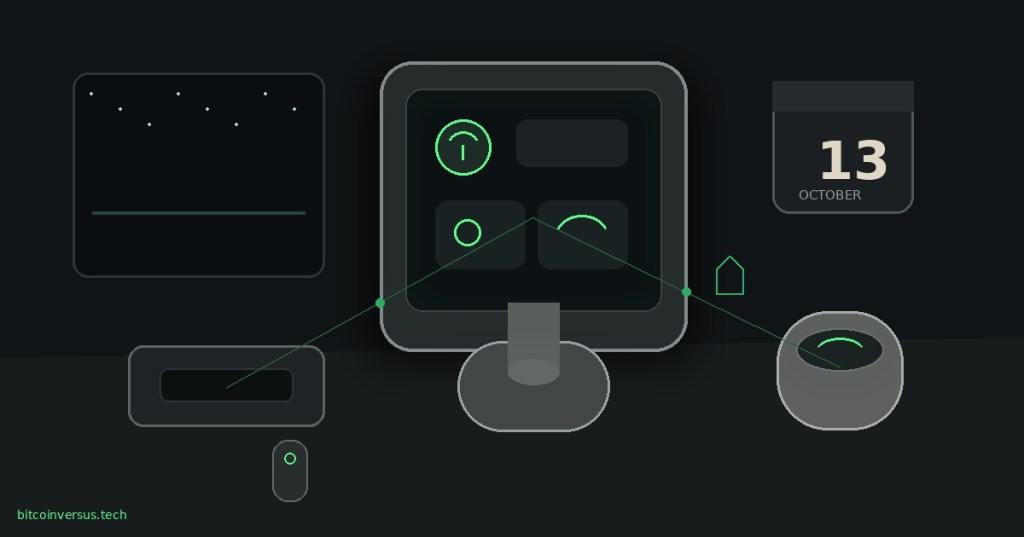
Apple has confirmed that its next product launch is set for Tuesday, October 13, using the unusually domestic tagline “Welcome home.” The company has not named a product in the announcement, but Apple’s own Newsroom teaser and media invitations for an “Apple Experience” in Tribeca, New York, make one thing clear: Apple is about to put the home at the center of its next hardware moment.
The timing matters because BitcoinVersus has already been tracking Apple’s broader home strategy, including the company’s reported collaboration with LG on doorbells, locks, thermostats and cameras designed to challenge Ring and Nest. The October 13 announcement is the first official signal from Apple itself that the next phase is now close.
What Apple actually confirmed
Apple senior vice president of Worldwide Marketing Greg Joswiak posted a short teaser on October 8 with the words “Welcome home. October 13.” The clip uses a hand-stitched, rainbow-colored Apple motif, and press invitations reported by 9to5Mac point to a 9:00 a.m. ET Apple Experience in Tribeca.
Greg Joswiak’s October 8 teaser is the official social-media confirmation of Apple’s October 13 launch.
That is the confirmed portion. Apple has not officially named a Home hub, HomePad, new HomePod mini, new Apple TV, price, processor, display size or shipping date. Those details remain reported expectations until Apple publishes them.
The expected hardware is much more interesting than a routine refresh
Current reporting points toward three main products: a long-rumored smart-home display or hub, an updated HomePod mini and a refreshed Apple TV 4K. The hub is the important one because it could give Apple a permanent, shared screen in the home instead of forcing every Home interaction through an iPhone, iPad or individual speaker.
MacRumors’ earlier overview explains why an Apple TV, HomePod and home hub package would fit together as a single smart-home platform.
A dedicated hub could become the visual control surface for lights, locks, cameras, thermostats, media, calendars and household automations. That would also give Apple a clearer place to surface Matter and Thread devices, two standards that are increasingly important because they reduce the need for every smart-home product to live inside its own isolated ecosystem.
Siri and local AI are part of the bigger picture
The home is also where Apple’s AI strategy can become more tangible. A household device that is always available has a different job from a laptop or phone: it needs fast voice recognition, strong privacy boundaries, reliable user identification and enough local processing to answer common requests without feeling like a remote control for a distant cloud service.
That fits the direction Apple has already taken with increasingly capable local silicon. BitcoinVersus recently examined the M6 Mac mini and Apple’s push toward more local AI compute, while Apple’s broader privacy architecture has included unusually large incentives for researchers to probe weaknesses in Private Cloud Compute. A smart-home hub would bring those questions out of the workstation and directly into kitchens, bedrooms and living rooms.
Apple Home Authority’s hardware overview shows how Apple’s TV, speaker, camera and hub ambitions can converge into one household platform.
Why the smart-home fight matters
The smart home is not just a collection of gadgets. Whoever controls the household hub can influence which cameras people buy, which doorbells they trust, how media is distributed, which voice assistant is used and how energy, security and automation data move around the house.
Apple already has a huge installed base of iPhones, Watches, Macs, iPads and Apple TVs. The missing piece has been an obvious shared household computer that stays in one place. If October 13 finally fills that gap, Apple will be competing less like a phone company adding accessories and more like a platform company trying to own the operating layer of the home.
What to watch on October 13
- Whether Apple actually introduces a new home hub. The event branding strongly points homeward, but the product itself remains unconfirmed.
- Whether Siri AI is central to the pitch. The usefulness of a shared home display depends heavily on how well voice interaction and household personalization work.
- Whether Matter and Thread get deeper platform treatment. Better interoperability would make Apple’s ecosystem more useful even when the accessory is not made by Apple.
- Whether HomePod mini and Apple TV become infrastructure devices. Faster networking and processors matter most if these products increasingly coordinate cameras, sensors, media and local automations.
- Whether Apple discusses third-party home hardware. The reported LG partnership could show that Apple wants an ecosystem larger than its own first-party product line.
The strongest conclusion for now is also the simplest: Apple has officially called everyone “home” for October 13, but the hardware behind that invitation is still waiting to be confirmed. That makes the event more interesting, not less. For the first time in years, Apple’s next major product category may be a device designed not to travel with you at all.
Editor’s Note: This article distinguishes Apple’s confirmed October 13 announcement from products and specifications that remain reported or rumored. It will be updated if Apple publishes additional official details.
Disclaimer: This article is for informational and educational purposes only and does not constitute investment, purchasing or financial advice.


Leave a comment