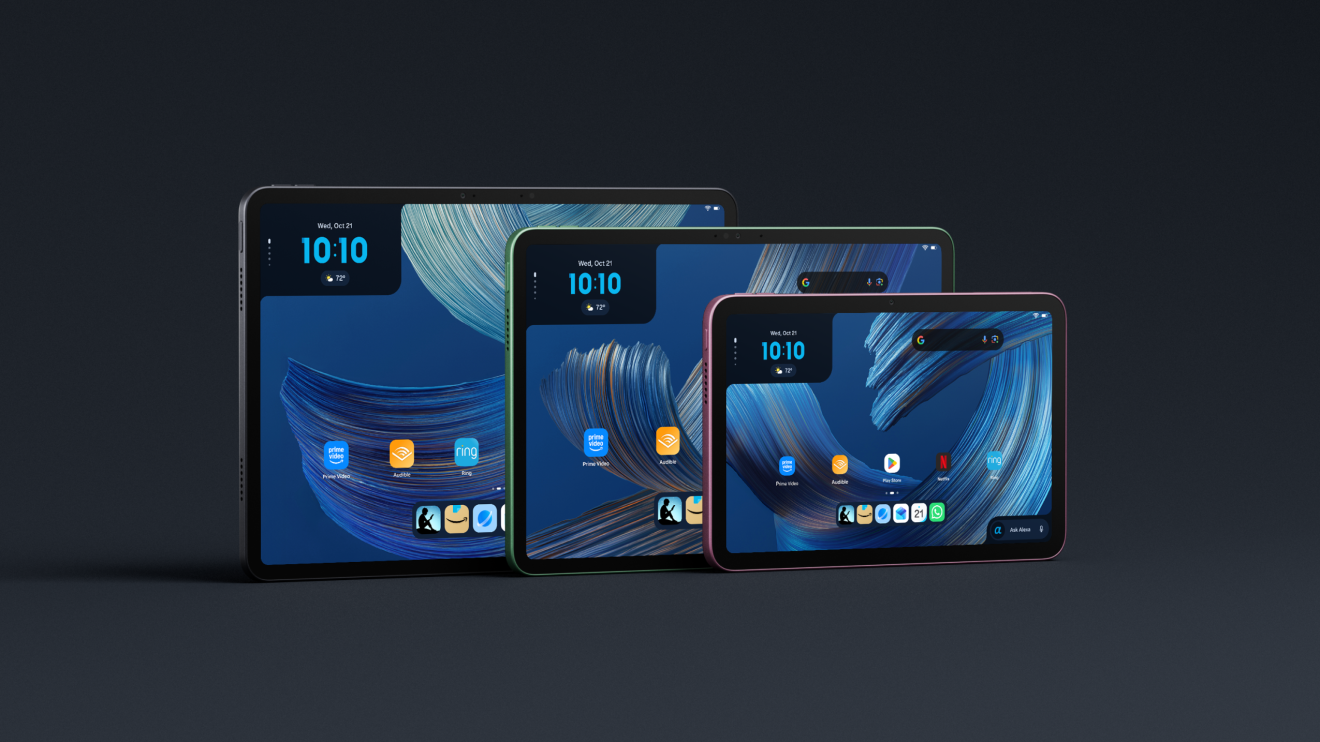
Amazon is making its biggest tablet-platform break in years. The company’s new Alexa Tablet 12 Pro, Alexa Tablet 11 and Alexa Tablet 8 run Google-certified Android with full Google Play Store access, replacing the old Fire-tablet formula of Fire OS plus Amazon’s smaller app ecosystem. Prices start at $229.99 and climb to $549.99 for the Nanomatte 12 Pro.
The shift matters because Amazon is no longer treating its tablets mainly as low-cost gateways into Prime Video, Kindle and shopping. It is moving toward conventional Android compatibility, materially better hardware and much tighter integration with Alexa+. Reuters described the launch as a higher-end push under Amazon devices chief Panos Panay, while Amazon itself says these are an all-new product line, not simply renamed Fire tablets.
The Play Store changes the equation
The most consequential change is software. Previous Amazon tablets were built around Fire OS, an Android-derived operating system that relied heavily on Amazon’s own Appstore. The new Alexa Tablets run Android and ship with the Google Play Store, opening straightforward access to apps such as YouTube, Gmail, Google Docs, Netflix and millions of other Android titles.
That removes one of the longest-running compromises of Amazon tablets. It also puts the devices into more direct competition with Android tablets from Samsung, Lenovo and others rather than occupying a separate Fire OS niche. BitcoinVersus recently covered how Android’s broader software ecosystem can shape gaming features, and the same app-availability advantage becomes much more important when Amazon is asking buyers to spend several hundred dollars on a tablet.
The 12 Pro is Amazon’s premium swing
The Alexa Tablet 12 Pro starts at $499.99, while its Nanomatte version starts at $549.99. Amazon says the 6.5 mm aluminum tablet uses a 12-inch, 280-PPI display with a 120 Hz refresh rate and a 3:2 aspect ratio. A 4 nm eight-core processor is paired with up to 16 GB of RAM, Wi-Fi 6E, quad Dolby Atmos speakers and up to 16 hours of video playback.
The optional Nanomatte display is more technically interesting than a basic anti-glare coating. Amazon says it worked with Corning on a photolithography process that etches a pixel-aligned texture into the glass at the sub-pixel level, aiming to cut glare without scattering light as aggressively as conventional matte finishes. For readers who want the display fundamentals underneath that idea, BitcoinVersus has separate explainers on touchscreen digitizers and modern display technology.
Alexa+ moves from an app to part of the interface
Alexa+ is built into the tablet experience instead of being treated as a separate voice-assistant app. Users can say “Alexa” or tap an Ask Alexa control while staying inside another application. Amazon’s On-Screen Intelligence can, when enabled, inspect what is currently displayed and answer contextual questions about it. The feature is off by default and requires an explicit opt-in, according to Amazon.
That design turns the tablet itself into a test bed for Amazon’s broader AI ambitions. The company is effectively betting that an assistant that can see the active screen, remember preferences and act across services can become part of the operating environment rather than merely another app icon. Amazon is also supporting continuous live voice sessions that do not require repeating the wake word between every question.
There are two cheaper models too
The Alexa Tablet 11 starts at $329.99 with an 11-inch 2.5K display, 90 Hz refresh rate, 8 GB of RAM and up to 15 hours of video playback. The smaller Alexa Tablet 8 starts at $229.99 with an 8.7-inch display, 4 GB of RAM, Wi-Fi 6 and up to 14 hours of video playback.
Amazon also built a Kindle-focused reading mode that silences notifications, reduces blue light and can stretch battery life to as much as 20 hours while reading. The 12 Pro supports a $149.99 detachable keyboard and an $89.99 USI 2.0 pen with 4,096 pressure levels, tilt detection, magnetic docking and wireless charging.
The Fire-tablet era is winding down
The hardware launch also marks a strategic exit from the old Fire-tablet identity. The Verge reported that Panay said Amazon is phasing out Fire tablets because they were no longer giving customers what they wanted, while existing devices will continue receiving security updates. Amazon’s new developer documentation reinforces the platform break: apps for Alexa Tablets are distributed through Google Play, and developers are directed to Google Play’s testing and console infrastructure rather than Amazon’s old tablet-app pipeline.
This is a bigger change than dropping one brand name. Amazon spent roughly 15 years using inexpensive Fire tablets to create a controlled software environment around its own store and media services. The Alexa Tablet strategy gives up some of that platform isolation in exchange for mainstream Android compatibility—and then tries to differentiate the hardware through Alexa+, premium displays and Amazon’s content ecosystem.
What comes next
The new tablets are available to order now and are scheduled to begin shipping on October 14, 2026 in the United States, Mexico and Canada, followed by the UK, Germany, France, Italy and Spain on October 19. The important question is whether customers who previously viewed Amazon tablets as inexpensive secondary devices will accept a premium model approaching $550—and whether full Android plus Alexa+ is enough to make the 12 Pro a serious alternative to established iPad and Galaxy Tab hardware.
Editor’s Note
BitcoinVersus.tech verifies primary-source specifications against independent reporting where possible. Amazon’s performance and battery-life figures are manufacturer claims unless otherwise stated.
BitcoinVersus.tech is not a financial advisor. This media platform reports on financial and technology subjects purely for informational purposes.


Leave a comment