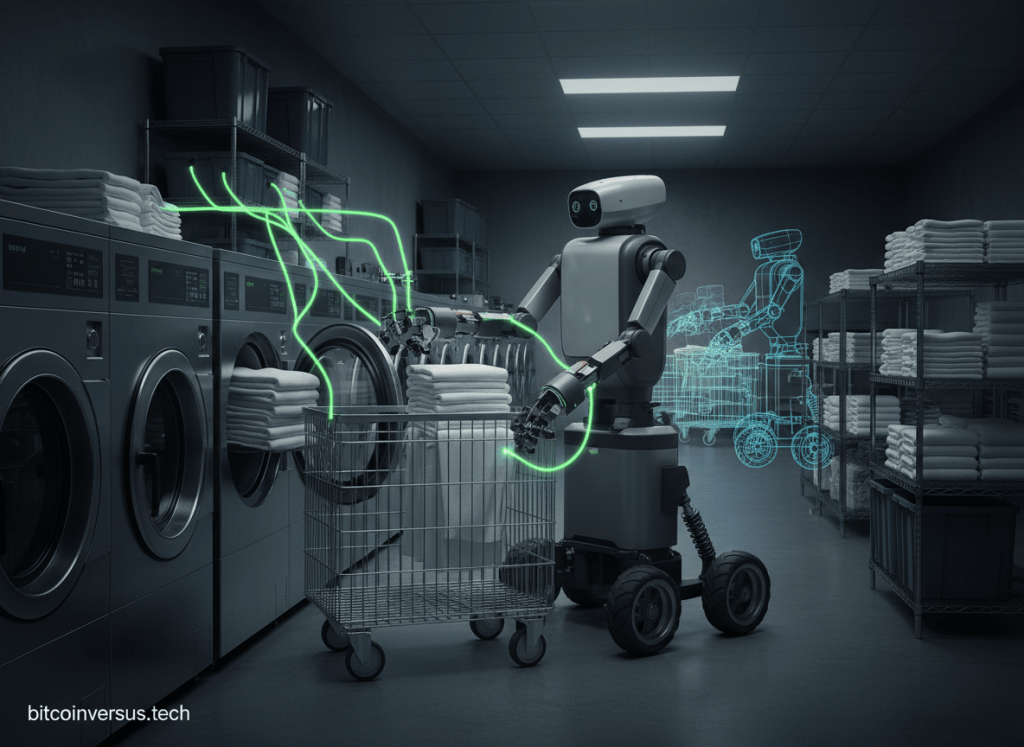
Dyna Robotics has introduced Dyna-2.1 and a new semi-humanoid robot called Taku, shifting the company’s physical-AI strategy from mastering isolated tasks toward completing long, multi-step workflows with less human intervention.
Dyna announced the system in a September 29 post, saying Taku was designed from the hardware level upward for robot learning, data transferability and whole-body autonomy across real customer workflows.
The company’s Dyna-2.1 launch page frames the key problem differently from most robotics demos: customers do not necessarily want a robot that can perform one impressive action. They want a system that can take responsibility for an entire role or workflow without requiring a person to constantly reset the scene, refill a bin or recover from every small mistake.
The hard problem is not one task — it is hundreds in sequence
A robot can look reliable when a demo asks it to repeat one constrained motion. Real work is much less forgiving. A commercial laundry shift can involve moving between machines, unloading wet material, folding, stacking, monitoring cycle completion, recovering dropped items and deciding which station needs attention next.
Dyna’s core argument is mathematical as much as mechanical. Even a very high success rate on one step can compound into poor workflow reliability when hundreds of steps must happen in sequence. Small failures that seem harmless in a short demo become expensive when they interrupt a process that is supposed to run for an hour or an entire shift.
Humanoids Daily’s independent coverage describes the same launch as an attempt to separate fast physical control from slower workflow-level decisions, allowing the robot to keep manipulating objects while a higher-level system tracks what should happen next.
Taku is shaped around human workspaces
Taku uses a human-scale upper body, two seven-degree-of-freedom arms, a folding lower body and a four-wheel steerable base. Dyna says it chose wheels because the target workflows need precise reach and fast movement between workstations more often than they need legged locomotion.
That is a pragmatic design choice. A hotel laundry room already has washers, dryers, folding tables and shelves positioned for human workers. A useful robot needs to reach into deep drums, lift stacks, bend low and reach above shoulder height without requiring the facility to rebuild itself around the machine.
This emphasis on useful deployment rather than humanoid appearance parallels BitcoinVersus.tech’s coverage of the Universal Robots Gen 7 platform, where the bigger story is not anthropomorphic design but making physical AI dependable enough to live beside existing industrial equipment.
Three control layers run on different clocks
Dyna-2.1 divides control across three layers. A whole-body controller handles fast joint and wheel behavior. The DYNA-2 action policy turns the current task into whole-body motion targets. A vision-language workflow orchestrator tracks the larger process and decides which step should happen next.
The separation matters because not every decision needs to happen at the same frequency. Balance, arm motion and wheel commands need rapid control loops. Deciding whether the washer is finished or which shelf has room can happen much more slowly.
BitcoinVersus.tech recently covered NVIDIA Isaac ROS 5.0 and agentic robotics tooling, which reflects the same architectural trend: perception, motion control and higher-level reasoning are increasingly becoming separate but coordinated layers in a physical-AI stack.
Simulation handles the expensive failures first
Dyna says Taku’s whole-body controller was trained with large-scale reinforcement learning in simulation, including thousands of simulated robots learning in parallel. That approach lets the team expose controllers to variations in mass, friction, damping, actuator response and motion targets without risking physical hardware on every failed trial.
Simulation does not eliminate the real-world gap, but it changes where the first thousands of mistakes happen. A controller can learn broad motion behavior in a synthetic environment, then be refined with real teleoperation and deployment data.
The broader robot-learning ecosystem is moving the same way. BitcoinVersus.tech’s Trossen and Stereolabs physical-AI stack showed how cameras, robot hardware and training pipelines are increasingly being designed as one integrated data system rather than separate components.
Human video becomes training data
One of Dyna’s more important technical claims is that Taku is designed to learn from human motion data, not only robot demonstrations. The company uses a shared task-space representation for wrists, elbows, chest and body position so human recordings and robot motion can be converted into a common training format.
Dyna says its improved DYNA-2 policy was pretrained on about one million hours of human video mixed with robot-fleet data. The goal is to let the system encounter far more examples of towels, machines, rooms and human motion than a robot fleet could collect physically on its own.
That does not mean a robot can simply watch any video and reproduce it perfectly. Human and robot bodies differ, camera viewpoints can be incomplete and physical contact still has to be executed by the robot’s own controller. The advantage is that human activity can supply a much larger behavioral prior before expensive robot-specific data collection begins.
Recovery may matter more than perfection
Dyna deliberately chose a laundry workflow where many mistakes are recoverable. A dropped towel can go back into the process. A bad stack can be rebuilt. That gives the system room to encounter failures without turning every error into a complete shutdown.
For commercial robotics, that ability to recover can matter more than chasing a perfect single-action success rate. A machine that occasionally makes a mistake but recognizes and repairs it may be more useful than one that performs a narrow task almost perfectly but stops whenever the environment changes.
The next test is outside Dyna’s own demo room
Dyna says its next milestone is deployment at customer sites so operating data can feed back into the system. That is the part that will determine whether Dyna-2.1’s workflow architecture transfers beyond a controlled demonstration.
The company’s one-hour laundry run is evidence that the stack can sustain a long chain of actions under the demonstrated conditions. It is not yet proof that Taku can handle every laundry room, every shift or every edge case without supervision.
Still, the framing is important. Physical AI is moving beyond the question of whether a robot can pick up, fold or insert one object. The harder commercial question is whether it can own a workflow long enough that the human operator can actually walk away.
Editor’s Note
We volunteer daily to ensure the credibility of the information on this platform is Verifiably True. If you would like to support our research initiatives, please donate here: 3C9o19EH5HSiwEPyCTmEKzxhNCbo2X6TTb
BitcoinVersus.tech is not a financial advisor. This media platform reports on financial subjects purely for informational purposes.


Leave a Reply