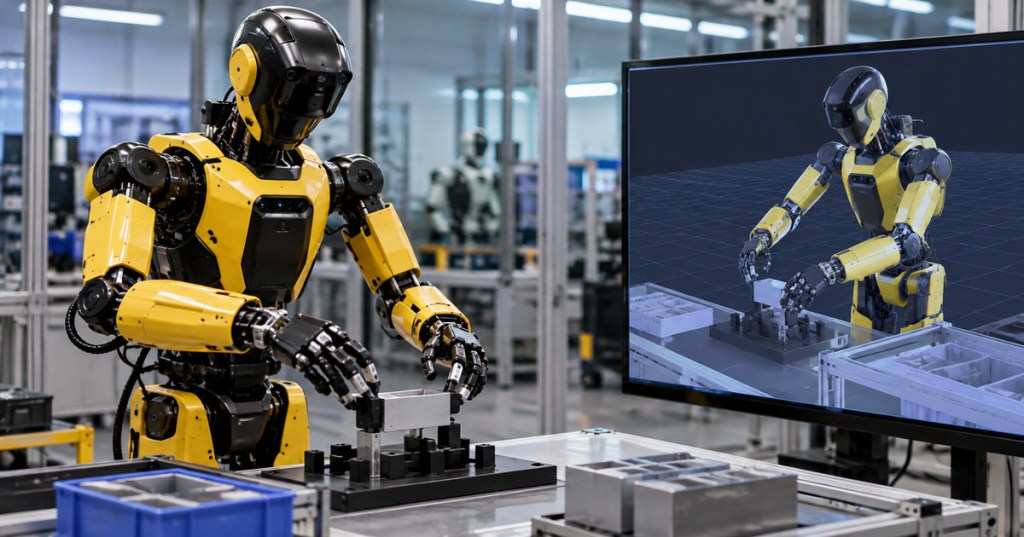
Shenzhen robotics startup DexForce is using simulated environments and synthetic data to train humanoid robots, aiming to reduce the cost and time required to teach machines real-world tasks. Reuters reported on October 15 that the company builds virtual versions of physical environments, trains policies there, and then transfers the learned behavior onto real robots.
The approach attacks the same bottleneck behind the robot-training data boom: collecting enough useful demonstrations in the physical world is expensive and slow. DexForce is betting that simulation can generate far more task variation before a robot touches a real workcell.
DexForce describes its EmbodiChain and Real2Sim2Real systems as an embodied-AI engine that simulates complex scenes, generates synthetic training data and transfers learned behavior back to physical machines. Its W1 Pro combines humanoid arms, dexterous end effectors, stereo vision and industrial control hardware.
NVIDIA demonstrates the broader Sim2Real method: train robots in simulation, then transfer the behavior into physical machines.
Reuters says DexForce recently raised 1 billion yuan, about $147 million, in Series B financing at a valuation above 10 billion yuan. The company says its technology is already being used in manufacturing and service deployments. The harder test is whether policies trained in virtual worlds remain reliable when lighting, objects, people and factory conditions change.
That challenge is also central to robots targeting multi-step physical workflows and to the wider physical-AI push across machines and autonomy. Synthetic data can increase scale; real-world validation still decides whether the robot is useful.
BitcoinVersus.Tech Editor’s Note:
We volunteer daily to ensure the credibility of the information on this platform is Verifiably True. If you would like to support to help further secure the integrity of our research initiatives, please donate using the QR code provided

For best QR-code scanning results, please scan this donation code from a desktop or larger screen. Mobile screens may prevent camera recognition.


Leave a Reply