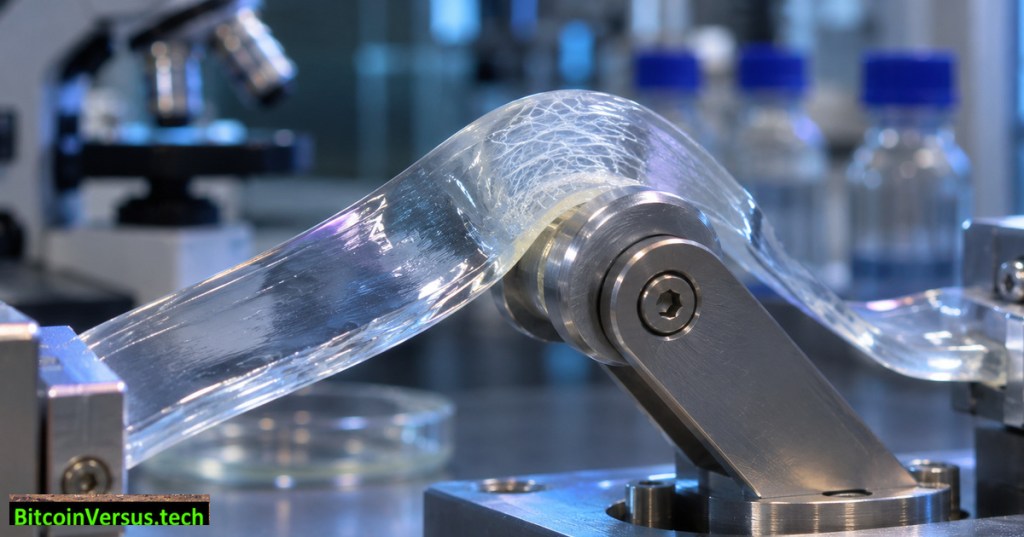
A research team led by Washington University in St. Louis has built a hydrogel that can grow mechanically tougher after repeated controlled stretching and bending. In laboratory tests, mechanical training increased selected measures of stiffness, strength and resistance to fracture or fatigue by as much as an order of magnitude. The peer-reviewed paper appeared in Nature Materials on November 5, 2026; the university highlighted the findings on November 20.
The material remains an early-stage research prototype, not an approved artificial-joint component or a commercially available self-repairing plastic. Its significance lies in a molecular structure that can record where mechanical stress has occurred, then reinforce those regions instead of responding uniformly across the entire object.
Archival research talk: Chenfeng Ke discusses programmable and adaptive 3D-printing materials in a Beckman Foundation presentation posted in 2023. The talk predates the 2026 hydrogel experiment.
How a material learns from being stretched
The team calls its design an adapt-ring network. Covalently bonded polyethylene glycol chains provide a polymer framework, while crystalline domains made from α-cyclodextrin—ring-shaped sugar molecules—act as reconfigurable physical junctions. An initially large domain does not simply stretch elastically and return unchanged. Mechanical loading breaks the domains into smaller clusters that can relocate and align along the stressed network.
After loading, the reorganized domains can become kinetically trapped in a new configuration. Their distribution carries a mechanical history: regions exposed to greater deformation gain additional reinforcement. The researchers measured changes in Young’s modulus, tensile strength, fracture energy and fatigue threshold. The paper reports improvements of up to approximately tenfold across selected measurements and conditions, not a universal tenfold gain for every sample or property.
The authors also report that a solvent-driven reformation of the crystalline domains can reverse the mechanically trained configuration. Such reversibility is scientifically important because it distinguishes controlled network reorganization from simple irreversible hardening caused by damage.
A 10,000-cycle joint test, not a medical trial
In a knee-like mechanical model, the research team subjected hydrogel material to 10,000 bending cycles. The university reports that the reinforced regions developed as predicted. The paper additionally describes spatially patterned adaptation and three-dimensional printing, suggesting that a soft structure could be engineered to stiffen only where repeated motion demands greater support.
Mechanical cycling of a demonstration fixture does not establish safety or useful service life inside a human body. Biocompatibility, sterilization, long-term degradation, inflammatory response, manufacturing consistency and performance under physiological loads would require separate evaluation. No clinical trial or regulatory clearance is reported.
Earlier research from Ke’s group: Dartmouth University linked to a 2021 YouTube demonstration of a moisture-responsive, 3D-printed polymer flower. It is background on ring-based programmable gels, not video footage of the November 2026 experiment.
Where the engineering might matter
A local reinforcement mechanism could interest designers of orthopedic supports, soft robotic joints or wearable devices where stiffening every surface would reduce flexibility. The mechanism differs from the geometrical approach in MIT and Northeastern’s network-inspired mechanical metamaterials, which tune deformation mainly by changing the arrangement of printed struts.
The new chemistry also complements Northwestern’s faster printing of complex lattices, UC San Diego’s air-powered soft robot and the University of Rochester’s low-cost bioprinter. Each project investigates a separate manufacturing or mechanical challenge; none provides a direct comparison of clinical effectiveness.
What remains to be proved
Washington University says the lab has made the polymer in batches weighing only tens of grams. Scaling production while preserving the α-cyclodextrin domain structure and repeatable stress response remains an open challenge. The authors’ patent filings also reflect an interest in eventual applications, not evidence of commercial readiness.
A stronger long-term case will require independent replication, quantitative testing over many more loading cycles and comparisons against established medical-grade elastomers. For now, the advance is a demonstrated way to encode local mechanical history directly into polymer microstructure, without requiring a sensor, battery or electronic controller.
Primary research and media sources
- Zheng et al., Nature Materials, November 5, 2026 — original study and six supplementary videos, including the knee-joint test
- Washington University, November 20, 2026 — laboratory report and interpretation
- Dartmouth University, June 30, 2021 — earlier work on 3D-printable, ring-based gels and video provenance
- Beckman Foundation — archival Chenfeng Ke materials research presentation
Cover disclosure: the featured photograph-style artwork is an original editorial illustration, not an image of the research apparatus or an experimental sample. Both embedded YouTube videos are verified earlier context and are not presented as recordings of the new study.


Leave a Reply