
SEMICONDUCTORS & AVIATION | NOVEMBER 21, 2026
A high-energy particle can alter a computer’s memory without breaking the chip. Researchers studying modern aircraft-relevant electronics have now identified a second concern: certain radiation-induced errors can also increase electrical current and heat, potentially shortening a component’s working life. The findings were published November 2 in the peer-reviewed journal Space Weather.
The study, led by researchers associated with the University of Surrey, examined four commercial static random-access memory (SRAM) designs with feature sizes of 40–90 nanometers. Three behaved broadly like earlier technologies. One repeatedly exhibited clusters of corrupted bits alongside abnormal increases in supply current. The observations do not establish a fleet-wide aviation hazard; they reveal a specific device-level weakness that conventional testing can overlook.
How one particle changes a zero into a one
A memory bit is maintained by a tiny electrical state. When an energetic ion passes through semiconductor material—or a high-energy neutron produces charged secondary particles—it can create electron–hole pairs. An internal circuit node collects some of the resulting charge. Once the collected charge exceeds the circuit’s critical threshold, a stored logical state can flip. Engineers call the resulting reversible data error a single-event upset, or SEU.
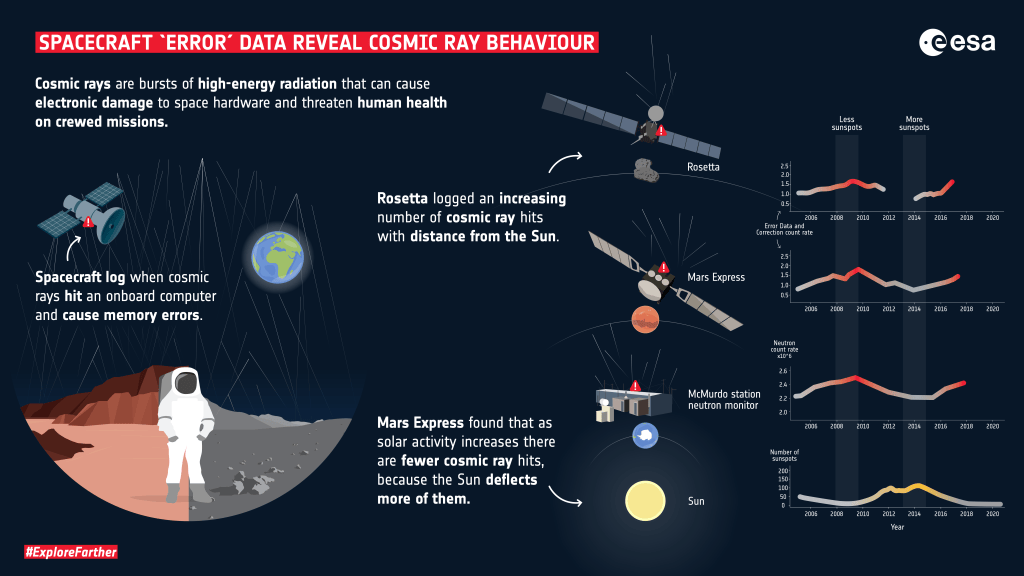
NASA’s ASIC radiation-design guidance distinguishes SEUs from potentially destructive single-event effects such as latchup. An upset can often be corrected by rewriting memory; latchup can create a persistent unwanted current path. Related problems matter beyond aviation, particularly in the satellite systems discussed in ESA’s mission to study Earth’s magnetic shield.
Why the new SRAM results matter
To test memory cells, researchers loaded known binary patterns into powered chips and exposed the devices to controlled neutron and proton radiation. They compared unchanged test patterns with the patterns read back after exposure, while monitoring supply current. In one SRAM type, some events produced stepped current increases that the authors associate with microscopic latchup-like behavior, called micro-latching. A thermal camera confirmed localized heating during some tests.
The test method also mattered. Static testing, with memory largely left undisturbed during irradiation, revealed some effects that were less evident during dynamic read-and-write testing. A procedure that repeatedly corrects errors may therefore hide an electrical side effect, even when the logged bit-error count appears manageable. The observation is relevant to reliability testing across semiconductor manufacturing, including emerging memory architectures such as MIT’s superconducting memory experiment, although its physics and operating environment differ.
A dramatic number—with a critical altitude caveat
Using experimental data and a model of a severe 1956-style ground-level enhancement event, the team estimated as many as 15 memory upsets per megabit per hour in polar regions at 21 kilometers altitude for the particularly sensitive SRAM design. A five-hour exposure at the same modeled rate would imply roughly 75 upsets per megabit. The model also predicted more frequent current-increase events in some conditions.
Those figures describe an extreme simulated radiation environment at an altitude far above routine commercial jet cruising levels. They are not measured error rates for every passenger airplane, nor proof of an in-flight equipment failure. Applying them to a real aircraft requires the actual device, redundancy architecture, route, altitude, shielding, space-weather conditions, and certification evidence. The importance of those distinctions also extends to aircraft development, including hybrid-electric regional aviation.
Engineering beyond error correction
Error-correcting codes, memory scrubbing, watchdogs, redundant computers, shielding, and radiation-qualified components can reduce consequences, but none makes every design invulnerable. The researchers’ strongest practical recommendation is more complete device characterization: measure both logical corruption and current behavior under realistic operating modes. Infrared monitoring is particularly relevant when a soft error produces heat rather than merely bad data—a distinction familiar from thermal diagnostics in ASIC hardware.
A smaller transistor is not automatically more vulnerable: three of the four SRAM types produced upset rates comparable to older designs, while one with relatively large features performed worse. Material choice, cell topology, charge collection, and circuit operation can matter as much as nominal process geometry.
Primary sources: Barker and colleagues, Space Weather (November 2, 2026); NASA/JPL ASIC radiation guidance; ESA spacecraft error-data visualization.


Leave a Reply