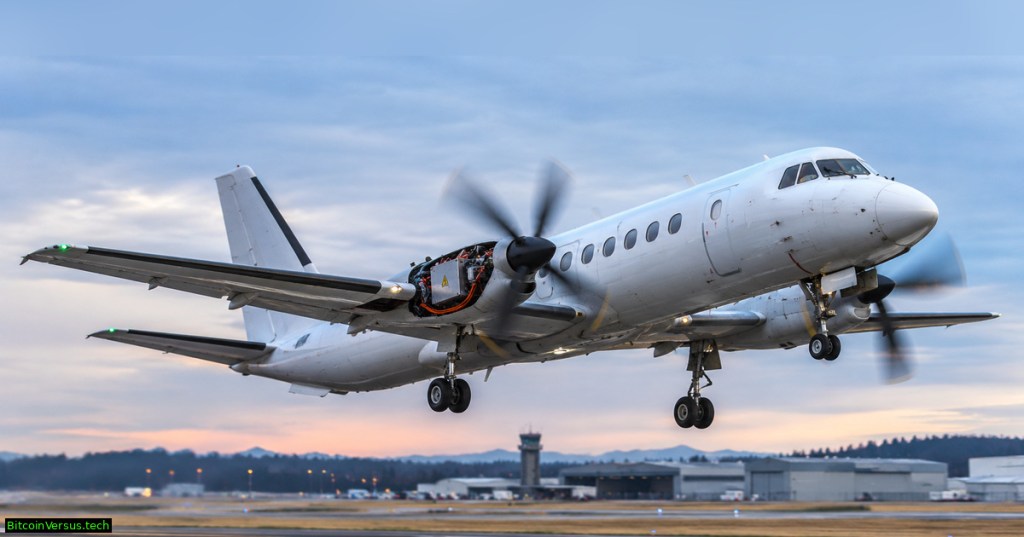
GE Aerospace and BETA Technologies say a modified Saab 340B successfully took off with battery-powered electric assistance, rather than relying only on its two gas-turbine engines. The test in Plattsburgh, New York, disclosed November 4, 2026, moves hybrid aviation beyond high-altitude cruising experiments into one of flight’s most demanding power phases.
The aircraft was not an all-electric airliner or a passenger-service launch. It was a research platform built to test whether a high-voltage electrical system can share the work with a conventional turbine. The result offers a practical engineering route to lower fuel consumption, although GE has not disclosed measured fuel savings from the assisted takeoff.
GE Aerospace’s official July 20, 2026 video documents earlier high-altitude hybrid-electric flying. It does not show the later electric-assisted takeoff announced in November.
How the electric takeoff worked
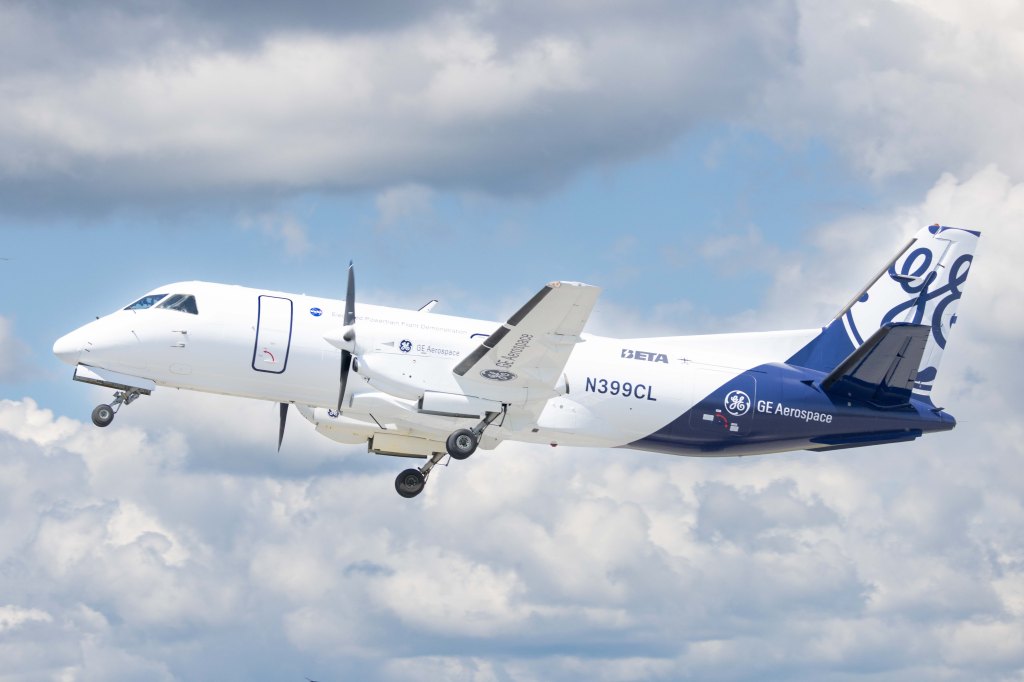
The left wing retained a GE Aerospace CT7 gas-turbine engine. On the right, the test crew integrated a modified turbine, electric motors, power electronics and batteries into a megawatt-class, multi-kilovolt hybrid propulsion system. At takeoff, electrical power added torque to the engine-driven propulsion system. The aircraft therefore remained dependent on fuel, with batteries supplying extra power during a high-demand interval.
The distinction matters. A hybrid does not need batteries large enough to power an entire transcontinental flight, but additional motors, wiring, cooling and cells impose mass and integration costs. Our earlier explanation of why fully electric aircraft are constrained by battery energy density covers the underlying tradeoff.
What engineers proved—and what they did not
GE says early observations suggest the hybrid-assisted takeoff was quieter than operation on gas turbines alone. The company did not publish a noise measurement in decibels, a certified fuel-burn comparison or a quantified payload penalty for the experiment. Therefore, a quieter departure is a preliminary observation, not yet a verified noise-reduction figure.
The November milestone builds on the same aircraft’s May 2026 flights above 30,000 feet with hybrid propulsion, followed by a July public demonstration at Farnborough. NASA’s Electrified Powertrain Flight Demonstration work helped mature the motors, power converters and thermal management. Additional engineering programs, such as NASA’s X-70 modular flight-test aircraft, likewise use experimental aircraft to validate hardware before any operational rollout.
Reddit’s r/aviation discussion dates to July 20, 2026 and concerns the earlier high-altitude flight. Community reactions are provided as contemporaneous social context, not proof of November test performance.
Why commercial deployment remains difficult
GE links the research to the CFM RISE technology-demonstration program. RISE targets more than 20% lower fuel burn compared with commercial engines currently in service through several advances, including Open Fan architecture. The target applies to the broader technology program; it is not a measured 20% fuel saving from the Saab assisted-takeoff test. RISE is not itself a certified engine for sale.
A workable airline design also needs redundant power management, robust high-voltage insulation, thermal protection, maintainable batteries, and compelling economics over thousands of cycles. Lessons from structural aircraft-battery research show how engineers are tackling weight in parallel, while investments in commercial drone delivery reveal a different path for electrification on smaller airframes.
Unlike hybrid road vehicles, aircraft face severe weight limits. Any fuel benefit depends on battery mass, charging and mission length. Jet-fuel production still matters as engine research evolves.
Aviation International News’ August 28, 2026 report on the same modified Saab 340B provides additional independent visual context from the earlier transatlantic test campaign.
The real next milestone
The immediate advance is a successful electrical assist during departure on a passenger-sized turboprop testbed, not a date for commercial certification. Before passengers see similar technology in scheduled service, developers must demonstrate repeatability, safety, maintenance economics and actual mission-level fuel benefits across representative flights.
Primary reporting and source material
- GE Aerospace, November 4 announcement of the assisted takeoff
- NASA, July 20 summary of the flight-test and engineering program
- GE Aerospace, October 27 photo essay on the earlier high-altitude test
- AVweb, November 5 independent industry report
- Official GE Aerospace video and AIN video
- GE Aerospace’s related official LinkedIn post (prior July campaign)
Editorial verification: The cover is an original photorealistic editorial illustration, not a picture of the actual November flight. The in-story aircraft photograph is authentic; its date is labeled. Both video clips and the social discussion precede the November test. Reported improvements are separated from estimates and program goals.
Editor’s Note: We volunteer daily to ensure the credibility of the information on this platform is Verifiably True. If you would like to support to help further secure the integrity of our research initiatives, please scan the QR code below

For mobile scanning, open the article on another display and scan the QR code with a Bitcoin wallet. The voluntary donation amount is 5,000 sats. Verify the receiving address 3C9o19EH5HSiwEPyCTmEKzxhNCbo2X6TTb before sending.
BitcoinVersus.Tech publishes technology and financial journalism for informational purposes and does not provide financial, investment, or legal advice.


Leave a Reply