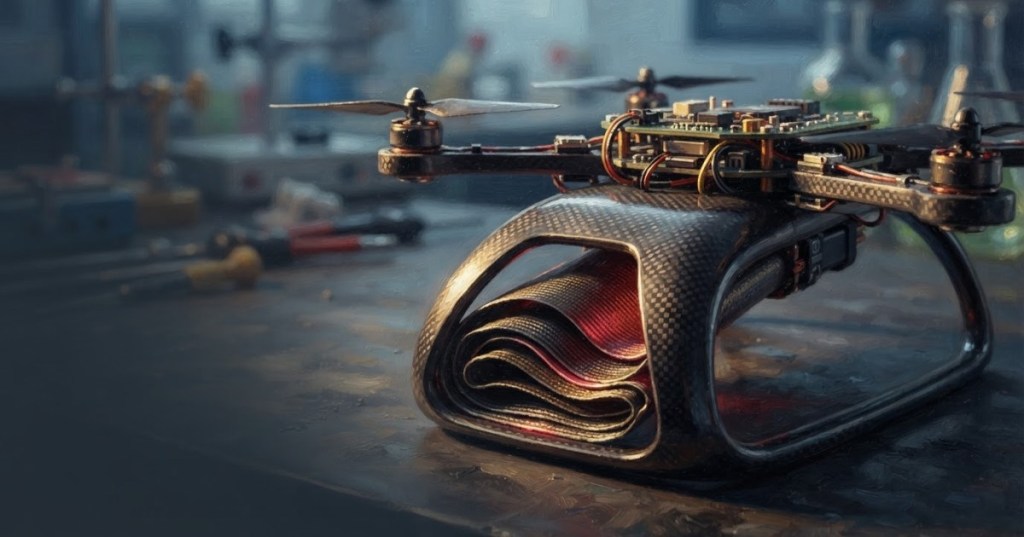
A research team at the Korea Advanced Institute of Science and Technology has placed a working lithium-sulfur pouch cell inside a curved drone-leg component. The cell powered a green LED after installation, while related tests showed the electrode surviving 1,000 tight bends. KAIST announced the findings November 18, 2026, following publication of the underlying study on October 1. The experiment suggests a way to use hollow structural space for energy storage, but the researchers have not demonstrated a longer-flying drone.
Official Chalmers University of Technology video from 2021 showing a different carbon-fiber structural battery. Chalmers professor Leif Asp is a coauthor of the new KAIST paper. The footage does not show the 2026 drone-leg experiment.
Why grow battery material directly onto carbon cloth?
Lithium-sulfur batteries offer potentially high storage capacity at low weight, but sulfur conducts electricity poorly. During discharge, dissolved lithium polysulfides can migrate through the cell and reduce usable performance. Bending also risks separating a conventional coating from its current collector. KAIST’s team grew nickel cobalt selenide nanowires directly onto woven carbon cloth, creating a connected, electrically conductive surface intended to hold sulfur species and preserve contact under curvature.
The peer-reviewed study, led by first author Jawon Ha with professors Il-Kwon Oh and Leif Asp, reports 1,544 milliamp-hours per gram of active sulfur at a 0.1 C discharge rate in a coin-cell test. The figure is sulfur-mass-specific electrode capacity, not the energy density of a completed drone or battery pack. Different battery chemistries require their own validation, as our vitamin-B12 battery report also demonstrates. Readers can compare other experimental metrics with our solid-state battery testing analysis.
What the laboratory actually measured
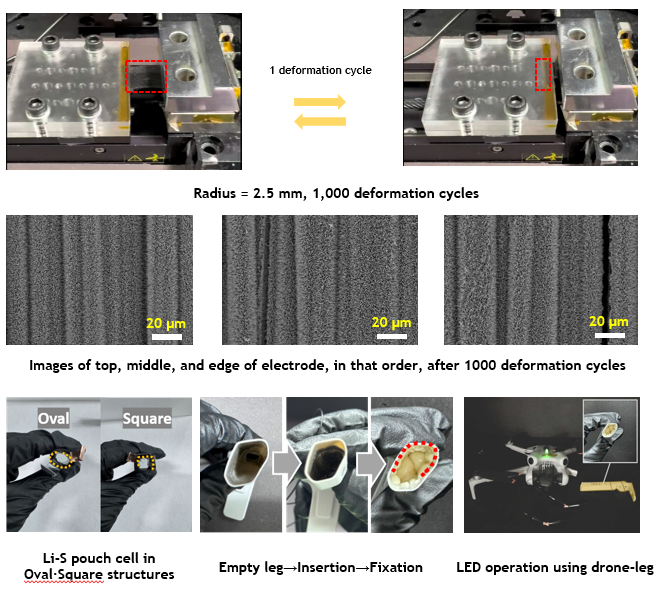
The electrode underwent 1,000 bending and release cycles at a 2.5-millimeter radius without severe surface cracking or nanowire detachment under microscopy. Its electrical resistance stayed between approximately 3.1 and 5.4 ohms over the test. In a separate pouch-cell comparison at 0.02 C, a curved cell delivered 1,117 mAh per gram of sulfur, versus 1,188 mAh per gram while flat.
The curved-to-flat ratio is 1,117 ÷ 1,188 = 94.0%, representing a 6.0% reduction under the specified conditions. The results used a modest sulfur loading around 1 mg per square centimeter and an electrolyte-to-sulfur ratio of 13 microliters per milligram, conditions that do not establish practical aircraft battery performance.
| Test configuration | Capacity (mAh/g sulfur) | Flat-state reference |
|---|---|---|
| Flat pouch cell | 1,188 | 100% |
| Curved pouch cell | 1,117 | 94.0% |
Materials Research Society interview, January 2025: coauthor Leif Asp explains structural battery research at Chalmers. The earlier batteries use different chemistry, so their figures are not directly comparable with KAIST’s lithium-sulfur results.
The green LED is not a flight endurance test
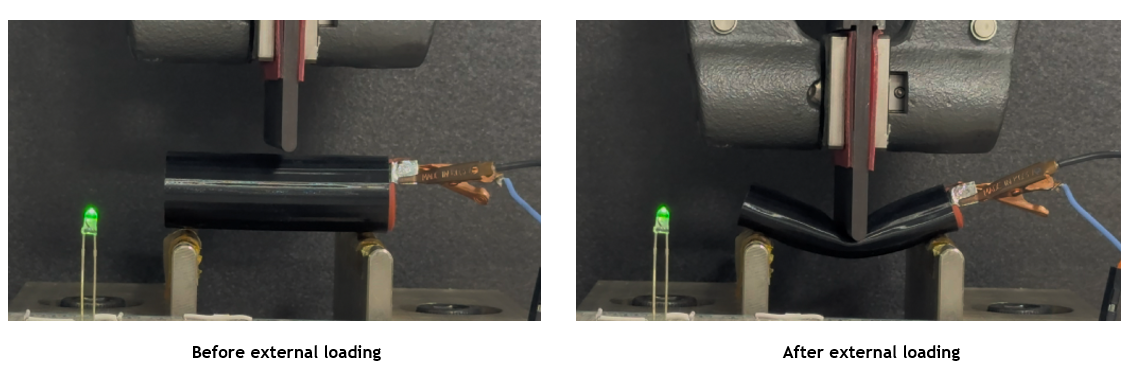
KAIST fitted pouch cells into oval, square and drone-leg cavities, showing they could still supply electricity. Under another controlled load, a cylindrical assembly maintained roughly 99.8% of its initial voltage as the surrounding frame fractured. Voltage stability under a brief test is not equivalent to retained charge capacity, crash safety or thousands of flight cycles. The laboratory also showed an LED staying illuminated during deformation.
What drone engineers still need to prove
Researchers must demonstrate real structural load transfer, safe encapsulation, vibration and impact tolerance, repeatable charging, long-term cycling, manufacturability and a net system-level weight benefit. A battery tucked into an existing leg is not necessarily the leg’s primary load-bearing material. Current drone constraints are illustrated by our coverage of an MIT microrobot that still needs external power and studies of impact-absorbing engineered structures.
The KAIST result is a demonstrated packaging and electrode-integration advance, not a commercial flight-ready battery. By putting working electrochemistry into a curved component, the team has made a credible next step toward lightweight robotic structures that do more than simply hold a machine together.
Primary research and media sources
Sources: KAIST’s November 18 research release; Ha et al., Advanced Composites and Hybrid Materials; and Chalmers University research record. KAIST supplied the original laboratory photographs. Both embedded videos are verified archival explanations featuring a collaborating research institution or coauthor, not footage of the new experiment. The featured oil painting is conceptual artwork.


Leave a Reply