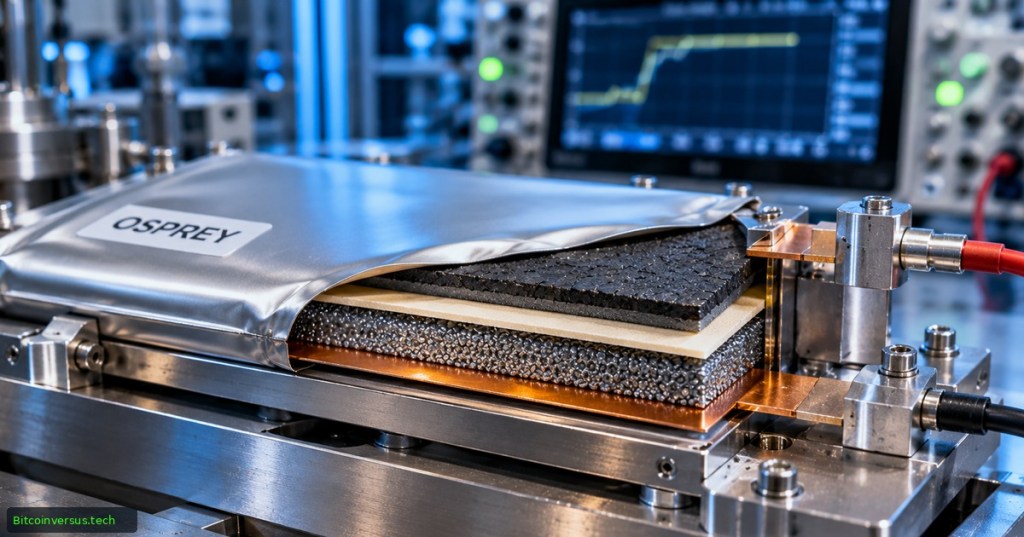
QuantumScape unveiled Osprey, a new all-solid-state battery development platform, on November 11, 2026. The company reports that an early two-layer laboratory cell retained approximately 80% of its initial capacity after 1,000 full charge-discharge cycles while operating under one atmosphere of applied pressure. The test marks a new result for QuantumScape’s sulfide-cathode approach, but not the launch of a commercially produced automotive battery.
“High-Tech Ceramics: The QuantumScape Separator in Context,” listed in QuantumScape’s official video library. Manufacturer background explaining ceramic-separator technology; not a demonstration of Osprey’s November 2026 laboratory results. Credit: QuantumScape / YouTube.
A different kind of solid-state battery
QuantumScape’s existing QSE-5 design uses a ceramic separator with a conventional high-nickel cathode containing a liquid catholyte. Osprey replaces the cathode’s liquid ion-conducting material with a solid sulfide electrolyte, while retaining QuantumScape’s lithium-metal, anode-free architecture. As manufactured, the cell has no pre-installed lithium-metal anode; lithium deposits during charging. Sulfides transport lithium ions effectively, but direct contact between sulfides and lithium metal can degrade cell life. The ceramic separator isolates those materials.
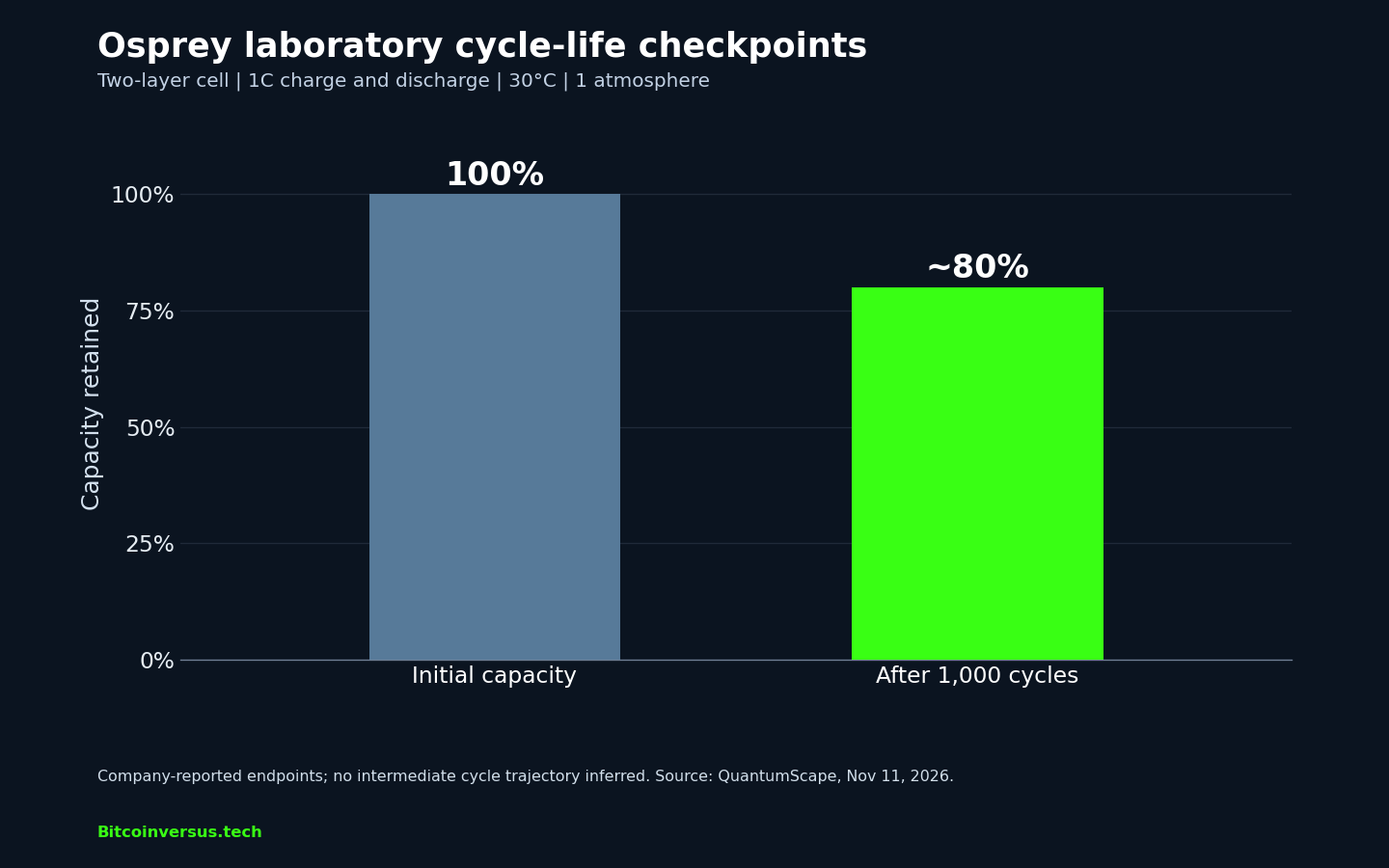
The 1,000-cycle result came from a two-layer unit cell measuring approximately 50 by 65 millimeters per electrode area, with a cathode loading above 5 milliampere-hours per square centimeter. Charging and discharging each occurred at 1C, with the full state-of-charge range used at approximately 30°C. An 80% endpoint means a 20-percentage-point loss from nominal initial capacity, not proof of the same result across thousands of multilayer cells, complete battery packs or daily vehicle service.
The five-minute claim has a temperature condition
The announcement also advertises charging from 10% to 80% in about five minutes. Independent reporting by Electrek, drawing on QuantumScape’s published test graphs, identifies a critical condition: the demonstrated fast-charge run used a two-layer cell at 80°C. No equivalent five-minute result at ordinary room temperature was supplied. The cold-weather claim is likewise based on a separate, smaller single-layer test at a modest discharge rate. Combining separate favorable test results into one assumed vehicle operating specification would be misleading.
Pressure matters because battery electrodes expand and contract during cycling. Some sulfide systems need strong compression to maintain contact between solid materials. One atmosphere is approximately 101 kilopascals, far below the tens of atmospheres applied in many experimental sulfide stacks. Less external compression could eventually reduce structural mass and mechanical complexity, but a thin laboratory unit cell does not establish complete-pack weight or cost savings.
Projected density is not measured Osprey output
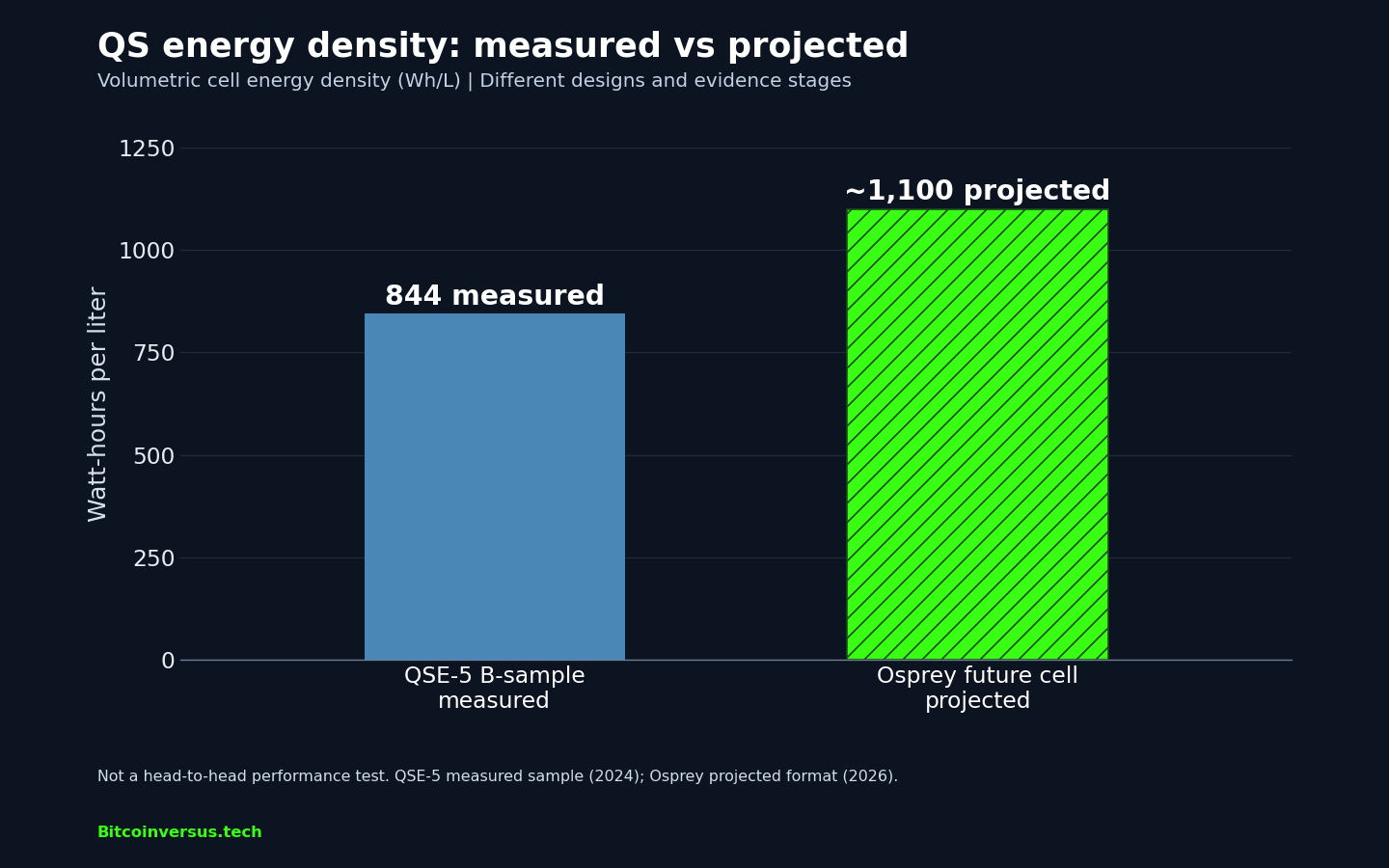
QuantumScape projects that a future, energy-optimized Osprey format could reach approximately 1,100 watt-hours per liter. By comparison, its existing QSE-5 B-sample was measured at 844 Wh/L. The ratio 1,100 ÷ 844 = 1.303, implying a roughly 30.3% higher volumetric density target. Different cell designs and evidence stages make the figures unsuitable as a direct measured product comparison. The higher-loading 10 mAh/cm² research cited for Osprey also used small laboratory cells, not a commercial automotive pack.
QuantumScape says Osprey will accept solid cathodes developed by partners, extending its licensing strategy. Its existing PowerBlock concept for AI data centers uses a separate product path. Other technology routes include ProLogium and Rimac’s EV-battery testing and solid-state batteries under evaluation for lunar missions. Successful battery deployment ultimately requires both chemistry and controlled manufacturing.
Automotive qualification remains a longer undertaking. QuantumScape acknowledges that Osprey manufacturing has only been demonstrated at laboratory scale and that automakers prefer larger prismatic cells with more layers. Process yield, safety, mechanical packaging, fast-charging durability and independent testing still need validation. Related battery diagnostic electronics and grid-storage economics show why system performance matters beyond a single cell. The documented achievement is promising low-pressure lab cycling, not mass-market readiness.
Sources and method: QuantumScape announcement, November 11, 2026; QuantumScape Osprey technical white paper, November 11; QuantumScape measured QSE-5 B-sample specifications; Electrek’s November 11 technical review; official QuantumScape video library. Calculations: 100% − 80% = 20 percentage points of capacity lost; (1,100 − 844)/844 = 30.3% projected density difference. Different tests, temperatures and cell formats are not directly interchangeable.
Editor’s Note: Osprey’s 1,000-cycle, approximately 80% retention and one-atmosphere pressure result is company-reported laboratory data from a two-layer cell, not independently reproduced automotive-pack performance. The advertised five-minute charge was observed under an elevated 80°C test condition according to published chart analysis. The approximately 1,100 Wh/L figure is a projection; the separate 844 Wh/L QSE-5 B-sample figure was measured. The original featured image is a conceptual laboratory illustration, not a photograph of QuantumScape’s actual Osprey hardware. Two original charts label evidence status and units. An older official QuantumScape video explains separator technology but does not document Osprey testing. Playback and mobile-device behavior have not been physically tested.

BitcoinVersus.Tech is volunteer-run and publishes independent educational technology reporting. An optional 5,000-satoshi donation supports continued research. Scan the original QR from a second screen with a compatible Bitcoin wallet; on mobile, use a wallet capable of scanning a saved image. Independently verify recipient address 3C9o19EH5HSiwEPyCTmEKzxhNCbo2X6TTb and the amount before payment. Bitcoin transfers are generally irreversible.
We volunteer daily to ensure information on the BitcoinVersus.Tech platform is Verifiably True. Coverage is educational and informational, not financial or investment advice.


Leave a Reply