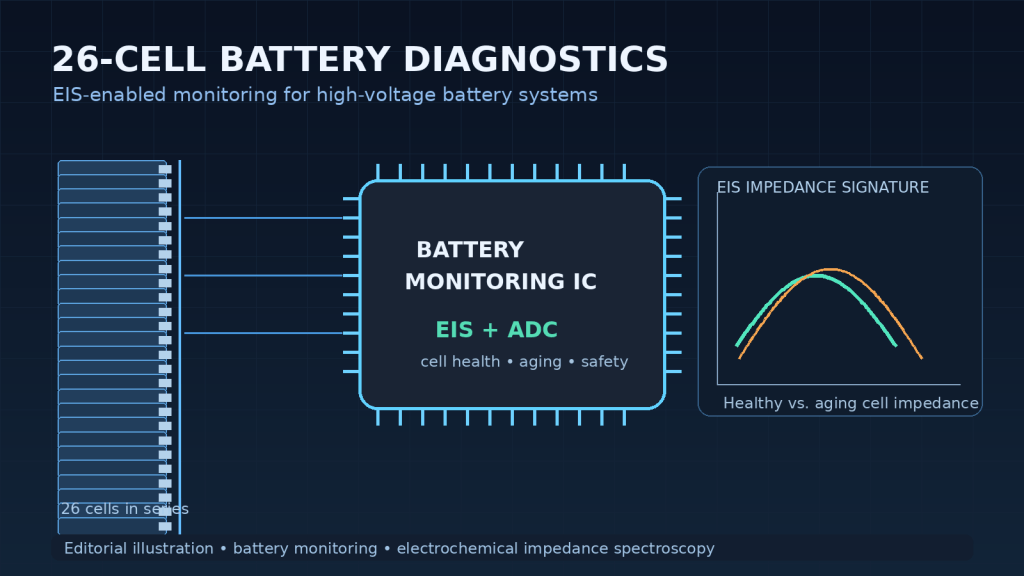
Nuvoton Technology is adding electrochemical impedance spectroscopy directly to a 26-cell battery-monitoring IC, giving automotive and large-scale energy-storage systems a way to track internal battery condition without relying only on voltage, current and temperature measurements.
The company says samples of the KA85010UA will become available in January 2027. Independent industry coverage highlights the same core feature: the chip combines conventional cell monitoring with EIS-based diagnostics aimed at battery degradation, lifetime prediction and early fault detection.
EIS Moves From the Lab Into the Battery Pack
Electrochemical impedance spectroscopy works by applying a small AC signal to a battery and measuring how voltage and current respond across frequency. Those impedance characteristics can reveal internal conditions that ordinary voltage measurements may miss, including changes in electrodes, electrolyte behavior and internal reactions.
Nuvoton’s announcement was also distributed through Kyodo News PR Wire on X, which provides a story-specific social reference for the new KA85010UA rather than a generic battery post.
The power-management story connects with several infrastructure trends BitcoinVersus.tech has been following, including xAI’s large Megapack battery installation behind Colossus 2, Infineon and Eaton’s silicon-carbide push into 800 VDC AI power, SolarEdge and Infineon’s solid-state protection for 800 VDC systems, and Delta’s 800 VDC power and 3 MW cooling architecture.
Nuvoton Claims 93% Lower PCB Temperature Rise
A major implementation problem with in-system EIS is heat. Conventional resistor-based measurement circuits can waste significant energy while driving the AC test current. Nuvoton says its proprietary inductor method circulates energy through a coil instead and reduced both power loss and PCB temperature rise by about 93% in the company’s evaluation conditions.
That matters because a diagnostic circuit that creates too much heat can become difficult to integrate into dense battery packs. Nuvoton says the lower-heat approach allows EIS measurements during operation, charging and rest.
One IC Monitors 26 Cells
The KA85010UA is designed to monitor up to 26 battery cells while adding the impedance-measurement circuitry required for EIS. Nuvoton positions the device for electric vehicles, large-scale energy-storage systems and reused-battery diagnostic platforms.
The company says frequency-dependent impedance data can help estimate state of health and internal temperature while identifying early signs of abnormalities. Those are vendor claims and will depend on the battery chemistry, pack design and diagnostic algorithms used in the final system.
The Company Already Demonstrated EIS Battery Monitoring
Nuvoton has previously demonstrated battery-monitoring ICs with integrated EIS at Embedded World. The English-language video below comes from the company’s own channel and shows the measurement concept behind the new generation of battery diagnostics.
The video predates the KA85010UA itself, so it should be read as a demonstration of Nuvoton’s EIS battery-monitoring approach rather than a product demo of the exact new IC. The new chip extends that direction into a 26-cell Gen 6 device.
January 2027 Samples Are the Next Milestone
The KA85010UA is not a mass-production product yet. Nuvoton says samples are scheduled for January 2027, making customer evaluation the next major step before broader deployment.
If the technology performs as claimed, integrating EIS directly into the battery-monitoring silicon could reduce the amount of separate diagnostic hardware required in high-voltage packs while giving operators a richer view of battery health. That is especially relevant as stationary storage becomes more tightly coupled to AI data centers, industrial power systems and grid infrastructure.
BitcoinVersus.Tech Editor’s Note
Support independent technology reporting: BTC donations may be sent to 3C9o19EH5HSiwEPyCTmEKzxhNCbo2X6TTb.
Follow BitcoinVersus.tech on X/Twitter for AI hardware, semiconductor, Bitcoin mining and data-center reporting.
Disclaimer: BitcoinVersus.tech is not a financial advisor. This media platform reports on financial subjects purely for informational purposes.


Leave a Reply