Tether’s plan to make Uruguay a springboard for Bitcoin mining has collapsed, exposing how quickly power contracts can overturn a crypto infrastructure project.
Uruguay project ended after electricity dispute
A Reuters investigation published August 21 found that Tether’s proposed two-site Bitcoin-mining operation in Uruguay was abandoned after a dispute with state utility UTE over how much electricity the projects could receive. A former contractor estimated the company spent about $120 million across the sites, although Tether did not publicly confirm that figure.
The project was announced in 2023 as part of Tether’s wider effort to invest in energy production and Bitcoin mining. Uruguay was presented as a favorable base because of its political stability, renewable-heavy grid and strong connectivity. The plan was also expected to serve as a launchpad for expansion into Brazil, Paraguay and Argentina.
Instead, the operation ran into a basic mining constraint: the site needed more power than the agreement ultimately provided. Tether reportedly treated the contract as a minimum allocation that could be increased, while UTE treated it as a maximum. After unpaid bills and failed attempts to revise the agreement, UTE cut power to the sites in July 2025.
Cheap energy remains the real mining asset
The failure matters because Bitcoin mining economics are unusually sensitive to electricity price and availability. A facility can own modern ASICs, operate beside renewable generation and still become uneconomic if it cannot secure enough contracted power at a predictable rate.
Reuters reported that Tether’s Uruguay operation eventually ceased activity and laid off most staff. The case also shows why mining infrastructure is portable: containers, networking equipment and ASIC fleets can be disconnected and relocated, while the host community may be left with limited long-term economic benefit.
That mobility is useful for operators, but it makes local power planning and contract language critical. Mining companies need clear expansion rights, delivery guarantees, curtailment rules and remedies for disputed invoices before they build around a projected energy supply.
Why Uruguay became a warning for Bitcoin miners
Uruguay’s renewable profile did not automatically make it a low-cost Bitcoin-mining jurisdiction. The country’s grid can be reliable while still being too expensive for a workload whose revenue depends on nonstop access to cheap electricity. Analysts cited by Reuters said the country’s connectivity and grid could be more valuable for AI data centers than for Bitcoin mining.
The same lesson appears in BitcoinVersus.tech coverage of miners shifting megawatts from ASICs to AI, Luxor’s AI infrastructure expansion, BitFuFu’s managed hashrate growth and ASIC efficiency measured in joules per terahash. Each case points to the same operating reality: power quality and price can matter as much as machine efficiency.
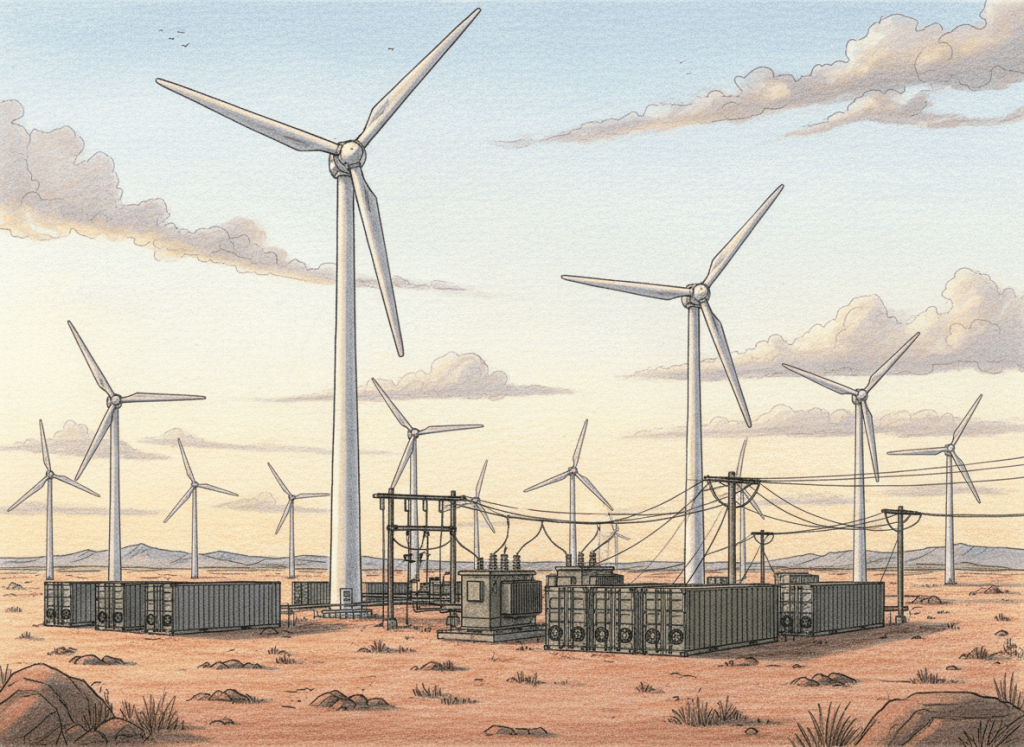
The company’s earlier promotional material showed compact mining buildings, cooling fans and wind turbines in rural Uruguay. The imagery captured the appeal of renewable-powered mining, but the later shutdown shows that a compelling energy story is not a substitute for an enforceable supply agreement. The investigation also reported that Tether did not respond to requests for comment on the UTE contract.
Mining follows the contract, not just the electrons
Tether has continued to invest in Bitcoin mining and energy projects elsewhere, including Brazil. Uruguay’s failed buildout does not prove that renewable-powered mining cannot work. It shows that the commercial structure around the power matters just as much as the generation mix.
For miners, the practical checklist is straightforward: confirm available megawatts, test the interconnection, define expansion rights, price curtailment, secure payment terms and verify who bears the risk when demand grows faster than the grid allocation. Without those protections, a large capital investment can become stranded even when the surrounding landscape is full of wind and hydropower.
Sources and disclaimer
Primary reporting: Reuters. Utility context: Uruguay’s UTE. Bitcoin mining is energy-intensive and project economics can change quickly. Reported investment figures and contractor accounts should be treated as reported estimates unless independently confirmed by Tether or UTE.
Illustration: BitcoinVersus.Tech. Uruguay wind power, mining containers and a disconnected grid represent the failed Tether buildout.
BitcoinVersus.tech on X
Follow BitcoinVersus.tech for original reporting on Bitcoin mining, ASIC efficiency, power markets and industrial compute.
Disclaimer: Educational and editorial content only. Nothing here is investment advice. Math is verifiable; interpretation is experimental. Support independent BitcoinVersus.tech reporting through the site’s published channels.


Leave a Reply