BitFuFu reported that total Bitcoin mining hashrate under management reached 20.6 EH/s in August 2026 as the company expanded managed power capacity and improved average fleet efficiency.
Hashrate under management increased 45.1% from 14.2 EH/s in July, while power capacity rose 34.9% from 255 MW to 344 MW. Average fleet efficiency improved from 18.0 J/TH to 16.7 J/TH. Bitcoin production increased from 112 BTC in July to 174 BTC in August.
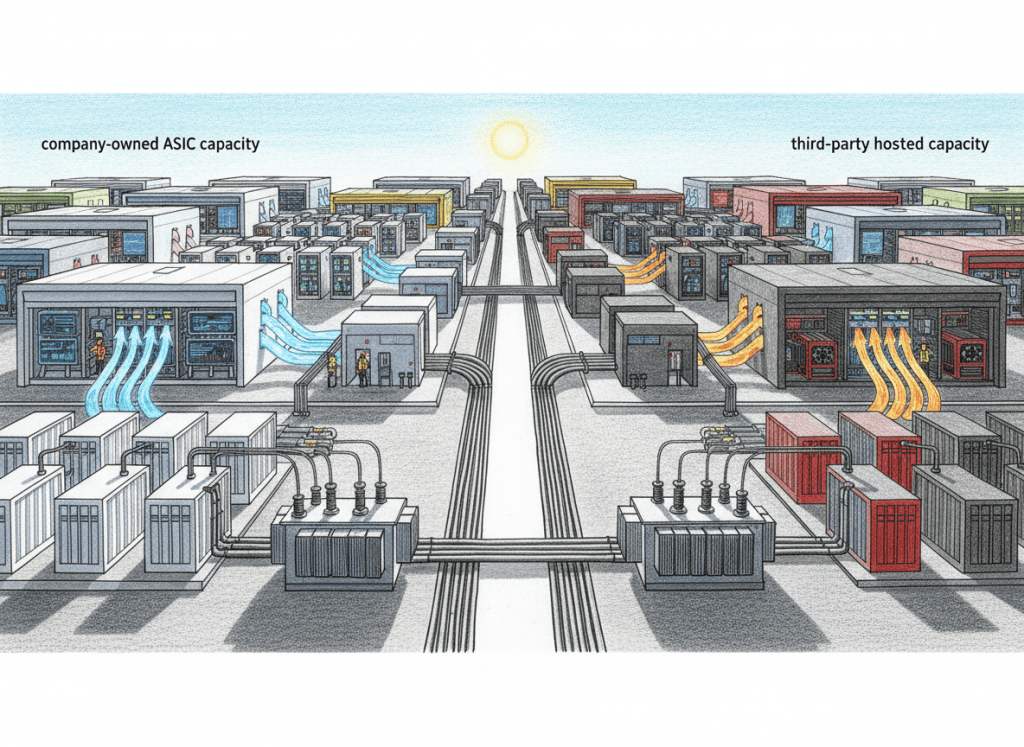
The headline 20.6 EH/s figure requires an important distinction. BitFuFu reported 3.8 EH/s of self-owned hashrate and 16.8 EH/s supplied by third-party suppliers and hosting customers. Managed hashrate therefore should not be interpreted as 20.6 EH/s of ASIC hardware owned directly by BitFuFu.
S21 XP Hardware Expands Self-Owned Capacity
BitFuFu said in June that it acquired and deployed 1,200 Antminer S21 XP units and signed agreements for another 2,000 S21 XP miners. The first deployment helped raise self-owned hashrate to 3.5 EH/s in June before it reached 3.8 EH/s in August.
Newer-generation ASIC deployment matters because fleet efficiency affects how much hashrate a facility can produce inside a fixed electrical envelope. Improving J/TH allows more SHA-256 compute to be delivered from the same megawatts, although total facility efficiency also depends on power conversion, cooling and auxiliary loads.
344 MW Shows Why Managed Hashrate Needs Context
Bitcoin mining companies increasingly operate combinations of self-owned miners, hosted customer equipment, contracted hashrate and third-party facilities. Comparing operators solely by headline EH/s can therefore obscure who owns the ASICs and who carries the associated hardware and infrastructure costs.
Data-center fundamentals provide another layer of comparison. Nameplate ASIC efficiency does not include every facility load. Transformers, switchgear, power supplies, networking, fans, pumps and cooling systems consume electricity. Uptime, rejected shares and thermal throttling can also cause accepted pool hashrate to differ from theoretical manufacturer specifications.
BitFuFu’s August expansion shows both sides of modern mining scale: efficient ASIC hardware remains important, while contracts, hosting infrastructure and access to hundreds of megawatts can expand a platform far beyond the company’s directly owned mining fleet.
Sources
- BitFuFu August 2026 Bitcoin Production and Operational Update
- BitFuFu June 2026 Bitcoin Production and Operational Update
- BitFuFu Second Quarter 2026 Results
BitcoinVersus.Tech Editor’s Note:
We volunteer daily to ensure the credibility of the information on this platform is Verifiably True. If you would like to support to help further secure the integrity of our research initiatives, please donate here: 3C9o19EH5HSiwEPyCTmEKzxhNCbo2X6TTb
Follow BitcoinVersus.Tech on X.
Financial Disclaimer: BitcoinVersus.Tech provides information for educational and informational purposes only. Nothing published here constitutes financial, investment, legal or tax advice. Readers should conduct independent research and consult qualified professionals before making financial decisions.


Leave a Reply