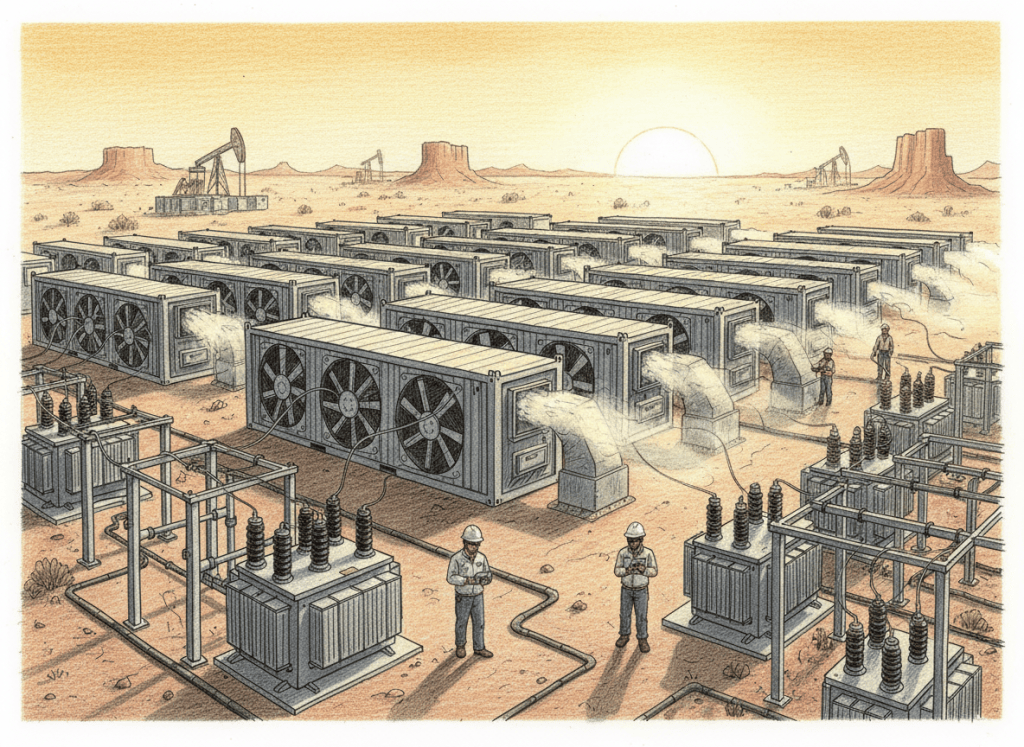
Olenox Industries reported approximately 15.63 Bitcoin mined during August 2026 while operating a large S21-class ASIC fleet through demanding summer conditions in Texas.
The company’s operating update lists 9,584 S21-class miners, approximately 35 MW of installed mining capacity and 2.19 EH/s of nameplate compute. Olenox reported blended hardware efficiency of about 16 J/TH.
Average operational hashrate during August was approximately 1.03 EH/s, materially below the fleet’s nameplate capability. Olenox said its economic fleet operated at roughly 67% capacity as extreme Texas temperatures led the company to curtail operations and run equipment in low-power modes.
ASIC Specifications Are Not Facility Performance
The difference between installed and delivered hashrate illustrates a basic data-center principle. An ASIC’s rated TH/s and J/TH describe hardware under specified operating conditions, while real mining output also depends on electrical availability, ambient temperature, airflow, equipment health, network connectivity and operational policy.
Air-cooled Bitcoin mines in hot climates have to manage intake temperature and prevent exhaust air from recirculating into miner inlets. As ambient temperature rises, fans can consume more power while ASIC controls may reduce performance to keep components within thermal limits. Operators can also deliberately lower miner power or curtail entire sections of a facility when grid conditions or electricity economics make full operation unattractive.
Power Infrastructure Shapes Mining Economics
A 35 MW mining site requires more than ASIC capacity. Utility or generation interconnections, transformers, switchgear, protection systems, distribution equipment and conductors must reliably carry sustained electrical load. Facility operators also track voltage quality, transformer loading, breaker conditions, cooling performance and rejected shares because each can affect productive hashrate.
Olenox has also described a longer-term strategy to move from third-party ERCOT hosting toward natural-gas-powered computing located near generation. The company has stated a target of electricity below $0.02 per kWh under that model. That figure is a forward-looking target rather than an achieved August operating cost.
August provides a useful example of why mining companies cannot be compared solely by installed EH/s. Hardware efficiency remains critical, but thermal conditions, energy strategy, uptime and facility engineering determine how much of that theoretical compute becomes sustained Bitcoin network hashrate.
Sources
BitcoinVersus.Tech Editor’s Note:
We volunteer daily to ensure the credibility of the information on this platform is Verifiably True. If you would like to support to help further secure the integrity of our research initiatives, please donate here: 3C9o19EH5HSiwEPyCTmEKzxhNCbo2X6TTb
Follow BitcoinVersus.Tech on X.
Financial Disclaimer: BitcoinVersus.Tech provides information for educational and informational purposes only. Nothing published here constitutes financial, investment, legal or tax advice. Readers should conduct independent research and consult qualified professionals before making financial decisions.


Leave a Reply