Bitdeer Technologies Group reported 79.9 EH/s of self-mining hashrate for August 2026 as the company continued expanding a vertically integrated Bitcoin mining platform built around proprietary ASIC hardware and large-scale power infrastructure.
Self-mining hashrate increased from 76.7 EH/s in July and 30.0 EH/s in August 2025. Total proprietary hashrate reached 84.1 EH/s, while another 21.6 EH/s of co-mining capacity used Bitdeer rigs operated in third-party data centers. The company mined 1,310 BTC during August, compared with 375 BTC a year earlier.
The expansion is notable because Bitdeer develops its own SEALMINER ASIC platform while also operating mining data centers. Its second-quarter results reported 243,000 self-mining rigs and average fleet efficiency of 15.8 J/TH, compared with 25.7 J/TH a year earlier. Total power usage during the quarter reached 2.537 million MWh at an average electricity cost of $44 per MWh.
ASIC Scale Depends on Data Center Fundamentals
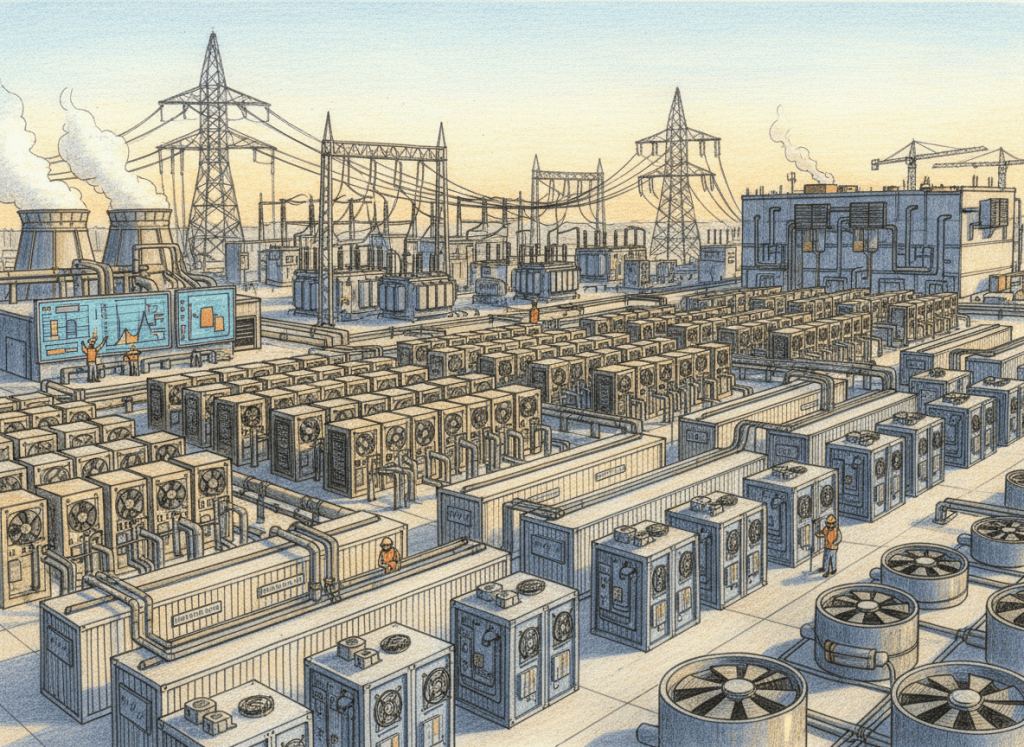
Adding hashrate at industrial scale requires more than installing additional miners. Electrical substations, transformers, switchgear, distribution equipment, conductor capacity and protection systems have to support sustained megawatt loads. Cooling and ventilation must also remove the heat created by continuous ASIC operation without excessive recirculation or thermal throttling.
Facility-level efficiency therefore differs from an ASIC’s nameplate J/TH rating. Transformer and power-supply losses, fans, pumps, network equipment and auxiliary systems all consume electricity. Mining economics ultimately depend on sustained accepted hashrate relative to total wall power, uptime and electricity cost.
Mining Infrastructure Is Expanding Toward AI
Bitdeer’s August update also shows how large mining operators are adapting power portfolios for AI infrastructure. The company secured all GPU capacity at its 9.5 MW A102 facility in Malaysia and signed a 10-year data center services agreement for another 65.1 MW at its Johor campus. Bitdeer also acquired 200 acres near its existing 563 MW Rockdale, Texas facility for potential AI and high-performance computing development.
Bitcoin mining and AI computing can share access to land, substations and large electrical interconnections, but the workloads are not interchangeable. AI clusters generally require higher network bandwidth, tighter redundancy requirements and different cooling architectures. Bitcoin ASIC fleets can often tolerate curtailment more readily, making them useful flexible loads where power availability changes.
Bitdeer’s August numbers demonstrate the scale now possible when ASIC development, data-center construction and power procurement are managed together. Continued performance will depend on hardware efficiency, electricity costs, network difficulty, facility uptime and the company’s ability to allocate infrastructure between mining and higher-density computing workloads.
Sources
- Bitdeer August 2026 Production and Operations Update
- Bitdeer Second Quarter 2026 Results
- Bitdeer infrastructure and grid investment update
BitcoinVersus.Tech Editor’s Note:
We volunteer daily to ensure the credibility of the information on this platform is Verifiably True. If you would like to support to help further secure the integrity of our research initiatives, please donate here: 3C9o19EH5HSiwEPyCTmEKzxhNCbo2X6TTb
Follow BitcoinVersus.Tech on X.
Financial Disclaimer: BitcoinVersus.Tech provides information for educational and informational purposes only. Nothing published here constitutes financial, investment, legal or tax advice. Readers should conduct independent research and consult qualified professionals before making financial decisions.


Leave a Reply