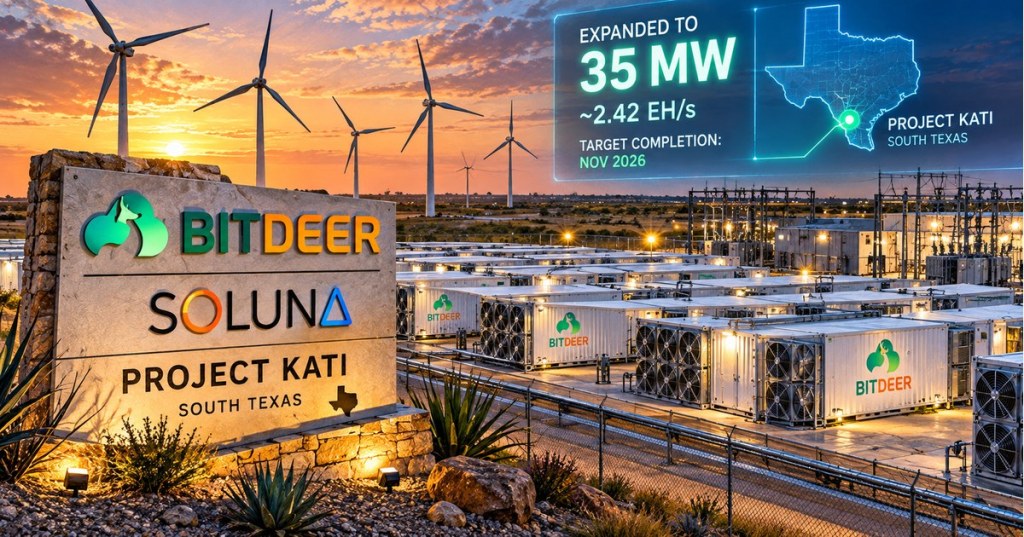
Bitdeer is expanding its Bitcoin mining deployment at Soluna’s Project Kati 1 in South Texas, adding approximately 7 MW of mining equipment under an amended agreement that is expected to bring the deployment to 35 MW and roughly 2.42 EH/s.
The expansion was announced September 28 and is expected to be completed in November 2026. The filed announcement says the additional equipment will fully subscribe the site’s K1BC phase. The figures describe the planned deployment after expansion, not capacity already energized today.
Seven More Megawatts for Bitcoin Mining
Under the co-mining structure, Soluna provides the site, power infrastructure and turnkey operations while Bitdeer supplies and owns the mining equipment. The companies then share mining proceeds. That structure separates the physical data-center plant from the ASIC fleet while keeping both parties exposed to mining output.
The amendment raises Bitdeer’s planned Kati 1 footprint from about 28 MW to 35 MW. At approximately 2.42 EH/s across 35 MW, the deployment represents a useful example of how modern mining capacity is increasingly described in both electrical and computational terms: megawatts define the facility constraint while exahashes define the productive load placed behind the meter.
Kati Is Built Around Renewable Power
Project Kati is one of Soluna’s renewable-powered computing developments in Texas. The broader campus has been positioned around curtailed or underutilized renewable generation, using flexible computing load to consume power that can otherwise be difficult to monetize continuously.
BitcoinVersus.tech recently examined Soluna’s larger Kati development plan, which pairs a 100 MW Bitcoin-mining campus with a potential 300 MW AI expansion. The new Bitdeer amendment fills more of the mining side of that campus rather than replacing it with AI load.
Bitdeer Supplies the Machines
Bitdeer’s role is particularly notable because it operates across several layers of the mining stack. It mines Bitcoin, develops and manufactures SEALMINER ASIC hardware and increasingly operates AI and data-center infrastructure. BitcoinVersus.tech previously reported on Bitdeer’s U.S. SEALMINER manufacturing push in Nevada and the company’s 79.9 EH/s self-mining fleet.
Soluna’s agreement does not say that all 35 MW will use one specific ASIC model, so assigning the deployment to a particular SEALMINER generation would go beyond the disclosed facts. What is confirmed is that Bitdeer owns the equipment and Soluna operates the site infrastructure supporting it.
35 MW Is an Electrical System, Not Just a Miner Count
At this scale, the mining fleet is inseparable from the power plant around it. Transformers, switchgear, distribution panels, network equipment, airflow systems and maintenance workflows all have to support a continuous industrial load. Even a small percentage of downtime across 35 MW can represent a meaningful amount of unavailable hashrate.
That infrastructure emphasis also connects with recent deployments elsewhere. BTC Digital’s Arkansas hosting agreement explicitly bundles power, ventilation, networking, security, equipment testing and on-site support, while BitSink’s infrastructure portfolio shows how cooling and electrical systems developed around high-density mining can transfer into other compute markets.
The Expansion Comes as Mining Economics Tighten
Hashrate Index’s September 28 weekly data put network hashrate around 952 EH/s on a seven-day moving average and spot hashprice near $39.87 per PH/s/day. Difficulty remained at 132.76T after the September 19 adjustment. Those conditions reward sites that can combine newer hardware with competitive electricity and high uptime.
The Kati expansion therefore represents more than seven additional megawatts. It is another example of mining companies matching specialized ASIC fleets with power-first infrastructure rather than treating machines and sites as interchangeable. Soluna monetizes the renewable-powered site and operations layer; Bitdeer contributes the computing equipment; both share exposure to the resulting Bitcoin production.
Completion remains targeted for November. Until those additional miners are installed and operating, the 35 MW and 2.42 EH/s figures should be read as the amended deployment target.
BitcoinVersus.Tech Editor’s Note
Support independent technology reporting: BTC donations may be sent to 3C9o19EH5HSiwEPyCTmEKzxhNCbo2X6TTb.
Follow BitcoinVersus.tech on X/Twitter for Bitcoin mining, ASIC hardware, AI infrastructure, semiconductor and data-center reporting.
Disclaimer: BitcoinVersus.tech is not a financial advisor. This media platform reports on financial subjects purely for informational purposes.


Leave a Reply