Bitcoin mining difficulty reached a record 132.76 trillion after the network’s September 19, 2026 adjustment, increasing competition for every unit of SHA-256 hashrate connected to the network.
The adjustment at block 967,680 raised difficulty approximately 4.16% from 127.45 trillion. Difficulty automatically changes every 2,016 blocks to keep Bitcoin’s average block interval near ten minutes as computing power enters or leaves the network.
For mining operators, higher difficulty directly changes ASIC economics. With Bitcoin price, transaction fees and uptime held constant, a 4.16% difficulty increase reduces expected Bitcoin production per unit of hashrate by roughly 4%. Newer miners with lower joules per terahash therefore gain additional operational importance when network competition increases.
ASIC Efficiency Is Only Part of the Power Equation
Nameplate efficiency does not capture every watt consumed by a mining facility. Operators also have to account for power-supply losses, fans and pumps, network equipment, transformers, switchgear, auxiliary systems and cooling infrastructure. Accepted pool hashrate can also differ from nominal ASIC hashrate because of rejected shares, downtime, thermal throttling and hardware faults.
A useful facility-level calculation therefore starts with total electrical input at the meter and compares it with sustained accepted hashrate. An ASIC rated at a competitive J/TH can deliver weaker economics if poor airflow, excessive ambient temperature, unstable power or frequent maintenance reduces its productive operating time.
Data Center Fundamentals Matter More as Margins Tighten
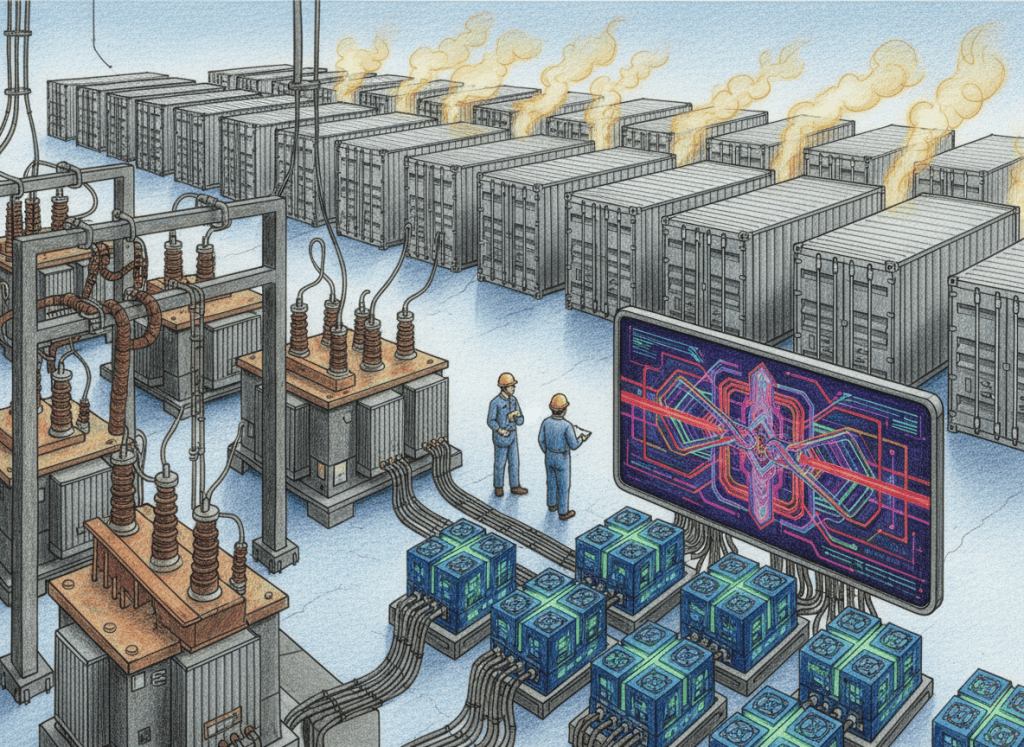
Electrical distribution and thermal management become increasingly important as difficulty rises. Transformer loading, conductor sizing, breaker coordination, voltage stability, grounding, airflow separation and preventive maintenance all influence whether installed ASIC capacity produces consistent revenue.
Cooling architecture also affects facility efficiency. Air-cooled mines must control recirculation and pressure while hydro and immersion systems introduce pumps, heat exchangers and fluid-management loads. Those systems consume power but can improve ASIC stability and permit higher-density operation when engineered correctly.
The record difficulty does not guarantee that every miner will become unprofitable. Electricity price, ASIC generation, financing, curtailment programs, transaction fees, Bitcoin price and operating reliability vary substantially between facilities. The adjustment does increase the amount of network competition that every active miner must overcome.
Sources
- Mempool.space Bitcoin network data
- Bitcoin Developer Guide: Block Chain and Difficulty
- Bitcoin Developer Reference: Difficulty Target
BitcoinVersus.Tech Editor’s Note:
We volunteer daily to ensure the credibility of the information on this platform is Verifiably True. If you would like to support to help further secure the integrity of our research initiatives, please donate here: 3C9o19EH5HSiwEPyCTmEKzxhNCbo2X6TTb
Follow BitcoinVersus.Tech on X.
Financial Disclaimer: BitcoinVersus.Tech provides information for educational and informational purposes only. Nothing published here constitutes financial, investment, legal or tax advice. Readers should conduct independent research and consult qualified professionals before making financial decisions.


Leave a Reply