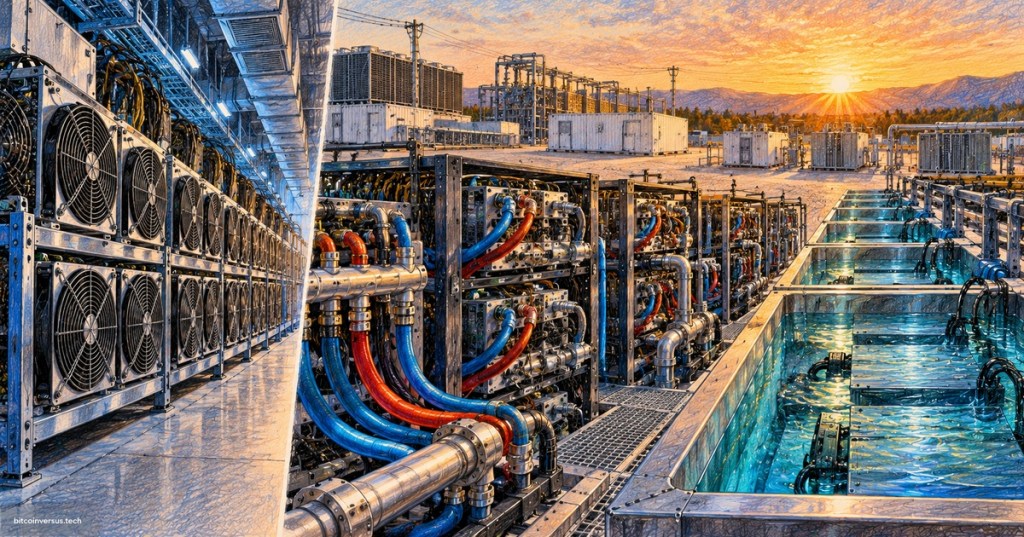
MicroBT and Canaan now sell or have announced modern Bitcoin ASIC families across air, hydro, and immersion cooling. But the strongest machine changes depending on whether an operator cares most about hashrate per box, joules per terahash, electrical density, or how much cooling infrastructure the site can support.
For this comparison, “best” means the strongest documented combination of ASIC efficiency and rated hashrate in each manufacturer’s current-generation lineup. It is a specification comparison, not a promise that every top-bin machine is available for immediate shipment. Availability changes quickly, and several current product pages are futures or sold-out listings.
| Cooling | MicroBT | Canaan | Spec Winner |
|---|---|---|---|
| Air | WhatsMiner M70S+ — up to 280 TH/s, 12.5 J/TH | Avalon A16XP — 300 TH/s, 12.8 J/TH | Split: Canaan hashrate / MicroBT efficiency |
| Hydro | WhatsMiner M73S+ — up to 600 TH/s, 12.5 J/TH | Avalon A1566HA — 500 TH/s, 16.8 J/TH | MicroBT |
| Immersion | WhatsMiner M76S+ — up to 440 TH/s, 12.5 J/TH | Avalon A1566I — 273 TH/s, 17.8 J/TH | MicroBT |
Round 1: Air Cooling Is Almost a Draw
MicroBT’s top air-cooled M70-series bin is the WhatsMiner M70S+, documented at roughly 244–280 TH/s and 12.5 J/TH. MicroBT officially launched the M70 series in December 2025 with three efficiency tiers—14.5, 13.5, and 12.5 J/T—and current manufacturer-manual references place the M70S+ at the top of the air-cooled range.
Canaan answers with the Avalon A16XP. Canaan’s official product page lists 300 TH/s, 3,850 W, and 12.8 J/TH. That gives Canaan about 7.1% more rated hashrate per machine than the 280 TH/s top M70S+ bin, while MicroBT holds a small efficiency advantage of roughly 2.3% on the published J/TH figures.
For an operator with a conventional air-cooled site, this is the closest round. If rack positions, shelves, breakers, and physical machine count are the binding constraint, Canaan’s 300 TH/s per box is attractive. If the binding constraint is megawatts, utility capacity, or long-run electricity cost, the 12.5 J/TH WhatsMiner has the edge.
At the theoretical ASIC-only level, 12.5 J/TH corresponds to about 80 PH/s per MW, while 12.8 J/TH corresponds to about 78.1 PH/s per MW. That gap looks small, but at a 100 MW fleet it becomes roughly 190 PH/s of additional nameplate hashrate before accounting for fans, transformers, PDUs, cooling overhead, downtime, and derating.
Round 2: Hydro Cooling Favors MicroBT
Hydro is where the comparison stops being close. The announced WhatsMiner M73S+ reaches as high as 600 TH/s at 12.5 J/TH. The hydro format removes the high-volume fan system and transfers heat into a liquid loop, allowing more power and hashrate to be concentrated into a denser miner chassis.
Canaan’s strongest current hydro listing is the Avalon A1566HA-500T. Canaan lists it at 500 TH/s and 16.8 J/TH. On the manufacturers’ stated efficiency ratings, MicroBT is therefore about 25.6% more efficient per terahash, while its top hydro bin also carries about 20% more rated hashrate per machine.
Translated into power density, 12.5 J/TH again implies roughly 80 PH/s per MW. At 16.8 J/TH, the same theoretical megawatt produces about 59.5 PH/s. That is a major fleet-level difference: roughly 20.5 PH/s of nameplate hashrate per MW separates the two stated efficiency classes.
That does not mean hydro is automatically the cheapest system to own. Operators must add pumps, heat exchangers, coolant quality management, piping, leak control, water treatment where applicable, and facility engineering. BitcoinVersus.Tech has covered the broader tradeoffs among air, water, and immersion cooling and why cooling overhead must be included in any real facility calculation.
Round 3: Immersion Is the Largest Gap
MicroBT’s top announced immersion model, the WhatsMiner M76S+, is rated up to about 440 TH/s at 12.5 J/TH. It is designed to run submerged in dielectric fluid, eliminating miner fans and moving heat through the facility’s immersion loop.
Canaan’s strongest current immersion listing is the Avalon A1566I-273T. Canaan’s product page lists 273 TH/s and 17.8 J/TH. On those published figures, the MicroBT is roughly 29.8% more energy-efficient per terahash and carries about 61% more rated hashrate per unit.
The theoretical density gap is even easier to see per megawatt: about 80 PH/s/MW at 12.5 J/TH versus roughly 56.2 PH/s/MW at 17.8 J/TH. For a large immersion deployment, that difference can change the number of tanks, power feeds, transformers, fluid loops, and buildings required to reach a target exahash.
Immersion still has operational advantages that raw J/TH cannot capture. A properly designed system can reduce fan failures, isolate electronics from dust, lower acoustic noise, and capture high-grade heat. But immersion also adds fluid compatibility, pump reliability, filtration, seals, service procedures, and more complex maintenance. The best miner is only “best” if the surrounding system is engineered for it.
A Note on Manufacturer Specifications
ASIC specifications should always be treated as rated operating points rather than guaranteed field performance. Ambient temperature, coolant inlet temperature, voltage quality, firmware, silicon binning, PSU losses, altitude, and facility design all affect what a machine actually produces at the wall.
Canaan’s current shop also contains a few internal inconsistencies between displayed wattage and the listed J/TH calculation on some hydro and immersion SKUs. For that reason, this comparison normalizes fleet efficiency using each manufacturer’s explicitly published J/TH rating rather than recalculating efficiency from every storefront wattage field. The individual model pages are linked so operators can verify the current listings before buying.
Cooling Method Changes the Whole Site
Air cooling is mechanically simple: miners move enormous volumes of air across heat sinks and exhaust the heat from the building. That simplicity makes air attractive for modular containers and retrofits, but fan power, dust, temperature swings, and acoustics become significant at scale. Our Bitcoin Mining Air Coolant Energy Operation Equation explains why the miner nameplate is only part of the energy equation.
Hydro moves heat into a controlled liquid circuit, which can support much denser racks and higher-power machines. Immersion removes the miner-air interface entirely by submerging the hardware in dielectric fluid. Both approaches can improve thermal stability, but they shift complexity from thousands of individual fans into pumps, heat exchangers, plumbing, coolant chemistry, tanks, and controls.
That is why operators should evaluate a miner as part of an electrical-and-thermal system rather than as an isolated box. BitcoinVersus.Tech’s rack-and-stack analysis makes the same point: useful compute density depends on power distribution, networking, service clearances, cooling, and maintainability as much as the machine’s headline TH/s.
MicroBT Wins the Fleet — Canaan Wins a Real Air-Cooling Argument
Across all three cooling methods, MicroBT has the stronger specification-level fleet today. Its 12.5 J/TH top tier spans air, hydro, and immersion, giving operators a consistent efficiency target even when the site architecture changes.
Canaan is much more competitive than that headline suggests. The A16XP’s 300 TH/s at 12.8 J/TH makes air cooling a legitimate split decision: Canaan wins raw hashrate per machine, while MicroBT wins slightly on efficiency. For a fleet constrained by physical machine positions rather than megawatts, the Avalon can make a strong case.
Hydro and immersion are different. The published gap is large enough that MicroBT wins both on efficiency and maximum unit hashrate. That matters in a market where hashprice can compress while network difficulty keeps rising.
The Bigger Battle Is J/TH
The manufacturer rivalry ultimately points back to the long-term constraint BitcoinVersus.Tech has tracked in The Bitcoin Mining Singularity: every new ASIC generation must extract more SHA-256 work from each joule while the physical and semiconductor gains become harder to find.
That is also why recent semiconductor analysis of WhatsMiner silicon matters. Cooling method changes the thermal envelope, but the decisive long-run competition still happens inside the ASIC, power delivery system, and firmware. Better cooling can expose more of a chip’s potential; it cannot replace better silicon.
Final score: air cooling is a split decision, hydro goes to MicroBT, immersion goes to MicroBT, and the overall three-cooling fleet goes to MicroBT. Canaan’s A16XP keeps the matchup interesting because it proves Avalon is back within striking distance at the high end of conventional air cooling.
BitcoinVersus.Tech
Advertisement
BitcoinVersus.Tech covers Bitcoin mining hardware, ASIC efficiency, cooling, semiconductors, energy, and data-center operations.
Editor’s Note
We volunteer daily to help keep the information on this platform verifiably accurate. Support our independent research through the support options available on BitcoinVersus.Tech.
BitcoinVersus.tech is not a financial advisor. Content is provided for informational purposes.


Leave a comment