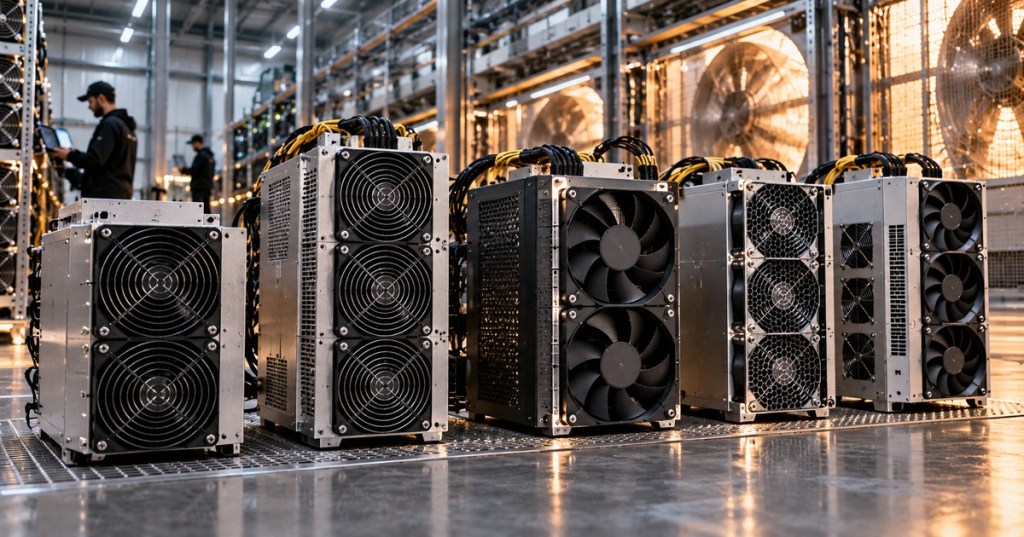
Air-cooled Bitcoin miners have crossed the 300 TH/s line without forcing operators into hydro loops or immersion tanks. The strongest current machines now push far more hashrate through a familiar fan-cooled chassis than the previous generation.
This ranking uses rated or manufacturer-stated SHA-256 hashrate for air-cooled machines only. Hydro and immersion models are excluded. One-off lab overperformance is not used as the ranking number, and overclock modes are called out separately when relevant.
| Rank | ASIC | Hashrate | Power | Efficiency | Cooling |
|---|---|---|---|---|---|
| 1 | Bitdeer SEALMINER A4 Pro Air | 336 TH/s | 3,662 W | 10.9 J/TH | Air |
| 2 | Bitmain Antminer S23 | 318 TH/s | 3,498 W | 11 J/TH | Air |
| 3 | Canaan Avalon A16XP | 300 TH/s | 3,850 W | 12.8 J/TH | Air |
| 4 | MicroBT WhatsMiner M72S | Up to 300 TH/s | 4,000 W normal / higher in OC mode | 13.5 J/TH upper bin | Air |
| 5 | Canaan Avalon A16 | 282 TH/s | 3,900 W | 13.8 J/TH | Air |
1. SEALMINER A4 Pro Air — 336 TH/s
Bitdeer’s A4 Pro Air takes the top spot by rated air-cooled hashrate. In its official A4-series launch, Bitdeer lists the machine at 336 TH/s, 3,662.4 W, and 10.9 J/TH.
Bitdeer later showed a lab unit running closer to 356–360 TH/s, but that is not the number used for this ranking. The rated 336 TH/s figure keeps the comparison apples-to-apples.
2. Antminer S23 — 318 TH/s
Bitmain’s air-cooled S23 is rated around 318 TH/s at roughly 3,498 W, or about 11 J/TH. That puts it just behind the A4 Pro Air on raw hashrate while remaining one of the most efficient fan-cooled SHA-256 machines in this class.
The important operator advantage is density without liquid infrastructure. A site already built around hot-aisle/cold-aisle airflow can add far more terahash per rack position than older S21- or S19-era fleets without installing pumps, CDUs, manifolds, or tanks.
3. Avalon A16XP — 300 TH/s
Canaan’s Avalon A16XP lands at 300 TH/s, 3,850 W, and 12.8 J/TH. Canaan’s current product listing explicitly identifies it as an air-cooled model.
Its strength is balance. The A16XP does not beat Bitdeer or Bitmain on raw TH/s, but it crosses 300 TH/s while staying below 4 kW nameplate power. That matters at sites where circuit limits, fan-wall capacity, and PDU layout are harder constraints than machine purchase price.
4. WhatsMiner M72S — up to 300 TH/s
MicroBT’s M72S is a special case because its air-cooled family spans multiple bins and operating modes. MicroBT markets the M72S line at up to 300 TH/s, while many common reference units are listed around 264 TH/s. The upper-end efficiency target is about 13.5 J/TH.
That is why it sits below the A16XP here even though both can reach the 300 TH/s headline. The Avalon’s 300 TH/s rating is a cleaner fixed product specification, while the M72S number depends more heavily on bin and mode. Hashrate Index’s M70-series breakdown also notes that higher-power operation can push the M72S toward the top end of its range.
5. Avalon A16 — 282 TH/s
The standard Avalon A16 rounds out the list at 282 TH/s, 3,900 W, and roughly 13.8 J/TH. It gives up 18 TH/s to the A16XP but stays ahead of the next tier of common air-cooled machines by rated hashrate.
For fleets that care about maintenance consistency, the A16 may also be attractive because it stays inside the same air-cooled platform family as the A16XP rather than introducing a separate cooling architecture.
Hashrate is not the same as profitability
This ranking is intentionally about raw air-cooled hashrate, not which miner earns the most money. Electricity price, machine cost, uptime, pool fees, ambient temperature, curtailment, and network difficulty can completely rearrange a profitability ranking.
BitcoinVersus recently ranked the most profitable Bitcoin miners at $0.08/kWh, which is a different question from which single air-cooled box produces the most terahash.
Operators comparing vendors should also look beyond one generation. BitcoinVersus has separately compared Bitmain versus Canaan across air, hydro, and immersion fleets and MicroBT versus Canaan across the same cooling classes.
The air-cooled ceiling is moving fast
A few years ago, 100 TH/s was a high-end air-cooled machine. The current leaders are now around 300–336 TH/s at roughly the same 3.5–4 kW electrical envelope. That is the real story behind this ranking: more of the mining industry’s hashrate growth is coming from silicon and efficiency improvements rather than simply putting more machines on the floor.
Editor’s Note: Rankings use manufacturer-stated or current reference specifications for air-cooled SHA-256 models. Hydro and immersion units are excluded. The SEALMINER A4 Pro Air is ranked at its 336 TH/s rated specification rather than higher lab-test output. The WhatsMiner M72S can vary by bin and operating mode, so its 300 TH/s figure should be read as the upper end of the air-cooled family rather than a universal base configuration.
Support independent technology reporting: Bitcoin donations help fund BitcoinVersus.Tech research and publishing.
Disclaimer: BitcoinVersus.Tech provides technology news and analysis for informational purposes only.


Leave a Reply