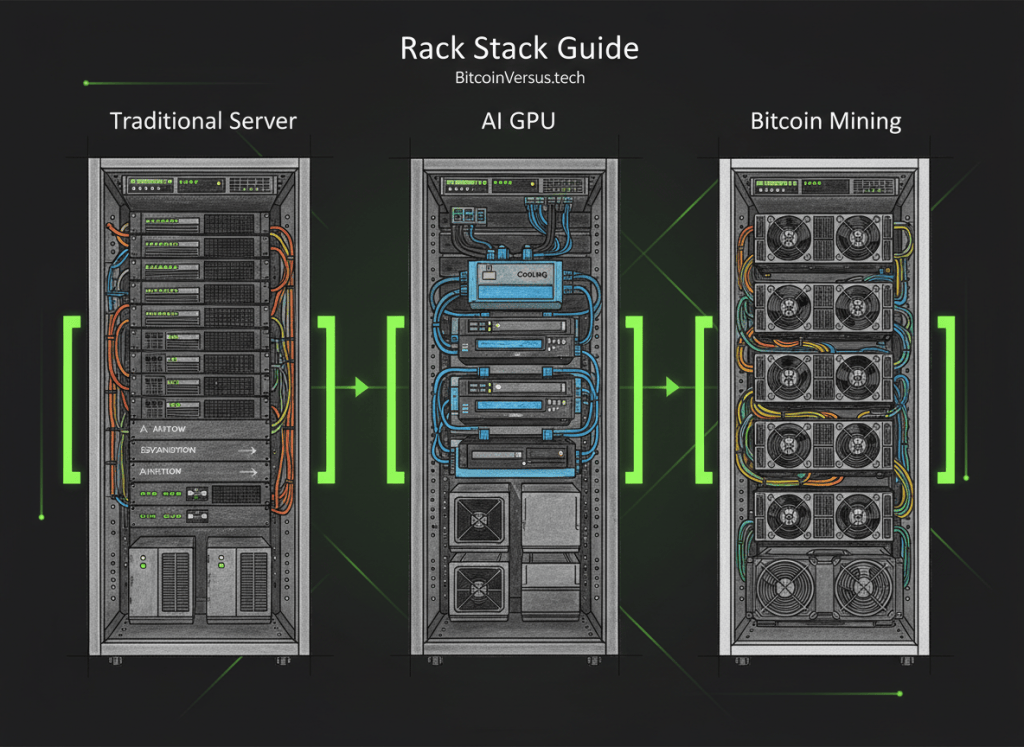
Rack and stack is more than physically installing hardware. A clean deployment balances equipment weight, airflow, electrical capacity, networking, cooling, serviceability and room for future expansion.
Start With the Rack Unit
A standard rack unit, written as 1U, is 1.75 inches (44.45 mm) tall. Traditional data-center servers commonly use standardized 19-inch racks with 1U, 2U and larger chassis. Before mounting anything, technicians should create a rack elevation showing exactly where each device, PDU, switch and cable-management component belongs.
Traditional Server Rack
A conventional rack may combine top-of-rack Ethernet switches, 1U or 2U compute servers, storage equipment and A/B power distribution. Heavy equipment should generally stay lower for stability. Front-to-back airflow must remain unobstructed, and blanking panels can help prevent hot exhaust air from recirculating through unused rack spaces.
Power and network cabling should follow documented paths that preserve service access and required bend radius. Label both ends. A technician troubleshooting a failed link at 2 a.m. should not have to guess which cable serves which port.
AI and GPU Rack
Modern AI racks push the same fundamentals much harder. GPU systems can occupy several rack units and create far greater power and thermal density than conventional servers. High-capacity PDUs, redundant feeds, high-speed Ethernet or InfiniBand and liquid-cooling infrastructure may all share the rack environment.
For liquid-cooled systems, technicians must account for coolant distribution units, supply and return manifolds, hoses, leak detection and service clearance in addition to ordinary data and power cabling. BitcoinVersus.tech recently covered NVIDIA’s DSX Ready power and cooling architecture, which illustrates how tightly compute, electrical and thermal systems are converging.
Bitcoin Mining Rack
Bitcoin ASIC miners change the physical layout again. Many air-cooled miners are not conventional 1U or 2U servers. Facilities therefore use purpose-built shelves, frames or containers designed around miner dimensions and extremely high continuous airflow.
Air-cooled ASICs should have a clear intake and exhaust path with enough separation to prevent hot-air recirculation. Electrical design must account for sustained miner load, circuit capacity and PDU limits. Network switches and environmental sensors should remain accessible without obstructing airflow. Hydro and immersion systems require entirely different plumbing, manifolds and service procedures.
The Rack-and-Stack Rule
The exact equipment changes, but the rule does not: plan power, cooling, networking and physical placement before installing the first machine. Keep heavy equipment secure, protect airflow, label everything, maintain cable discipline and reserve enough electrical, thermal, network and physical capacity for expansion.
For more physical-infrastructure fundamentals, see BitcoinVersus.tech’s Data Center Cabling Fundamentals 101.
BitcoinVersus.Tech Editor’s Note:
We volunteer daily to ensure the credibility of the information on this platform is Verifiably True. If you would like to support to help further secure the integrity of our research initiatives, please donate here: 3C9o19EH5HSiwEPyCTmEKzxhNCbo2X6TTb
BitcoinVersus.tech is not a financial advisor. Information is provided for informational purposes.


Leave a Reply