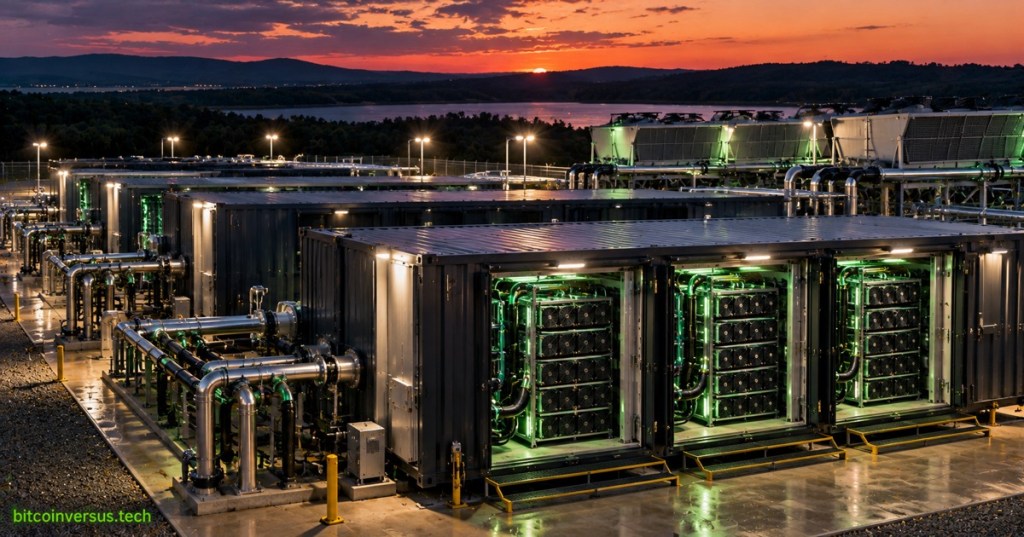
Stellar Forge Mining says approximately 1,650 new hydro-cooled Bitcoin miners are arriving and preparing to come online across its infrastructure. The expansion adds another sizable batch of liquid-cooled ASIC capacity to a U.S. hosting platform that is increasingly built around high-density 2U and 3U hydro systems.
It is a straightforward piece of positive mining news: more specialized Bitcoin hardware is being deployed, more hosting capacity is being used, and the underlying infrastructure is shifting toward denser, serviceable, closed-loop cooling rather than simply adding more fan-cooled boxes.
About 1,650 Hydro Miners Are Preparing to Come Online
In a recent company update, Stellar Forge said approximately 1,650 new hydro Bitcoin mining units were arriving and being prepared for deployment across its mining business.
The company did not disclose the exact miner models, combined hashrate, fleet-wide joules per terahash, or the final site-by-site allocation in that post, so BitcoinVersus is not estimating those figures. What is confirmed is the scale of the incoming batch and Stellar Forge’s continued focus on hydro-cooled infrastructure.
Hydro Hosting Is Moving From Niche to Standard Infrastructure
Hydro mining removes most of the airflow burden from the ASIC chassis itself and shifts the thermal work into pumps, coolant loops, manifolds, heat exchangers, and dry coolers. That lets operators pack more hashrate into a smaller physical footprint while maintaining tighter temperature control.
BitcoinVersus recently covered the same architectural shift in a 10 MW Charlotte hydro deployment built around 832 3U slots. Stellar Forge’s 1,650-unit batch shows that this is not a one-off design experiment. Large hydro fleets are becoming a normal part of modern Bitcoin-mining infrastructure.
The trend is also visible at the hardware level. New rack-style machines such as the Bitmain S23e U2H are explicitly designed around high-density liquid cooling, while compact cabinets such as the ANTRACK AR30 make smaller hydro deployments easier to standardize.
Stellar Forge Is Selling the Infrastructure, Not Just Rack Space
On its current website, Stellar Forge describes its hosting platform as renewable-powered and advertises 2U and 3U hydro capacity, 24/7 remote hands, real-time dashboards, enterprise fleet support, and liquid-cooled deployments. It also markets its hydro facilities as closed-loop systems with no ongoing external water consumption for the cooling process.
Those are company-reported operating characteristics, not BitcoinVersus measurements. But the architecture is important because modern mining economics increasingly depend on the site around the ASIC. A machine with excellent nameplate efficiency can still underperform when coolant flow, electrical distribution, networking, maintenance access, or uptime are poor.
That is why ASIC J/TH is not the same as site J/TH. Pumps, dry coolers, transformers, switchgear, networking, and controls all sit outside the miner’s sticker efficiency but still determine how much useful hashrate a megawatt ultimately produces.
1,650 Machines Is Also a Logistics Project
Bringing a fleet this size online is not simply a matter of plugging machines into empty shelves. Each unit has to be received, inventoried, physically installed, connected to electrical and coolant infrastructure, assigned network access, configured for a mining pool, tested, and monitored after commissioning.
Those steps are why rack-and-stack discipline, monitoring, and Stratum connectivity matter as much as the miner purchase itself. Large deployments become operational systems, not collections of independent boxes.
More Hydro Capacity Can Keep Older Sites Competitive
The strongest reason hydro continues to spread is not that water is inherently better than air. It is that liquid cooling can support higher power density and more stable chip temperatures as ASIC power levels rise.
That gives operators another way to increase useful compute per site megawatt without constantly expanding the physical footprint. In an industry where interconnection capacity and energized land are often harder to secure than machines, getting more productive hashrate from existing infrastructure can be just as valuable as building a new site.
Why This Is Good News for Bitcoin Mining
The mining industry has spent the last several years under pressure from rising network difficulty, tighter margins, and increasingly expensive infrastructure. A 1,650-unit hydro deployment is a useful counterpoint: operators are still investing in purpose-built Bitcoin hardware and expanding dedicated mining capacity.
It also reinforces a larger trend BitcoinVersus has been tracking across air, hydro, and immersion mining: the next phase of competition is increasingly about complete systems engineering—cooling, power density, serviceability, uptime, controls, and fleet management—not just who can buy the newest ASIC first.
What Comes Next
The next useful data point will be the exact models and combined hashrate of the incoming fleet once Stellar Forge finishes commissioning them. That would make it possible to compare the deployment’s compute density, power demand, and expected efficiency against newer 2U and 3U hydro platforms.
For now, the confirmed story is simpler: approximately 1,650 additional hydro Bitcoin miners are being prepared to come online, adding another meaningful block of dedicated mining hardware to the network.
BitcoinVersus.Tech
Editor’s Note: The 1,650-unit figure, renewable-power description, uptime marketing, and closed-loop hydro claims come from Stellar Forge Mining’s own public materials. The company has not disclosed enough information in the cited update for BitcoinVersus to independently calculate the batch’s combined hashrate or fleet efficiency.
We volunteer daily to improve the credibility of the information on this platform. If you would like to support the research, please donate here: 3C9o19EH5HSiwEPyCTmEKzxhNCbo2X6TTb
BitcoinVersus.tech is not a financial advisor. This media platform reports on technical and financial subjects purely for informational purposes.


Leave a Reply