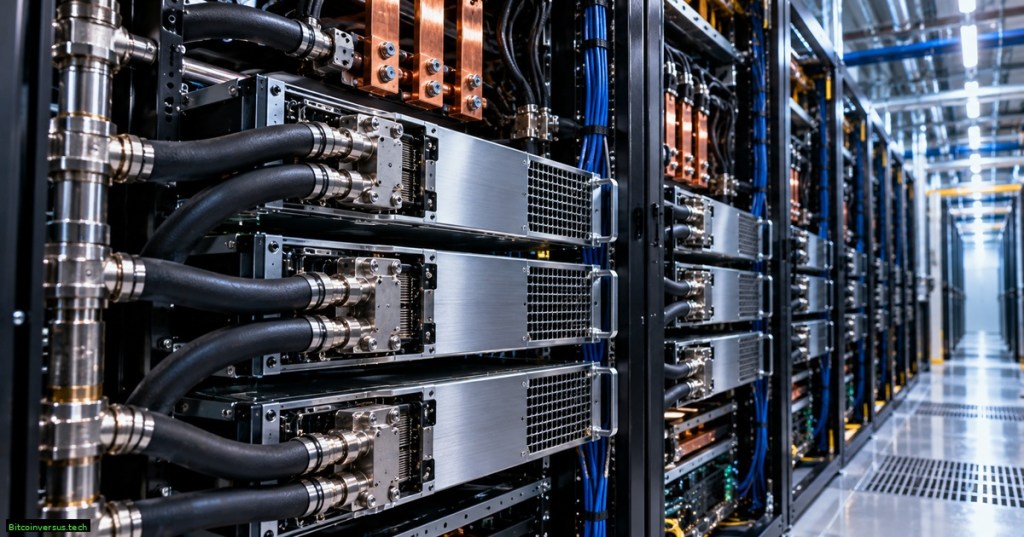
Bitmain’s Antminer S23e U2H takes a different approach to the Bitcoin ASIC race. Instead of chasing the absolute lowest joules per terahash, it pushes 865 TH/s of SHA-256 hashrate into a standard 2U rack chassis at 8,650 W and 10 J/TH.
That makes the S23e U2H a rack-density machine first and an efficiency champion second. Bitmain’s S23 XP Hyd. reaches 8.9 J/TH, but the U2H is designed to fit much more hashrate into standard server-style infrastructure where rack space can become a hard constraint.
865 TH/s in Two Rack Units
A 2U chassis is about 3.5 inches tall. In pure rack arithmetic, a 42U cabinet could fit 21 S23e U2H miners before reserving space for networking, coolant distribution, switching, service clearance, or other infrastructure. Twenty-one units equal about 18.165 PH/s of nameplate hashrate and roughly 181.65 kW of miner power.
That form factor aligns Bitcoin hardware with the same basic physical language used in data-center rack-and-stack: U positions, rails, network ports, power distribution and repeatable service access.
The Tradeoff Is Efficiency
At 10 J/TH, the S23e U2H is efficient by modern fleet standards, but it is not Bitmain’s lowest-energy machine. That gap shows why nameplate J/TH is only one operating metric. A site also pays for rack space, pumps, heat exchangers, coolant loops, electrical distribution, networking and maintenance.
Hydro Cooling Is Mandatory at This Density
An 8.65 kW miner packed into 2U cannot be treated like an ordinary server. At theoretical full 2U density, one rack approaches 182 kW of miner load before pump and facility overhead. Liquid cooling moves that heat into a facility loop where pumps and heat-rejection equipment can carry it out of the building.
BitcoinVersus previously covered Bitmain’s ANT COLD STORAGE system, which the company has promoted alongside the same 865 TH/s U2H platform.
The Launch Price Was Aggressive
At WDMS Global 2026, Bitmain promoted the S23e U2H at $11 per TH for a limited launch period. At 865 TH/s, that equals about ₿0.11342 ($9,515) per machine using the BTC/USD conversion available at publication time.
ASICB independently lists the same 865 TH/s, 8,650 W and 10 J/TH specifications. Current reseller pricing varies by batch, delivery date and inventory.
Rack Density Changes Site Design
Once miners become standardized rack appliances, operators can plan cabinets, network switching, power distribution, coolant manifolds and service workflows around repeated modules instead of shelf-style layouts. But density simply moves the bottleneck: more hashrate per rack means more electrical current, coolant flow and heat rejection concentrated into less floor space.
What Operators Should Watch
The field metrics that matter are sustained accepted hashrate, actual wall power, coolant inlet temperature, flow and pressure, hashboard failure rate, PSU reliability, firmware behavior, and total facility energy required to move roughly 8.65 kW of heat per miner.
The S23e U2H does not reset the efficiency record. Its engineering advantage is simpler: 865 TH/s now fits inside 2U. For operators that run out of rack space before they run out of megawatts, that changes the mining-floor equation.
BitcoinVersus.Tech
Advertisement
Editor’s Note
Published specifications are nameplate values. Actual hashrate, wall power and facility efficiency depend on firmware, voltage, coolant conditions and site design. The 42U example is theoretical rack arithmetic and does not reserve U space for facility infrastructure or service requirements.
Support and donation options are available through BitcoinVersus.Tech.
BitcoinVersus.tech is not a financial advisor. Content is provided for informational purposes.


Leave a Reply