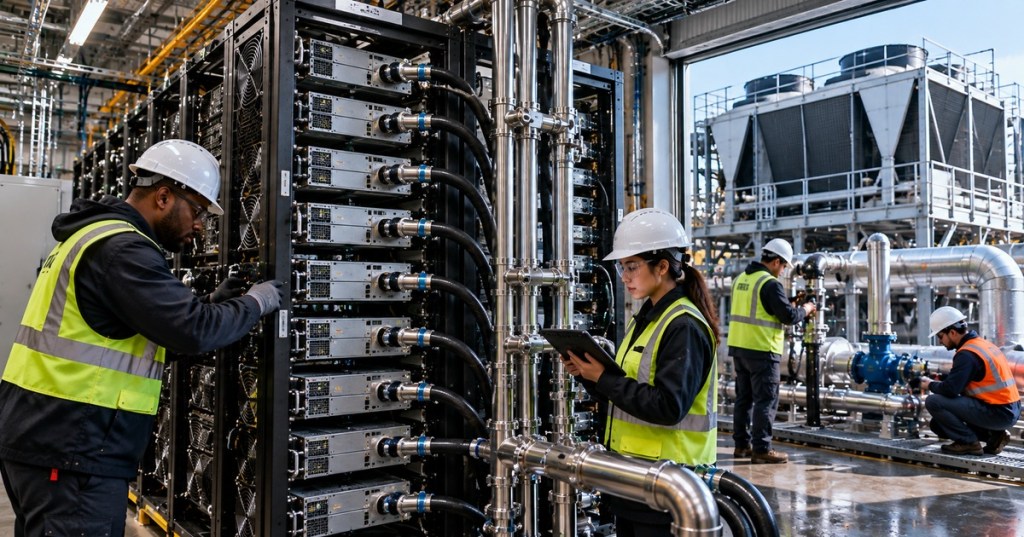
BITMAIN is pushing Bitcoin mining deeper into standard data-center form factors. Its ANTRACK AR31 is a 47U hydro-cooling system designed to hold up to 20 U2 hydro ANTMINERs or 14 T-type hydro miners, with a separate dry cooler and support for recovering useful heat from the cooling loop.
The system is not another ASIC launch. It is infrastructure around the ASIC: a rack-scale way to package high-density 2U hydro miners, electrical distribution, liquid cooling and heat rejection into a smaller footprint than a full mining container.
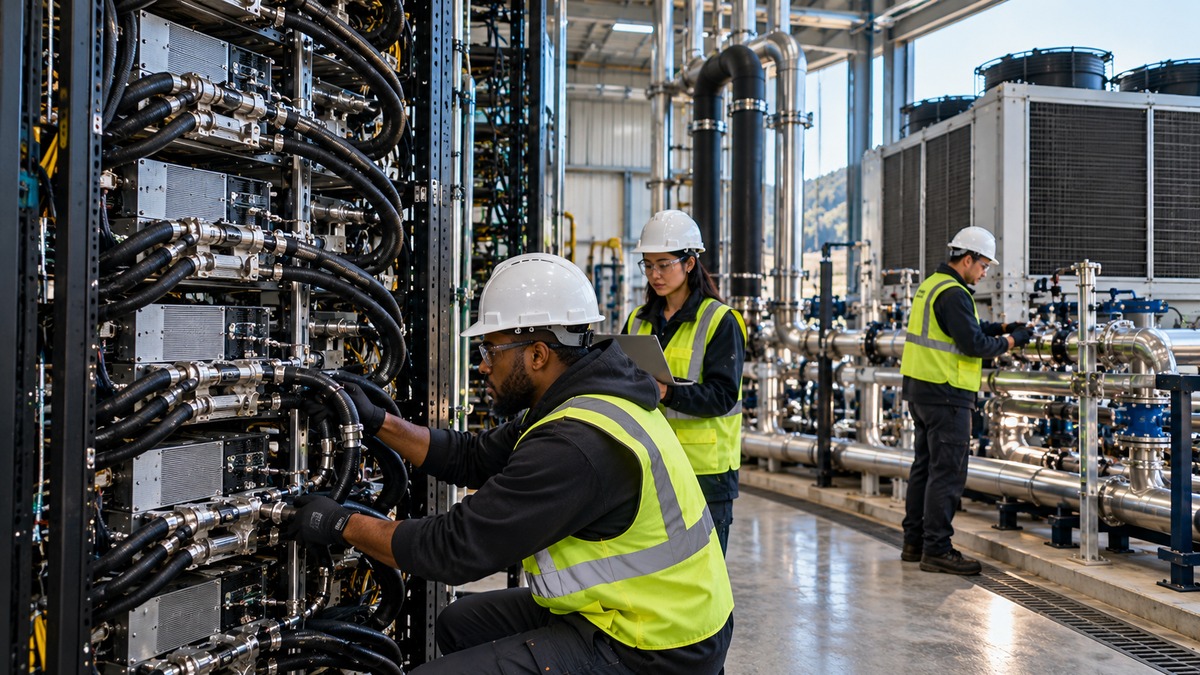
The AR31 Is a 200 kW Rack-Scale Mining System
BITMAIN’s current store listing rates the AR31 for a 200 kW maximum miner load and a 215 kW total load. The rack accepts 380–480 V input power and is designed around a conventional 47U cabinet footprint.
That distinction between miner load and total load matters. The miners are not the entire electrical system. Pumps, controls, fans and the dry cooler consume power too, which is why site-level efficiency always differs from the ASIC’s nameplate efficiency. BitcoinVersus recently explained why an ASIC’s J/TH is not the same as the facility’s J/TH.
The manufacturer’s AR31 listing prices the package at $20,000 and lists spot shipping from November 2026. BITMAIN’s earlier sales announcement described shipping within 45 business days after an order.
Twenty S23e U2H Miners Would Mean 17.3 PH/s in One Rack
The clearest example is BITMAIN’s S23e U2H. That 2U hydro miner is rated at 865 TH/s, 8,650 W and 10 J/TH.
Twenty of them would total about 17.3 PH/s of nameplate hashrate and 173 kW of miner power. That fits below the AR31’s 200 kW miner-load rating while leaving headroom for other supported U2 configurations. The rack’s published 215 kW total-load figure is the more important number for upstream electrical design.
This is why rack density has become a real mining-engineering constraint. Modern machines can put enormous SHA-256 output into a small physical envelope, but every additional terahash still has to be fed by conductors, breakers, switchgear, coolant flow, pumps and heat rejection.
AR31 Differs From AR30 at the Cooling Boundary
BitcoinVersus previously covered the ANTRACK AR30, another 20-miner hydro cabinet. The key difference is where the cooling responsibility stops.
- AR30: connects to an existing facility cooling system.
- AR31: adds a separate dry cooler and is marketed with heat-recovery support.
That makes the AR30 more natural for a site that already has a suitable liquid loop, while the AR31 is closer to a packaged thermal system for a building or small deployment that does not already have mining-specific cooling infrastructure.
Heat Recovery Changes the Mining Economics Outside the Hashboard
Nearly all electrical power consumed by a Bitcoin miner eventually becomes heat. Hydro cooling makes that heat easier to move because it is collected into a liquid loop instead of being dispersed directly into room air.
BITMAIN markets the AR31 as supporting heat recovery. In practice, the value depends on whether a site has a real thermal load that can use the recovered energy: building heat, domestic hot water, process heat, greenhouses or another low-temperature application. Heat has little economic value if there is nowhere useful to send it.
This is the same engineering idea behind other hash-to-heat applications: the miner is simultaneously a compute device and a resistive heater. A liquid loop simply gives operators more control over where that heat goes.
BITMAIN Is Trying to Put Mining Into Existing Data Centers
At WDMS Global 2026, BITMAIN described ANTRACK as a way to put mining into places that are not traditional mining farms: existing data centers, buildings with surplus power, and sites that can use the heat. The AR30 and AR31 are the hardware expression of that strategy.
That direction is significant because Bitcoin mining historically favored purpose-built containers and large open-air or warehouse-style deployments. A 47U rack changes the physical vocabulary. It lets mining infrastructure look more like conventional rack-and-stack compute, even though the electrical and thermal loads remain unusually high.
Watch the ANTRACK Deployment Model
The WDMS 2026 overview below includes BITMAIN’s new hydro hardware, the S23e U2H promotion and an ANTRACK V2 segment beginning around the middle of the video.
What Operators Should Verify Before Deployment
A packaged rack reduces integration work, but it does not remove facility engineering. Before deployment, operators still need to validate the exact miner configuration, branch-circuit design, upstream transformer capacity, coolant chemistry, flow and pressure requirements, ambient conditions, dry-cooler placement, drainage, leak detection and maintenance access.
Heat recovery adds another interface: the receiving heating system must actually be able to use the available coolant temperatures and thermal output. A useful heat sink can improve total site economics; a poorly matched one can become extra equipment with no meaningful return.
Why the AR31 Matters
The AR31 is less about creating a new class of ASIC than changing where high-density Bitcoin mining can physically live. Twenty U2 hydro miners in one rack, a self-contained dry-cooler path and optional heat recovery make it possible to think about mining at the rack level instead of only at the container or warehouse level.
If that model works operationally, the next generation of mining sites may look less like rows of standalone boxes and more like conventional high-density data centers—with the difference that every rack is still converting megawatts into SHA-256 work and heat.


Leave a Reply