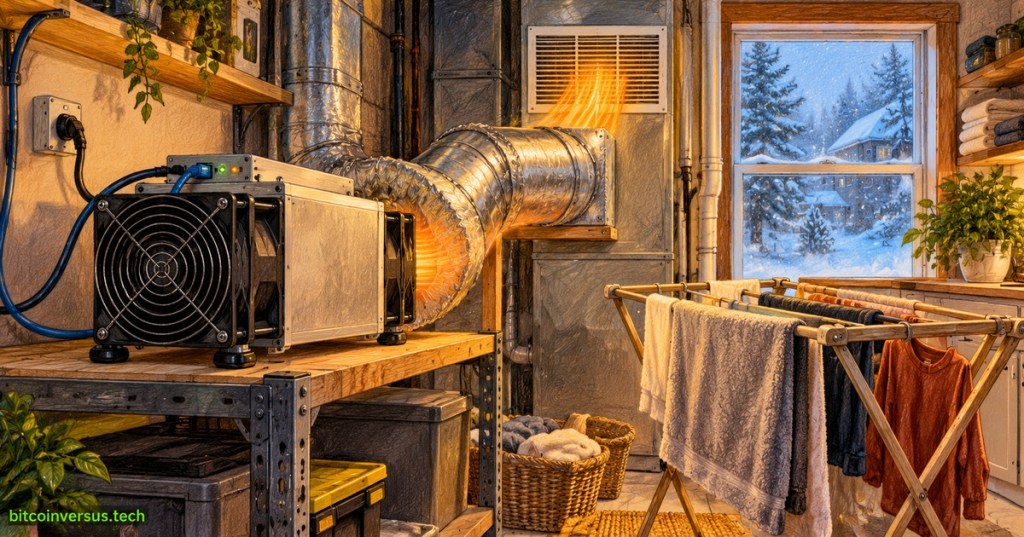
A Bitcoin miner does not have to live in a warehouse to do useful work. A newly published home-mining case study revisits Bitcoin Park researcher Robert Warren’s early experience running a Bitmain S9 in a Denver apartment, where the machine’s hot exhaust first helped dry laundry and later evolved into a home setup that fed mining heat into an HVAC return.
It is one of the more cheerful examples of what compute heat reuse can look like at human scale. Instead of treating every watt leaving an ASIC as waste heat that must be expelled, Warren treated the heat as something the house could actually use.
It Started With an S9 and a Bathroom
Bitcoin Park’s account of Warren’s 2026 Bitcoin Takeover keynote traces the story back to a roughly 14 TH/s Bitmain S9 running in his Denver apartment. The machine was loud, hot, and very physical—the opposite of the abstract “cloud” people sometimes imagine when they hear the word computing.
Warren noticed something simple: the machine was already making heat, so that heat could be put to work. Laundry placed nearby dried faster. The experiment then moved through a plywood balcony enclosure and eventually into the laundry room of a house, where the miner’s exhaust was directed into the HVAC return.
A Miner Is Also an Electric Heater
The useful idea is basic thermodynamics. An ASIC miner converts electrical energy into computation, but nearly all of the energy it draws ultimately becomes heat in the surrounding environment. In a warehouse that heat is normally an engineering problem. In a cold house, greenhouse, workshop, pool room, or district-heating loop, it can become a useful output.
That does not mean mining creates free heat. The electricity still has to be paid for. The more interesting comparison is with whatever heating system would otherwise be running. A resistance space heater consumes electricity and produces heat. A miner consumes electricity, produces heat, and performs SHA-256 work that can earn Bitcoin at the same time.
The comparison changes when a home uses a heat pump. A heat pump can move multiple units of thermal energy for each unit of electrical energy consumed, so it may beat an ASIC on pure heating efficiency. Home mining makes the most sense when the owner values both outputs—heat and hashrate—or has electricity that would otherwise be underused.
The Same Idea Is Scaling Beyond One House
Warren’s experiment looks small next to what the mining industry is now doing with the same principle. BitcoinVersus recently covered an 8 MW Canaan installation delivering recovered mining heat to roughly 2,800 Nordic homes. Hydro-cooled miners move hot water instead of hot air, making their thermal output easier to connect to municipal heating systems.
The scale is radically different, but the engineering logic is identical: do not automatically throw away a useful energy stream. The S9 warming a laundry room and the 8 MW Nordic project both ask the same question—what else can the heat do?
Home Mining Changes the Revenue Equation
Industrial miners generally judge machines through power price, uptime, efficiency, and hashprice. Home miners can add another variable: the value of heat that would have been purchased anyway.
Imagine a homeowner who already plans to run an electric heater during winter. Redirecting the same class of electrical load through a miner does not erase the electricity bill, but it changes what the electricity produces. The homeowner receives heat plus Bitcoin-denominated mining revenue instead of heat alone. How attractive that is depends on electricity cost, miner efficiency, network difficulty, Bitcoin price, noise, ventilation, and whether the heat is genuinely useful at that moment.
The Mining Shop’s September 29 case-study review makes the evidence limit clear: Warren’s setup is a participant account, not a certified appliance test or a complete financial study. That is the right way to read it. The story proves that the heat can be useful; it does not prove that every house should replace its furnace with an S9.
Noise and Airflow Are the Real Home-Mining Boss Fight
An industrial ASIC was never designed to be a polite roommate. Fans can be extremely loud, exhaust air is concentrated, dust matters, and the electrical circuit has to safely support a continuous high load. That makes ducting, sound management, filtration, clearances, and electrical protection part of the project—not optional decorations.
Newer home-focused miners are attacking those problems directly with lower power levels, slower fans, quieter enclosures, and designs intended to behave more like appliances. That is a very different direction from the massive rack-density race BitcoinVersus covers in industrial hydro mining hardware.
Bitcoin Mining Gets More Interesting When the Heat Has a Job
The best part of Warren’s story is not that an old S9 dried some clothes. It is that the experiment turns mining into a systems problem instead of a single-purpose machine.
Electricity enters. Hashing happens. Heat exits. The engineering opportunity is deciding whether that heat is waste—or another product.
That philosophy also connects to stranded-energy mining and flexible-load mining. Bitcoin’s unusual feature is that the computation can happen almost anywhere electricity and connectivity exist. Once miners start asking what the power source, heat output, grid behavior, and physical location can do together, the machine becomes part of a broader energy system.
What Comes Next
Home mining will probably never look exactly like industrial mining. That may be the point. Smaller miners can optimize for things a megawatt-scale site does not care about: quiet operation, room heating, water heating, education, solo mining, decentralization, and simply making Bitcoin’s proof-of-work process tangible.
Sometimes the positive Bitcoin-mining story really is that simple: the machine mined Bitcoin, dried the laundry, and helped heat the house.
BitcoinVersus.Tech
Editor’s Note: Warren’s home setup is a personal case study rather than a controlled appliance-efficiency test. Residential electrical work, high-current continuous loads, ventilation, noise, and fire safety should be treated seriously. Mining profitability changes with electricity prices, network difficulty, Bitcoin price, hardware efficiency, and pool conditions.
We volunteer daily to improve the credibility of the information on this platform. If you would like to support the research, please donate here: 3C9o19EH5HSiwEPyCTmEKzxhNCbo2X6TTb
BitcoinVersus.tech is not a financial advisor. This media platform reports on technical and financial subjects purely for informational purposes.


Leave a comment