
Elementary overview: people cannot reliably meet a standard that exists only in a leader’s head. Setting clear expectations means making the desired outcome, the quality standard, the important constraints, and the method of confirmation understandable before the work begins. This is Lesson 002 of the Open Source Leadership Technical Certification (OSLTC), following OSLTC.001 — How to Lead With Positive Reinforcement.
Clear Expectations Are a Basic Operating Requirement
Gallup’s Q12 workplace research treats “knowing what is expected” as the most basic employee need. Gallup reports that globally only about one in two employees strongly agree that they know what is expected of them at work. The same research says the strongest managers do not stop at a job description: they define and discuss explicit and implicit expectations, describe outstanding performance, and connect the employee’s work to the larger team. See Gallup’s Q12 explanation of clear expectations.
This matters even more in technical work because ambiguity can become downtime, rework, safety exposure, bad data, or damaged equipment. “Check the electrical room” is not equivalent to “verify panel status, record any active alarms, do not open energized equipment, and escalate any abnormal condition before changing state.” In work involving lockout/tagout, commissioning, firmware, networking, robotics, or semiconductor equipment, a vague instruction can hide assumptions that should have been stated explicitly.
The Four-Part OSLTC Clear-Expectation Check
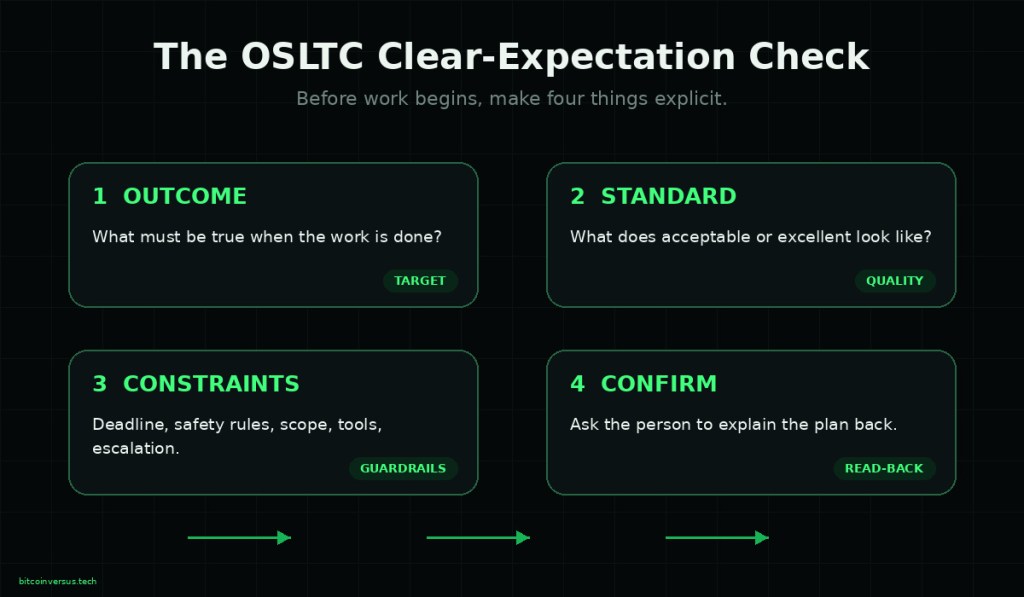
Before assigning work, check four things: Outcome, Standard, Constraints, Confirm. This is a practical OSLTC teaching model rather than an industry standard. Its purpose is to make the leader’s expectations inspectable instead of invisible.
- Outcome: What must be true when the work is finished?
- Standard: What does acceptable or excellent work look like?
- Constraints: What deadlines, safety rules, scope limits, tools, approvals, or escalation conditions apply?
- Confirm: Can the person explain the assignment and planned approach back in their own words?
A useful expectation therefore sounds less like “handle the issue” and more like: “Restore the device only after you identify the current fault state, preserve the alarm evidence, stay within the approved recovery procedure, and document what changed. If the fault returns after the approved reset, stop and escalate.” That language resembles the evidence-first discipline taught in robot fault-recovery troubleshooting.
1. Define the Outcome Before the Method
Start by describing the result that needs to exist. Gallup has long argued that strong managers define the right outcomes instead of over-controlling every step. That distinction protects both clarity and autonomy. If the outcome is “produce a verified L3 commissioning record for this equipment,” the employee needs to know what evidence proves completion. They do not necessarily need the leader narrating every mouse click.
This is especially useful during data center commissioning. The outcome might be a completed functional test with recorded readings, resolved exceptions, named witnesses, and a turnover package. A leader who only says “finish the commissioning” leaves too much interpretation inside one sentence.
2. Define What Good Looks Like
“Done” and “done correctly” are not always the same thing. A standard describes the level of accuracy, completeness, safety, documentation, response time, or quality the work must meet. Gallup’s 2026 research on accountability notes that only a minority of workers strongly agree that exceptional performance is clearly defined for their role. Without a shared definition of good work, leaders can end up correcting people against a standard they never communicated.
- Weak: “Clean up the rack.”
- Clearer: “Remove abandoned patch leads, preserve every active connection, route remaining cables without blocking airflow, verify labels, and leave the rack ready for photo documentation.”
- Weak: “Write a good handoff.”
- Clearer: “Record current state, alarms, measurements, actions already taken, open risks, and the exact next test so the next shift can continue without reconstructing the history.”
3. State the Guardrails
Constraints tell the employee where initiative stops and escalation begins. In technical environments, useful guardrails can include safety rules, maintenance windows, approved firmware versions, change-control boundaries, access permissions, test limits, customer-impact thresholds, or a maximum acceptable outage duration.
For example: “You may troubleshoot and collect evidence, but do not change the production configuration without an approved change.” That expectation is stronger because it distinguishes investigation from modification. The same idea appears in data center reliability and change-control engineering: disciplined operations depend on knowing what can change, who approves it, and how the result is verified.
4. Confirm Understanding Without Asking “Do You Understand?”
A yes-or-no question can produce a yes even when two people are imagining different assignments. A stronger check is: “Walk me through how you’re going to approach it,” or “What will you bring back to me when this is complete?” The goal is not to quiz or embarrass the employee. It is to compare the leader’s mental model with the employee’s before time and risk are spent.
If the read-back is wrong, the leader has discovered a communication defect early. Correct the expectation, not the person’s character. This is the same reason technical teams verify configuration, measurements, and test results instead of assuming that an instruction was interpreted perfectly the first time.
Clear Expectations Are Not Micromanagement
Micromanagement controls unnecessary details, repeatedly overrides reasonable judgment, and makes the employee dependent on the manager. Clear expectations do something different: they define the target and the important boundaries so the employee can operate with more independence inside them.
The more hazardous, irreversible, regulated, or customer-impacting the work is, the tighter some constraints should be. A technician should not improvise around energy-isolation requirements. But the same technician may have broad freedom in how they organize documentation or sequence low-risk diagnostic checks. Good leadership distinguishes between non-negotiable controls and areas where professional judgment is expected.
Expectations Must Change When Conditions Change
An expectation is not automatically permanent. Priorities shift, incidents change scope, parts become unavailable, schedules move, and new evidence appears. Gallup recommends regular two-way conversations because role clarity cannot be maintained by a job description alone. When the environment changes, leaders should explicitly reset the outcome, priority, deadline, or guardrail rather than expecting employees to infer the new standard.
This is also where positive reinforcement from OSLTC.001 connects to clarity. Once the expectation is clear, the leader can recognize the specific behaviors that met it: disciplined escalation, accurate documentation, strong troubleshooting evidence, safe execution, or a clean handoff.
A 60-Second Technical-Leader Script
A leader assigning a technical task can use this structure:
Outcome: “I need the failed unit diagnosed and its current state documented.”
Standard: “The record needs the alarm, measurements, evidence, root-cause hypothesis, and what you tested.”
Constraints: “Do not replace parts or change firmware until we review the evidence. Stop immediately for any safety concern.”
Confirm: “Walk me through your first three steps and what will make you escalate.”
That takes less than a minute, but it gives both people a common definition of success.
Common Leadership Failure Modes
- Vague verbs: “handle,” “fix,” “clean up,” “keep an eye on,” or “make it good” without defining the result.
- Hidden quality standards: judging work against criteria the employee was never told.
- Moving deadlines silently: changing priority without resetting the expectation.
- Too many priorities: calling everything urgent until the employee has no real priority order.
- No escalation rule: expecting initiative but punishing the employee for crossing an invisible boundary.
- No confirmation: assuming silence means alignment.
- Over-specifying harmless details: turning clarity into micromanagement by dictating method when only the outcome needs control.
Exercises
- Take one real assignment you gave recently and rewrite it using Outcome, Standard, Constraints, and Confirm.
- Rewrite the phrase “keep me updated” so it defines exactly when an update is required.
- Choose one technical task and identify which parts are non-negotiable safety or change-control boundaries and which parts can be left to technician judgment.
- Ask a teammate to read back an assignment in their own words. Compare their interpretation with yours.
- Review one missed expectation from the past month and identify whether the problem was capability, effort, resources, or unclear direction.
Knowledge Check + Answers
- What are the four parts of the OSLTC clear-expectation check? Outcome, Standard, Constraints, and Confirm.
- Why define the outcome before the method? It gives the employee a clear target while preserving appropriate autonomy.
- What is a standard? The level of quality, completeness, safety, accuracy, or performance the result must meet.
- What are constraints? Boundaries such as deadlines, safety rules, scope, permissions, tools, approvals, or escalation conditions.
- Why is “Do you understand?” a weak confirmation method? A yes does not prove that both people share the same mental model of the assignment.
- Are clear expectations the same as micromanagement? No. Clear expectations define the target and important guardrails; micromanagement unnecessarily controls the employee’s method and judgment.
- What should happen when conditions change? The leader should explicitly reset the affected expectation rather than assume employees will infer it.
Primary Leadership References
- Gallup — How to Measure Employee Engagement With the Q12
- Gallup — Employees Want a Lot More From Their Managers
- Gallup — The Great Detachment: Reset Expectations and Priorities
- Gallup — How Leaders Build Accountability and High Performance
- Center for Creative Leadership — First-Time Manager Research
Elementary Review
The simplest rule is: do not hold someone accountable to an invisible standard. State the result, show what good looks like, identify the important boundaries, and confirm that both people understand the same assignment. Clear expectations make accountability fairer and autonomy safer.
Next Leadership Lesson
OSLTC.003 — How to Give Corrective Feedback Without Making It Personal. That lesson will build on the first two lessons by separating observable behavior and performance standards from attacks on personality.
Editor’s Note
The featured artwork is a unique 1200×630 cover created specifically for this lesson and is not reused inside the body. The separate teaching diagram illustrates the four-part OSLTC clear-expectation check. This lesson is educational and does not replace an employer’s safety, HR, legal, or operating procedures.
BitcoinVersus.tech is not a financial advisor. Content is provided for informational purposes.


Leave a comment