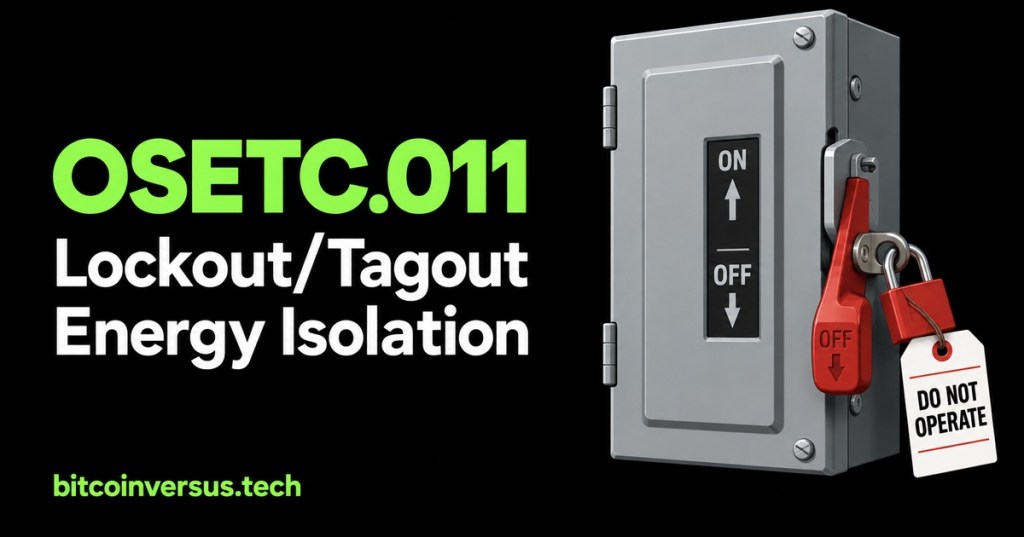
Simple explanation: A stopped machine can still hurt someone. A button may stop its motor while electricity remains connected, air stays pressurized, or a raised part can fall. Lockout/tagout helps keep hazardous energy controlled while servicing takes place.
Definition: Lockout/tagout (LOTO) is an energy-control process. Lockout physically secures an energy-isolating device in its safe position. A tag warns that equipment must not be operated. Energy isolation separates equipment from its energy sources.
In OSETC.010: Fuses and Circuit Breakers, we learned about protection against excessive current. This lesson asks a different question: how is equipment made safe for servicing?
Why OFF is not enough
A STOP button controls operation; it does not physically disconnect the energy supply. An emergency stop or software command also cannot serve as the sole means of isolation. A proper isolating device might be a disconnect switch, suitable circuit breaker, valve, or mechanical block.
Look beyond electricity. Compressed air, hydraulic pressure, springs, hot surfaces, rotating parts, and gravity can retain dangerous energy after shutdown. A machine may also have more than one supply. The equipment-specific procedure must identify every relevant source.
Who does what?
An authorized employee is trained to apply the employer’s energy-control procedure for servicing. An affected employee operates the equipment or works nearby and must understand the restrictions. Reading this lesson does not make someone authorized or electrically qualified.
A lock provides physical restraint. A tag communicates a warning; it does not provide that restraint. Do not bypass either or restart equipment under energy control. Where tagout is used instead of lockout, the employer must meet the applicable requirements for worker protection.
Watch the concept in practice
Watch AutomationDirect’s introduction, then use the scenario below to distinguish shutdown, isolation, and verification. The video illustrates general machine LOTO; it does not replace electrical absence-of-voltage verification or an employer’s procedure.
Video: “What is Lockout Tagout?” — AutomationDirect.
Understand the sequence
The employer’s procedure guides notification, shutdown, isolation, application of energy-control devices, control of stored energy, and verification before servicing. It also governs restoration after work. This is a conceptual overview, not a field checklist.
Verification matters: Failure to restart does not prove an electrical circuit is de-energized. Under OSHA 1910.333, a qualified person checks that equipment cannot restart and tests the exposed electrical parts to verify de-energization, including possible backfeed. A locked disconnect alone is not proof that every conductor inside an enclosure is safe.
Restoring service requires checks of equipment and the work area, clearing people, and controlled removal of locks and tags under the applicable procedure. Never remove another worker’s lock on your own initiative.
Paper exercise: a conveyor that looks stopped
Imagine a fictional conveyor with an electric motor, an air-powered pusher, and a raised weight. Its STOP button has been pressed. No one is touching the machine. Answer on paper only; do not operate or open real equipment.
1. Is the stopped belt enough evidence that servicing can begin? 2. Which three energy sources should the procedure address? 3. Does a warning tag physically prevent someone from restoring power?
Answers: 1. No—the visible motion has stopped, but energy control has not been demonstrated. 2. Electrical supply, compressed air, and the weight’s gravitational energy. 3. No—a tag warns; a lock supplies physical restraint at the isolating device. The scenario still requires trained personnel and equipment-specific verification.
Review and sources
Remember three separate ideas: stop operation, isolate and control energy, verify the safe condition. A quiet machine is not evidence that all hazards are controlled.
U.S. references: OSHA 1910.147 addresses hazardous energy in covered machine servicing; OSHA 1910.333 addresses electrical work practices under Subpart S. Their scopes differ. See also OSHA’s training and tag limitations and lockout/tagout guidance. Follow the rules applicable to your workplace and jurisdiction.


Leave a Reply