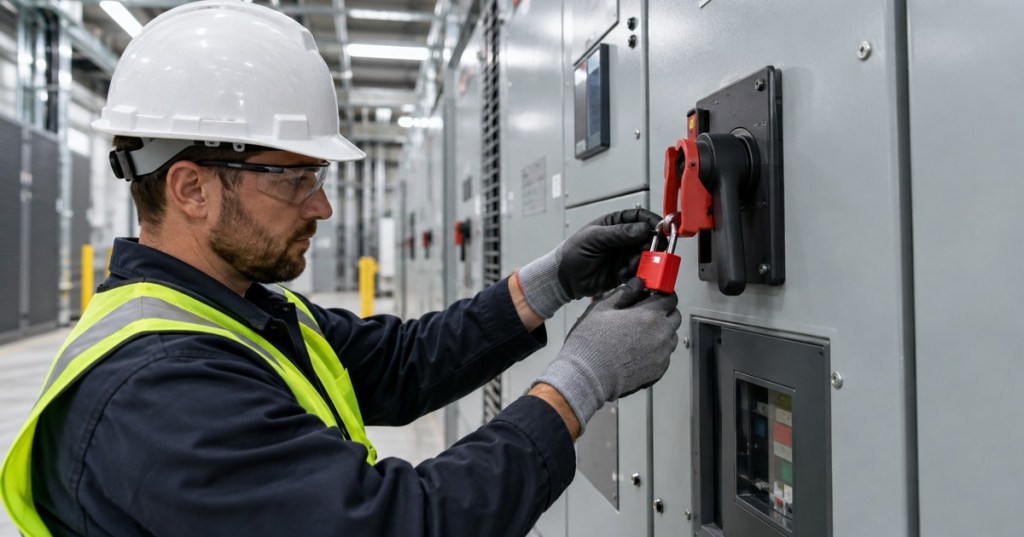
Lockout/tagout, usually shortened to LOTO, is the safety process used to keep machinery and equipment from unexpectedly starting, moving, pressurizing, heating, or becoming energized while somebody is servicing it. It is one of the most important ideas in industrial maintenance because a machine that looks “off” can still contain dangerous energy. For the deeper technician lesson, see OSETC.011: Lockout/Tagout and Energy Isolation.
The U.S. Occupational Safety and Health Administration’s 29 CFR 1910.147 hazardous-energy standard covers servicing and maintenance where unexpected energization, startup, or the release of stored energy could injure workers. LOTO is therefore much broader than simply switching off electricity. It is about controlling every hazardous energy source before hands, tools, or bodies enter the danger zone.
“Off” Is Not the Same as Isolated
A stop button, touchscreen command, software shutdown, PLC instruction, selector switch, or local control can stop a machine without physically separating it from its energy source. That distinction matters. A control signal can fail, a relay can close, an automatic sequence can restart, another worker can press a button, or backup power can return. This is why technicians need to understand both electrical switches and the larger switchgear and breaker system that actually isolates power.
LOTO aims to place a physical barrier between the worker and the energy. Depending on the equipment, that can mean opening and locking a disconnect, securing a breaker, closing and locking a valve, blocking a raised load, releasing hydraulic pressure, venting pneumatic pressure, discharging capacitors, restraining springs, or isolating a battery. Even a correctly opened high-voltage circuit breaker does not automatically prove that every possible source feeding the work area has been eliminated.
Hazardous Energy Is More Than Electricity
Electrical energy is the form most people associate with LOTO, but hazardous energy can also be mechanical, hydraulic, pneumatic, chemical, thermal, gravitational, or stored inside rotating parts, springs, capacitors, pressure vessels, batteries, and elevated equipment. NIOSH’s 2026 Lockout / Tagout / Tryout Toolbox Talk specifically reminds workers to identify all of those energy sources before maintenance begins.
The Core LOTO Sequence
A practical way to remember LOTO is: identify, shut down, isolate, lock/tag, release stored energy, verify, work, then restore safely. OSHA’s general-industry sequence begins with preparation for shutdown, followed by orderly shutdown, physical isolation, application of the lockout or tagout devices, control of stored energy, and verification that isolation was actually achieved. Affected employees also need to be notified before the controls are applied and again after they are removed.
- Identify every energy source. Know what can move, energize, pressurize, heat, fall, or release stored energy.
- Shut the equipment down normally. Use the established operating procedure so the shutdown itself does not create another hazard.
- Physically isolate the energy. Open disconnects, breakers, valves, blocks, or other energy-isolating devices.
- Apply the personal lock and tag. The lock physically prevents operation; the tag identifies the person and warns others not to operate the device.
- Control stored energy. Discharge, bleed, vent, block, restrain, ground, or otherwise render it safe.
- Verify zero-energy state. Do not assume isolation worked. Test and try the equipment using the approved procedure.
Why Verification and Tryout Matter
The verification step is where LOTO stops being a paperwork exercise and becomes a real energy-control process. For electrical work, that can include a properly rated meter and an established live-dead-live or equivalent verification method performed by qualified personnel. That connects directly to digital multimeter safety and voltage measurement. For machinery, it may also include attempting the normal start command after isolation, confirming that the equipment cannot operate, and then returning the controls to the safe position.
Stored energy can be especially deceptive. Capacitors may hold charge after a disconnect opens. A hydraulic cylinder can drift. Compressed air can remain trapped. A flywheel can continue rotating. Gravity can pull a suspended part downward. A battery system, UPS, generator, solar input, or second feeder can backfeed equipment that appears dead. Electrical workers also have to consider arc-flash hazards during the process of establishing an electrically safe work condition.
Lockout vs. Tagout
A lock is a physical restraint. A tag is a warning. Under OSHA’s general-industry rule, if an energy-isolating device is capable of being locked out, lockout is the default unless the employer can demonstrate that a tagout system provides equivalent full employee protection. That is why “we put a warning tag on it” is not automatically the same thing as physically preventing the device from being operated.
What LOTO Looks Like in Data Centers, Bitcoin Mines, and Fabs
In a data center, LOTO can involve switchgear, UPS systems, battery cabinets, PDUs, cooling pumps, CRAC or CRAH equipment, generators, busway, motor-driven fans, and mechanical systems. In a Bitcoin mining facility, the same thinking applies to transformers, distribution equipment, miners, pumps, immersion-cooling equipment, fans, and containerized infrastructure. BitcoinVersus has previously argued that an ASIC site should treat a miner as an industrial machine with formal safety procedures, not merely as a computer that happens to hash.
Semiconductor fabs add vacuum systems, toxic or corrosive chemicals, robotics, RF power, heat, compressed gases, pumps, chillers, high-voltage power supplies, and stored mechanical energy. The basic logic does not change: identify every source that can hurt someone, establish real isolation, control stored energy, and prove the equipment is safe before entering the hazard zone. Proper grounding and bonding remain important electrical-safety concepts, but grounding is not a substitute for an energy-control procedure.
Who Owns the Lock?
The worker performing the service is the authorized employee who applies the lock or tag under the procedure. Other workers who operate the equipment or work in the area are affected employees and must understand what the lockout means. Group lockout, shift changes, contractors, and emergency removal of another employee’s lock require formal procedures because ownership and accountability are central to preventing an unexpected restart.
Restoring Power Is Part of LOTO Too
The procedure does not end when the maintenance task ends. Before re-energization, tools and nonessential items need to be removed, guards and components restored, workers positioned safely, and locks or tags removed according to the approved procedure. Affected employees are then notified that the equipment is returning to service. Skipping the restoration steps can turn a successful maintenance job into a startup injury.
The Simple Rule
If you have not isolated the energy and verified the isolation, the equipment is not safe just because the screen is dark or the switch says OFF. LOTO is the bridge between “we told the machine to stop” and “the machine physically cannot hurt the person working on it.” That distinction is what makes lockout/tagout one of the foundational safety skills across electrical work, manufacturing, robotics, data centers, Bitcoin mining, and semiconductor maintenance.


Leave a comment