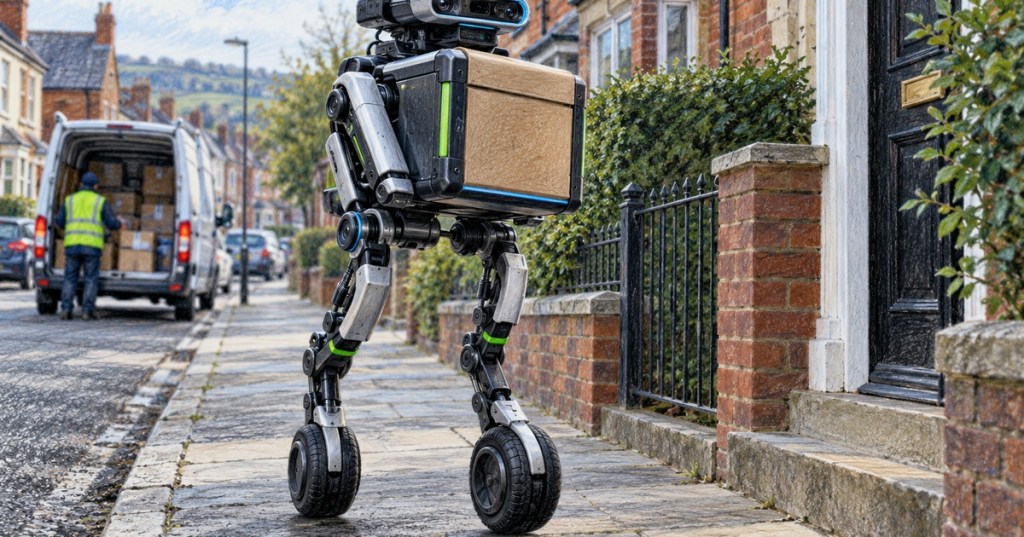
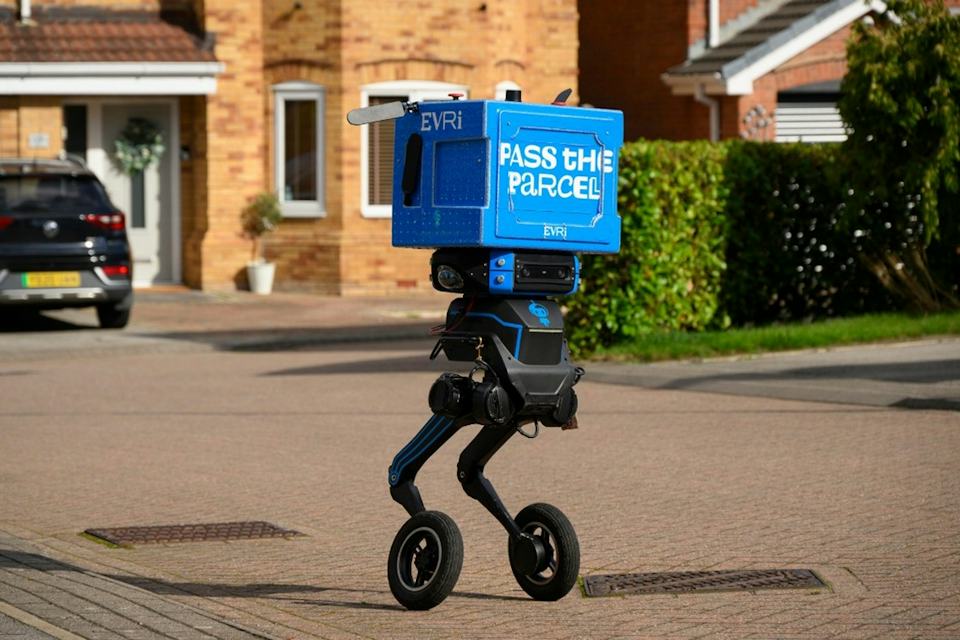
A two-legged robot named Iris is now carrying parcels through residential streets in northern England. Parcel company Evri is testing the autonomous machine in Barnsley with Japan-based Refined Robotics, bringing a wheeled-legged approach to the same last-mile delivery problem already being attacked by smaller sidewalk robots.
Evri says the pilot is Europe’s first trial of a two-legged autonomous delivery robot. Iris is designed for outdoor parcel work, including situations that are difficult for conventional wheeled machines.
Two Legs, Two Wheels, and a Parcel Box
Unlike a traditional sidewalk bot, Iris combines articulated legs with wheels at the bottom. Evri says the robot can carry parcels weighing up to 15 kilograms, travel at up to 6 kilometers per hour, climb stairs, cross uneven ground and move in and out of delivery vans.
That hybrid design is important. Wheels are efficient on smooth pavement, while legs give a machine more options when curbs, steps and irregular surfaces appear. The idea sits between compact delivery bots and larger autonomous industrial robots such as Boston Dynamics’ Atlas.
The Robot Can Work Autonomously or Be Monitored Remotely
Evri says Iris can operate autonomously or under remote monitoring and can support both attended and unattended deliveries. The trial is meant to measure how the machine performs around real homes rather than only inside a controlled warehouse or laboratory.
That makes the Barnsley test especially interesting for robotics. A delivery robot has to combine perception, navigation, obstacle avoidance, locomotion, battery management and communications while moving around people, vehicles, doors and changing weather. Similar generalization problems are showing up in newer home robotics systems designed to work in places they have never seen before.
Evri Says the Goal Is to Support Couriers, Not Remove Them
Evri CTO Marcus Hunter said the company is exploring whether robotics can support its couriers while increasing delivery choice and operational efficiency. The company says its human couriers remain central to the network.
That “robot plus worker” model is becoming common across automation. Instead of requiring a fully autonomous machine to solve an entire job, companies can deploy robots on the portions where machines have a clear advantage. The same progression can be seen from early humanoid robot demonstrations toward machines increasingly targeted at useful industrial and logistics work.
Bipedal Delivery Is Moving From Demo to Street Test
Reuters highlighted Iris on October 8 as the robot moved through the northern England trial. The bigger change is not that a two-legged machine can move a box; robotics researchers have demonstrated that for years. What matters is that the concept is now being tested inside a real parcel network with ordinary streets, doorsteps and customers.
If the trial works, the most valuable capability may be the ability to go where ordinary delivery wheels struggle. That is the same reason the industry keeps investing in better locomotion, AI-powered humanoids, and dedicated robotics processors: the real world is full of stairs, curbs, clutter and unpredictable movement.
Iris turns that engineering problem into a very simple question for customers: can a robot reliably get the parcel from the van all the way to the front door?
BitcoinVersus.Tech
Editor’s Note
We volunteer daily to ensure the credibility of the information on this platform is Verifiably True. If you would like to support the integrity of our research initiatives, please donate here: 3C9o19EH5HSiwEPyCTmEKzxhNCbo2X6TTb
BitcoinVersus.tech is not a financial advisor. This media platform reports on financial subjects purely for informational purposes.


Leave a Reply