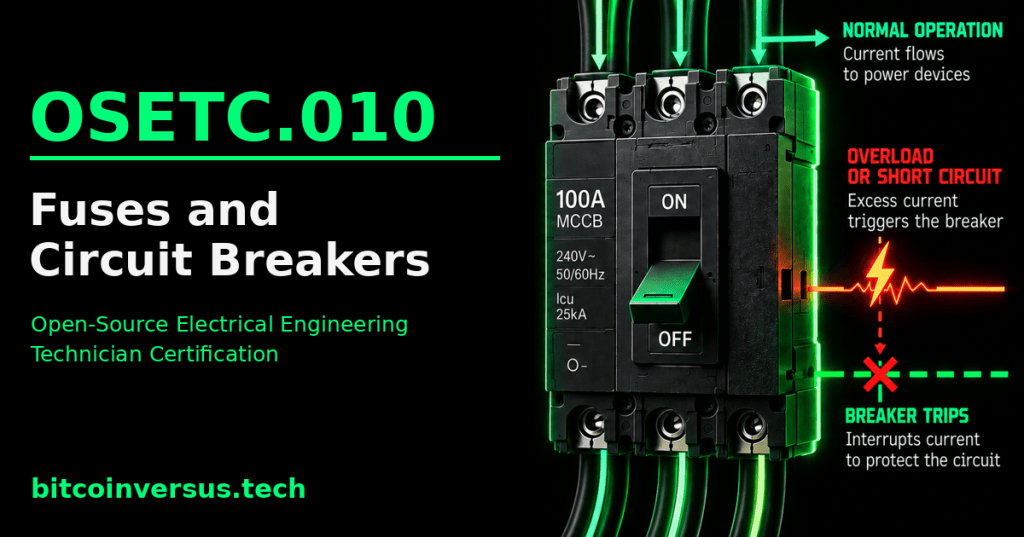
OSETC is the Open-Source Electrical Technician Certification. In OSETC.009, we learned how a short creates an unintended current path. Now we will learn how fuses and circuit breakers interrupt excessive current.
1. What overcurrent means
Overcurrent means current exceeds an equipment rating or a conductor’s allowable current. An overload happens along the normal current path, such as too many loads on a circuit. A short circuit creates an unintended low-resistance path. Both can require protective action.
2. What a fuse does
A conventional fuse contains a metal element designed to melt and open the circuit during specified overcurrent conditions. Once it operates, it must be replaced with the approved replacement after the cause is resolved. Eaton’s fuse reference explains the element and its operating characteristics.
A fuse is not simply a piece of wire. Its rating and construction determine how it handles current, voltage, and fault energy. Never bypass it with wire, foil, or another improvised conductor.
3. What a circuit breaker does
A circuit breaker opens contacts when its protective mechanism operates. Depending on its design, it can respond to sustained overloads and short-circuit currents. It may be reset after the fault is resolved and the equipment is assessed as safe. Eaton’s breaker guide describes these functions.
Circuit breaker basics: ON, OFF, and TRIPPED
ON means the breaker is closed and intended to carry current. OFF means it has been intentionally opened. TRIPPED means its protection mechanism operated after detecting a condition requiring interruption. The exact handle indication depends on the breaker design.
A trip is information—not permission to immediately reset the breaker. Identify the affected circuit and equipment, follow the site’s electrical-safety procedure, and investigate or escalate the cause within your authorization and training.
Read the breaker nameplate
Depending on the device, markings may include current rating, voltage rating, number of poles, interrupting rating, model or family, and trip-unit information. Two breakers that look similar are not automatically interchangeable.
Safety boundary
Do not remove panel covers, expose energized conductors, defeat interlocks, or perform live measurements unless you are qualified, authorized, using the required PPE, and following the site’s electrical-safety and lockout/tagout procedures.
\n
Watch the explanation below, then use the label-reading exercise. Focus on the difference: a conventional fuse needs replacement; a serviceable breaker may be reset under the approved procedure.
4. Three ratings to recognize
Current rating, in amperes: the device’s rated current under specified conditions. A 5 A fuse is not a promise that it opens instantly at 5.1 A; operating time depends on its time-current curve.
Voltage rating: the permitted circuit voltage for its specified application. Check AC or DC suitability.
Interrupting rating: the fault current the device can safely interrupt at the stated voltage. This is different from its normal current rating.
These are only part of selection. Fuse class, speed, physical format, equipment compatibility, and manufacturer requirements also matter. A larger current rating is not a repair for repeated operation.
5. Simple technician exercise
Use a photograph, datasheet, or instructor-provided disconnected training device. Record its part number, current rating, voltage rating, and AC/DC designation. Find its interrupting rating in the approved datasheet. Do not remove installed devices or open an energized panel for this exercise.
Example: a label says 5 A and 250 V AC. Those markings identify two ratings, but they do not establish DC suitability, operating speed, or the correct replacement. Use the full part number and equipment specification.
6. What to do when protection operates
Record the equipment, affected loads, and circumstances. Follow the site’s isolation and troubleshooting procedure. Investigate the cause before replacement or reset. Do not repeatedly reset a tripping breaker or increase a fuse rating to keep equipment running.
Standard overcurrent protection does not guarantee protection from electric shock. An open protective device also does not prove all equipment conductors are de-energized; other sources may exist.
Quick review
Does a conventional blown fuse reset? No. Is interrupting rating the same as current rating? No. Should a larger fuse fix repeated failures? No; investigate the cause and follow the equipment specification.
Technician takeaway
Fuses and breakers interrupt overcurrent according to their ratings and operating characteristics. Identify the device, understand its labels, and resolve the cause before restoring service.


Leave a Reply