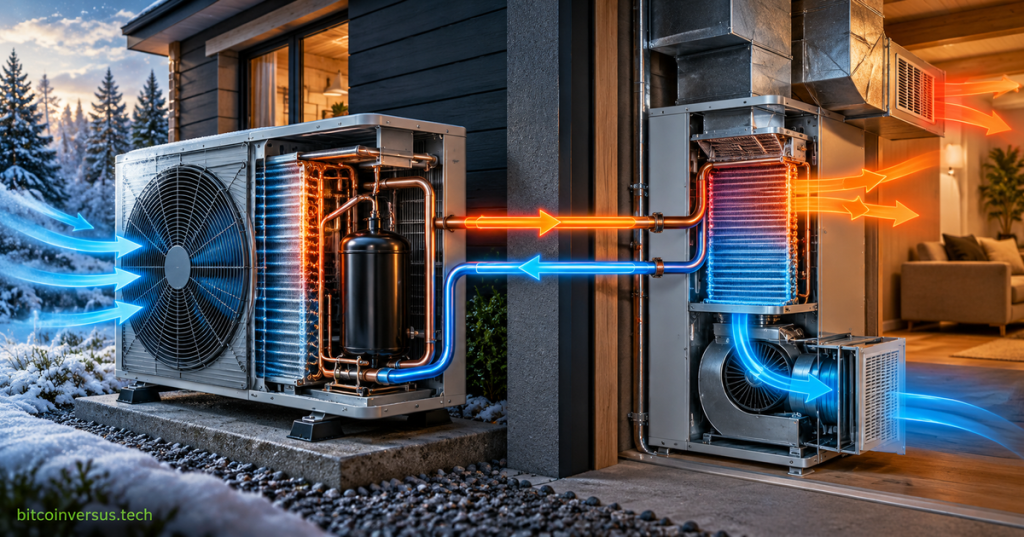
A heat pump is a machine that moves heat from one place to another. In winter, it can pull usable heat from outdoor air and move it indoors. In summer, the same system can reverse direction and move heat from inside a building to the outdoors. That makes a heat pump less like a furnace and more like an air conditioner that can run backward.
The key idea is simple: moving heat can require much less electrical energy than creating the same amount of heat with resistance heaters. The U.S. Department of Energy describes heat pumps as an energy-efficient alternative to furnaces and air conditioners because they transfer heat instead of generating it directly. DOE’s Heat Pump Systems guide also notes that modern air-source systems are now viable across a much wider range of climates than older designs.
Heat pumps also sit inside the broader move toward electrification: replacing equipment that burns fuel at the point of use with electrically powered equipment that can use grid electricity, renewable generation, nuclear power, batteries, or other sources.
A Heat Pump Is Basically a Reversible Air Conditioner
A normal air conditioner removes heat from a building and dumps it outdoors. A reversible heat pump uses the same basic vapor-compression refrigeration cycle, but adds controls and valves that let the direction of heat transfer change.
The core loop normally includes an evaporator, compressor, condenser and expansion device. A refrigerant circulates through those components, repeatedly changing pressure, temperature and—in parts of the cycle—phase. The system uses those changes to absorb heat at one coil and release it at the other.
The Four Main Pieces
1. Evaporator
The evaporator is the heat exchanger where refrigerant absorbs heat. In heating mode, the outdoor coil typically plays this role. Even cold outdoor air still contains thermal energy, so refrigerant colder than that air can absorb some of it.
2. Compressor
The compressor is the electrical workhorse of the cycle. It raises the refrigerant vapor’s pressure, which also raises its temperature. That hotter, higher-pressure refrigerant can then release heat at the other coil.
3. Condenser
The condenser is the heat exchanger where the refrigerant gives up heat. In heating mode, this is usually the indoor coil. Air moving across the coil picks up that heat and carries it through a room or duct system.
4. Expansion Device
After the refrigerant releases heat, an expansion valve or other metering device drops its pressure before it returns to the evaporator. That pressure reduction prepares the refrigerant to absorb heat again and repeat the loop.
The Reversing Valve Changes the Direction
A reversible heat pump adds a reversing valve that changes refrigerant flow so the two coils can trade jobs. In winter, the outdoor coil absorbs heat and the indoor coil releases it. In summer, the indoor coil absorbs heat and the outdoor coil releases it.
That is why the phrase “heat pump” can be confusing. The machine is always pumping heat. What changes is where the heat is being pumped from and where it is being pumped to.
How Can It Pull Heat From Cold Air?
Cold air is not the same as air with zero thermal energy. Absolute zero is far below ordinary winter weather. If the refrigerant in the outdoor coil is colder than the surrounding air, heat can still flow from that air into the refrigerant.
The harder part is the temperature lift. As outdoor temperature falls, the system generally has to work harder to move useful heat indoors. That is one reason compressor design, heat-exchanger size, variable-speed operation, refrigerant properties and defrost control matter so much in cold-climate heat pumps.
COP Explains Why “More Than 100% Efficient” Is Not Magic
Heat pumps are often described with a coefficient of performance, or COP. COP compares useful heat delivered with electrical energy consumed:
COP = useful heat delivered ÷ electrical energy consumed
If a heat pump uses 1 kWh of electricity while moving 3 kWh of heat into a building, its heating COP for that operating condition is 3. That does not mean the machine created energy. The electrical input powered the compressor, fans, controls and pumps while the remaining heat came from the outdoor environment.
ENERGY STAR explains the same principle in practical terms: efficient air-source heat pumps can deliver up to roughly three times as much heat energy to a home as the electrical energy they consume. Actual performance depends on weather, equipment, installation, controls and the building itself.
This is also why heat-pump efficiency should not be compared casually with a furnace’s combustion efficiency percentage. The two machines are doing fundamentally different things: one converts fuel into heat while the other spends electrical work to move heat.
Air-Source, Mini-Split and Ground-Source Heat Pumps
Air-source heat pumps exchange heat with outdoor air and are the most familiar form. A ducted system can resemble a conventional central air conditioner connected to an indoor air handler.
Ductless mini-splits use the same general thermodynamic idea but move conditioned air directly into individual rooms or zones through indoor heads instead of a large central duct system. That makes them useful for additions, retrofits and buildings without existing ducts.
Ground-source or geothermal heat pumps exchange heat with the ground through buried loops. Underground temperatures change less dramatically than outdoor air temperatures, which can improve seasonal performance, although installation is usually more involved.
Heat Pumps, BTUs and Building Load
Heat-pump capacity is commonly discussed in BTUs per hour or in tons of cooling. A “ton” of cooling equals 12,000 BTU/h. Those units describe the rate at which heat is moved, not the electrical power draw of the compressor.
Correct sizing matters. A system that is badly oversized may cycle inefficiently and control humidity poorly. A system that is undersized may struggle to meet load during extreme conditions or rely more heavily on supplemental heat. The building envelope, climate, air leakage, windows, insulation, duct losses and occupancy all affect the real heating and cooling load.
The thermostat is only the command layer. The deeper control logic involves temperature sensing, compressor staging or modulation, fan speed, defrost logic and sometimes auxiliary heat. BitcoinVersus.Tech’s overview of thermostat and temperature-control basics covers the simpler switching concepts underneath that broader HVAC control problem.
Why Frost Forms and Why Defrost Mode Exists
During cold, damp weather, the outdoor coil can operate below freezing. Moisture from the air may freeze onto the coil, blocking airflow and reducing heat transfer. An air-source heat pump therefore needs a way to remove that ice.
Many systems periodically run a defrost cycle that temporarily reverses the refrigeration cycle so hot refrigerant warms the outdoor coil and melts accumulated frost. During that period, indoor heat delivery can pause or supplemental heat may operate depending on the design.
Heat Pumps Are Also Useful Beyond Houses
The same concept scales beyond residential HVAC. Heat pumps can heat water, support commercial buildings, move heat into industrial processes and upgrade low-temperature waste heat into a more useful temperature range.
That last application connects directly to data-center waste-heat reuse. Servers and ASIC miners reject large amounts of low-grade heat. In the right district-heating design, a heat pump can raise the temperature of that recovered heat before it is delivered to buildings.
It also explains why refrigeration and computing cooling are closely related engineering fields. A data center may use air handlers, chillers, pumps, cooling towers or liquid loops, but the core challenge remains moving heat from sensitive equipment to somewhere that can safely accept it. BitcoinVersus.Tech’s data-center cooling overview follows that same heat-transfer problem from the computing side.
The Simple Way to Remember It
A furnace makes heat. A heat pump moves heat. The compressor supplies the work, refrigerant carries thermal energy, coils absorb and release heat, the expansion device resets pressure for the next pass, and a reversing valve lets the same machine switch between heating and cooling.
Once that idea clicks, the name makes sense: the machine is literally a pump for heat.
References
BitcoinVersus.Tech
BitcoinVersus.Tech covers energy, electrical engineering, data centers, Bitcoin infrastructure, hardware, software and the systems that connect them.
Editor’s Note
Heat-pump performance depends on equipment selection, climate, refrigerant circuit design, installation quality, building load and controls. Use manufacturer data and qualified HVAC engineering or installation guidance for a specific building.
We volunteer daily to help keep the information on this platform verifiably accurate. Support our independent research through the support options available on BitcoinVersus.Tech.
BitcoinVersus.tech is not a financial advisor. Content is provided for informational purposes.


Leave a comment