
Alaska residents can reduce household energy expenses through several state-supported programs, but there is no single universal Alaska energy rebate. The $10,000 New Home Construction Rebate is accepting applications; qualifying rural electricity customers can receive Power Cost Equalization credits; and eligible households can apply for heating assistance or free weatherization. In contrast, the federally supported HOMES and high-efficiency appliance rebates have not launched in Alaska as of November 7, 2026. Understanding the differences prevents residents from mistaking a planned incentive for money available today.
New homes may qualify for a $10,000 rebate
The Alaska Housing Finance Corporation (AHFC) launched its New Home Construction Rebate in January 2025. Eligible Alaskans who build or purchase a newly constructed, owner-occupied home may receive a $10,000 payment after completion and approval. Available funding is limited and allocated on a first-come, first-served basis; the program does not issue an automatic $10,000 check to existing homeowners.
Qualifying properties must have foundations completed and inspected on or after January 2, 2025, achieve an AHFC 5-Star Plus or higher efficiency rating, and serve as the owner’s primary residence. A single-family house, duplex, triplex or fourplex can qualify if the applicant occupies one residential unit. Developers, investment properties and commercial buildings are excluded. Unlike income-tested weatherization assistance, AHFC states the new-home incentive has no household income cap.

Applicants building a home should submit the online form with supporting plans and builder documentation. Preliminary approval normally allows 18 months to finish construction and provide qualifying records. Final proof may include an AHFC energy-rating document (PUR-101), an inspection summary (PUR-102) or certificate of occupancy, ownership documentation and a W-9. Owners building their own homes may need an independent AHFC-authorized energy rater. A completed newly purchased home can also qualify when the program’s conditions are met.
AHFC’s homeowner FAQ and official application portal identify the current documents, contact details and remaining funding process. AHFC lists 907-330-8203 and 1-888-994-2432 for assistance. Award recipients receive a 1099-G tax form; the ultimate tax treatment depends on their individual circumstances.
Planned HOMES and appliance rebates are not live
Alaska’s residential energy rebate consumer notice confirms that the Home Owner Managing Energy Savings (HOMES) and High-Efficiency Electric Home Rebate (HEEHR) programs are not yet open and have no announced start date. The Alaska Energy Authority and AHFC received a roughly $74.6 million federal allocation, but allocation does not equal an operational application system or guaranteed homeowner award.
HOMES was designed for measured or modeled whole-home energy reductions; HEEHR concerns qualifying electrification and efficient appliances. Future program terms might cover measures such as insulation, heat pumps or electrical upgrades, but prospective maximum rebate amounts should not be advertised as currently obtainable in Alaska. AHFC explicitly warns that no retroactive rebates are available under the unlaunched programs and cautions residents about unsolicited calls, messages, advertisements and door-to-door promises.
An earlier Alaska Home Energy Rebate program is also distinct from the two pending federal initiatives. Its waitlist closed to new applicants in 2016. For technical background on potential equipment upgrades, BitcoinVersus.Tech explains how heat pumps transfer heat, but learning about a technology is not evidence of rebate eligibility.
Weatherization improves existing homes for eligible residents
AHFC’s Weatherization Assistance Program helps qualifying low- and moderate-income households reduce heating demand and improve building safety. Unlike a purchase rebate, regional contractors perform authorized work at no cost to approved participants. Eligible applicants can be homeowners or renters, and some condominiums qualify.
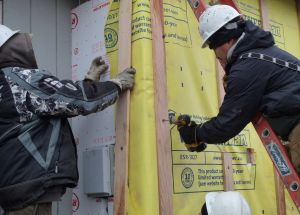
Depending on the energy assessment and program rules, upgrades may include insulation, air sealing, heating-system repairs, ventilation and related health-and-safety measures. Applicants should check the current income limits and contact the weatherization service provider assigned to their region. Prior weatherization before May 14, 2008 does not necessarily prevent another application, although previously untreated homes receive higher priority. A renter may need the property owner’s participation.
Energy savings arise from reducing heat losses and improving how a building delivers warmth, not from receiving free energy. Cold-climate performance varies with the envelope, ventilation, equipment and the cost of fuel. BitcoinVersus.Tech’s related guide to energy production and power distribution explains the difference between electricity supply and delivered energy.
Rural electricity customers may receive PCE bill credits
The Alaska Energy Authority’s Power Cost Equalization (PCE) program helps residential customers of eligible rural utilities where isolated generation, often powered by diesel, produces higher electricity bills than major urban grids. The Regulatory Commission of Alaska determines approved credits, participating utilities apply them to eligible customer bills, and the state reimburses the utilities. PCE is not a statewide cash rebate, and residents of nonparticipating utilities cannot claim it solely because they live in Alaska.
Current Alaska law AS 42.45.110 allows the residential credit on up to 750 kilowatt-hours per month. Some older brochures still cite 500 kWh, but the current statutory limit is 750. The actual credit per kWh depends on a participating utility’s approved rate and cost structure. Alaska Village Electric Cooperative explains the billing method in its residential rate guide. Electricity consumed above the residential limit is billed at the normal rate.
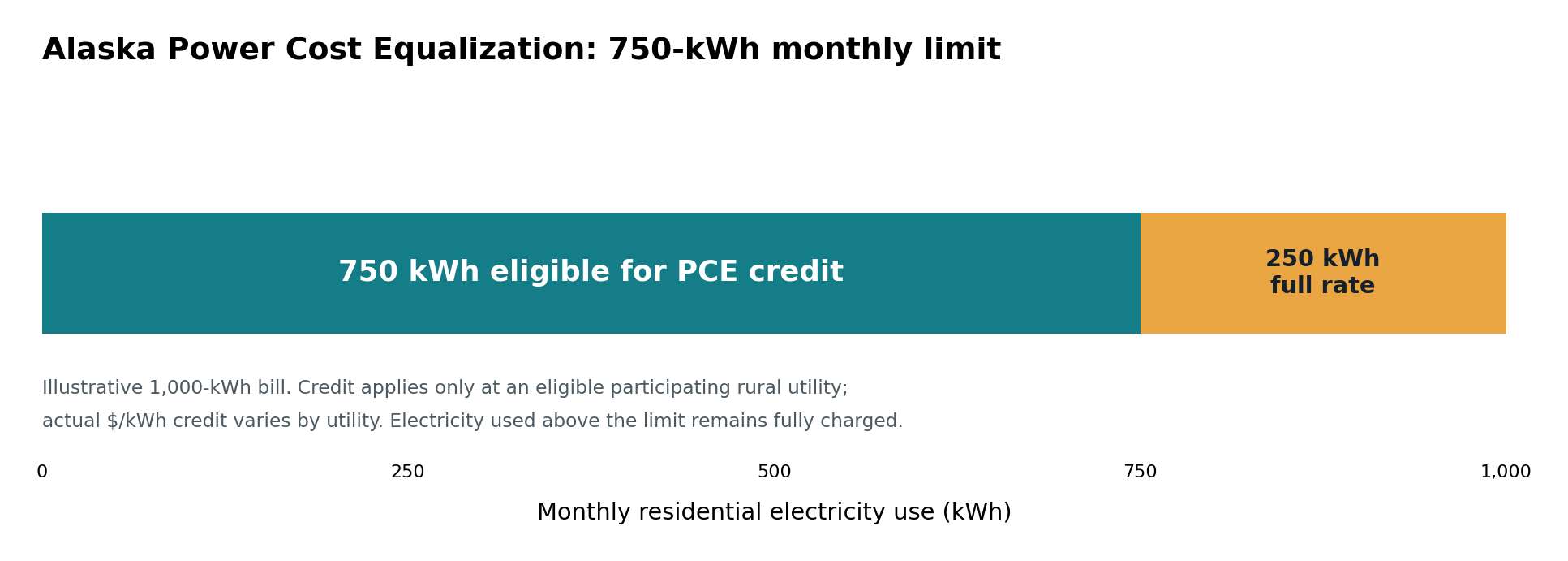
For example, a rural household consuming 1,000 kWh in one month could receive its community-specific PCE price credit on the first 750 kWh, but pay the full ordinary rate on the remaining 250 kWh. The bill credit reduces eligible energy cost, not measured consumption or the household’s peak electrical demand. For context on electricity billing, BitcoinVersus.Tech distinguishes kilowatt-hours from peak power-demand charges. Residents should inspect their bill or ask the local utility whether PCE has been applied.
PCE serves communities with particular utility systems, not all remote industrial loads. The infrastructure challenge is broader than residential billing: BitcoinVersus.Tech has separately reviewed Alaska’s proposed data-center power developments. Commercial computing projects should not assume the residential electricity subsidy is available to them.
Heating aid helps qualifying households through winter
The Alaska Department of Health administers Heating Assistance for residents meeting household income and heating-cost requirements. Households generally must incur at least $200 annually in out-of-pocket heating expenses. Federally supported Low-Income Home Energy Assistance (LIHEAP) serves eligible households up to 150% of the federal poverty guideline; the state-funded Alaska Affordable Heating Program (AAHP) covers qualifying households above 150% and through 225%. The programs’ income rules differ.
The state’s published 2026–2027 overall upper monthly income limits are $3,739 for one person, $5,071 for two, $6,401 for three and $7,733 for four. Qualification is not automatic, and benefit amounts depend on circumstances and funding. A season’s typical heating payment is a one-time credit to an approved fuel or electric-heating vendor rather than freely spendable cash.
Regular applications are accepted from October 1 to April 30. Crisis Assistance has separate rules and dates for situations such as running out of primary heating fuel or imminent service shutoff. Applicants can use the official Alaska Connect portal or call the state’s Virtual Contact Center at 800-478-7778. Households generally receive one eligible benefit per season across the state’s related assistance options.
Mortgage incentives and federal tax credits are different
The AHFC Energy Efficiency Interest Rate Reduction may lower the interest rate on qualifying AHFC-financed properties. For loan commitments dated October 1, 2024 or later, the reduction applies to the first $250,000 of the mortgage, with a blended rate on larger balances. An interest-rate reduction is a financing benefit, not a payment for appliances or insulation.
Residents should also distinguish Alaska benefits from federal tax credits. The Internal Revenue Service states that Section 25C home-improvement credits no longer apply to qualifying property placed in service after December 31, 2025, and Section 25D residential clean-energy credits ended for expenditures made after that date. Past eligible installations may still require tax-filing review. Old marketing materials promising a new federal residential credit in 2026 should not be treated as current law.
How residents should select an assistance program
A homeowner building a certified, owner-occupied new home should start with the AHFC $10,000 construction-rebate portal and confirm funds remain. A rural household should first verify PCE participation through its electric utility. Income-qualified renters and homeowners with inefficient housing should approach their regional weatherization provider; residents struggling with immediate heating costs should review heating and crisis assistance. AHFC mortgage customers may separately investigate the energy-efficient loan rate reduction.
Before paying an energy contractor, verify licensing, request written estimates and check the applicable state agency’s current program notice. An advertised allocation, an expired tax credit and an active rebate are three different things. The final measure of a useful Alaska energy incentive is whether the applicant satisfies a live program’s rules and receives an approved bill credit, service or payment.
Editor’s Note: Current as of November 7, 2026. The $10,000 rebate eligibility, 5-Star Plus requirement, inspected foundation date and required documentation follow Alaska Housing Energy’s official program page and AHFC homeowner FAQ. The unlaunched status and no-retroactive-rebates warning for HOMES and HEEHR follow AHFC’s consumer protection notice. Weatherization, heating assistance and PCE were verified against AHFC, the Alaska Department of Health, the Alaska Energy Authority, and Alaska Statutes. The IRS supplies federal-credit termination dates. The featured image is a conceptual editorial illustration, in-story photographs are credited to AHFC, and the bill-credit chart depicts a hypothetical household rather than an actual utility bill. Program funding and eligibility may change.

To donate 5,000 sats, open the article on a separate display and scan the original QR code with a compatible Bitcoin wallet. On mobile, use another screen or your wallet’s supported image-scanning feature. Verify the destination 3C9o19EH5HSiwEPyCTmEKzxhNCbo2X6TTb before sending.
We volunteer daily to ensure the information on this platform is Verifiably True. If you would like to support the research, please scan QR code.
BitcoinVersus.tech is not a financial advisor. Program information is educational and does not guarantee eligibility, a rebate or a particular tax outcome.


Leave a Reply