Alaska’s proposed data centers are some of the most ambitious—and least certain—in the United States. A North Slope developer has outlined 1–3 gigawatts of natural-gas generation, another applicant wants to put computing hardware under Cook Inlet, and a separate venture has sought land for 50 MW of Bitcoin-mining equipment. None of these three should be confused with a commissioned large-scale campus. This is the second report in BitcoinVersus.Tech’s state-by-state data center series, verified against public records through October 27, 2026.
The ranking below orders three named computing projects with published electrical-scale figures by their reported maximums. Important limitation: Alaska’s records mix proposed electricity generation with proposed computing demand. Those measures are not interchangeable. All figures are early-stage plans—not utility connections, approved IT load or operating capacity.
3. STaX Franklin Bluffs Bitcoin Mining Pilot — 50 MW proposed
The Alaska Department of Natural Resources recorded a May 2025 permit application from STaX Capital Partners for up to 30 acres of pad space roughly 35 miles south of Deadhorse. STaX described multiple 10 MW mobile gas-turbine generators intended to supply 50 MW of modular Bitcoin mining pods in a temporary first-phase proof of concept.
This is a mining proposal, not a completed hyperscale AI data center. The public notice listed an intended July 2025–July 2029 permit term; that schedule does not establish the project received its permit or began operating. On-site power generation could reduce dependence on the Railbelt grid, but gas supply, emissions permits, fiber, land access and Arctic maintenance would still matter. For context on the sector’s wider infrastructure choices, see our Bitcoin-mining heat reuse ranking.
2. DeepGreen Cook Inlet Subsea Computing Hub — 100 MW proposed generation
Near Nikiski, DeepGreen Cook Inlet SPV has requested a federal preliminary study permit for an underwater compute concept. The September 4 Federal Register notice describes about 330–350 tidal turbines, 66 subsea-compute pods and approximately 3.5 miles of hybrid power/fiber cable to shore. Its estimated 100 MW is potential generation, chiefly intended for the underwater data center—not verified compute load.
A preliminary permit, even if later granted, would confer study priority rather than authorize construction. The proposal faces questions about underwater thermal effects, fisheries, endangered beluga habitat and vessel activity. The public FERC docket timeline records interventions from local governments and other parties. Comments and competing filings are due November 2, 2026, at 5 p.m. Eastern. That is a live regulatory deadline, not an opening date.
The Cook Inlet concept illustrates an engineering distinction that often disappears from project headlines: cooling water, turbine output and server demand form separate systems. A 100 MW tidal-array claim does not mean 100 MW of computing hardware is installed, nor does it establish round-the-clock generation without performance data.
1. STAK Energy North Slope Campus — 1–3 GW proposed on-site generation
STAK Energy’s proposal is the largest named Alaska computing campus with a disclosed power-design range. The state’s May 12, 2026, preliminary lease notice concerns 715.4 acres about 26 miles south of Deadhorse. Plans involve modular high-performance computing, an on-site gas-fired power plant, associated utilities and 1–3 GW of planned generation at potential full scale.
The crucial qualifier is that 3,000 MW is the upper end of the proposed generation design, not an approved 3 GW IT connection or capacity already built. The preliminary state-land decision is not a final lease, and a new gas pipeline would require a separate process. Alaska Public Media’s May reporting described a proposed $500 million development; other developer-scale figures are higher. Those values should not be combined into a single verified construction budget.
Remote gas availability and cold ambient conditions are potential advantages, but they are not proof of financial viability. The campus would still need generation and gas infrastructure, fiber connectivity, air-quality compliance, permafrost-sensitive foundations, cooling design and dependable field service. The state extended public comments through July 17, 2026; a final operating authorization has not been established by the sources reviewed.
Alaska’s power-system economics are as significant as the servers themselves. A national megaproject comparison shows why the distinction between power requested, generation planned and actual IT load is essential. Off-grid generation may avoid direct reliance on some utility upgrades, but it introduces fuel, emissions, reliability and construction risks of its own.
What is not in the Top 3
Other Alaska initiatives are substantial but lack comparable confirmed computing power requirements. The U.S. Air Force offered roughly 4,700 acres across Joint Base Elmendorf-Richardson, Eielson Air Force Base and Clear Space Force Station for potential privately financed AI centers, without an established MW figure or selected operator in the April announcement. A separate 1,250 MW Terra Energy Center power-plant concept has discussed possible large customers, including data centers, but that generator nameplate is not a disclosed, committed data-center load. Neither merits a fabricated position in a like-for-like campus demand ranking.
Where Alaska stands in October 2026
The three headline figures cannot legitimately be added into an Alaska operational-capacity total: one is a maximum natural-gas generation design, one is projected tidal generation, and one is proposed mining demand. According to statewide project tracking, Alaska has no approved or operating hyperscale campus of 50 MW or more among the large proposals reviewed. Small existing colocation and edge facilities are a separate market.
By comparison, Alabama’s largest proposed campuses are predominantly discussed in terms of land development and grid-served demand; Alaska’s biggest concepts lean heavily on dedicated power generation and remote-site engineering. That makes Alaska a useful test of whether access to fuel, Arctic conditions and available land can overcome permitting, connectivity and project-finance hurdles.
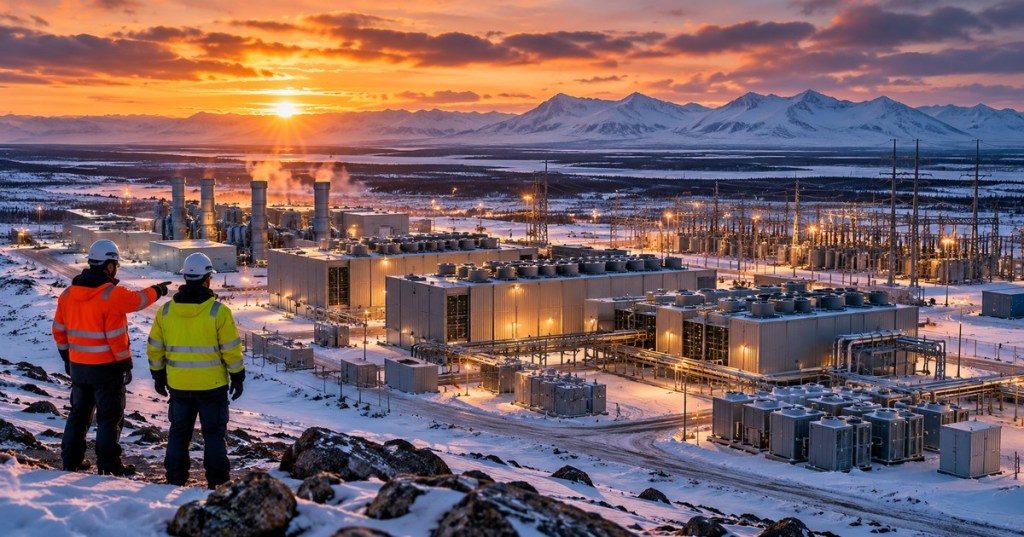
Editor’s Note: This independent report ranks proposed project scale, not operational computing capacity. The featured cover is conceptual editorial artwork, not a photograph of any completed Alaska facility. The two recorded videos are attributed stakeholder and energy-policy discussions; neither confirms construction or commissioning. Help support source-driven reporting with a donation of 5,000 sats by scanning the QR code below.

Scan this QR code with your Bitcoin wallet, ideally while viewing the report on another screen.


Leave a Reply