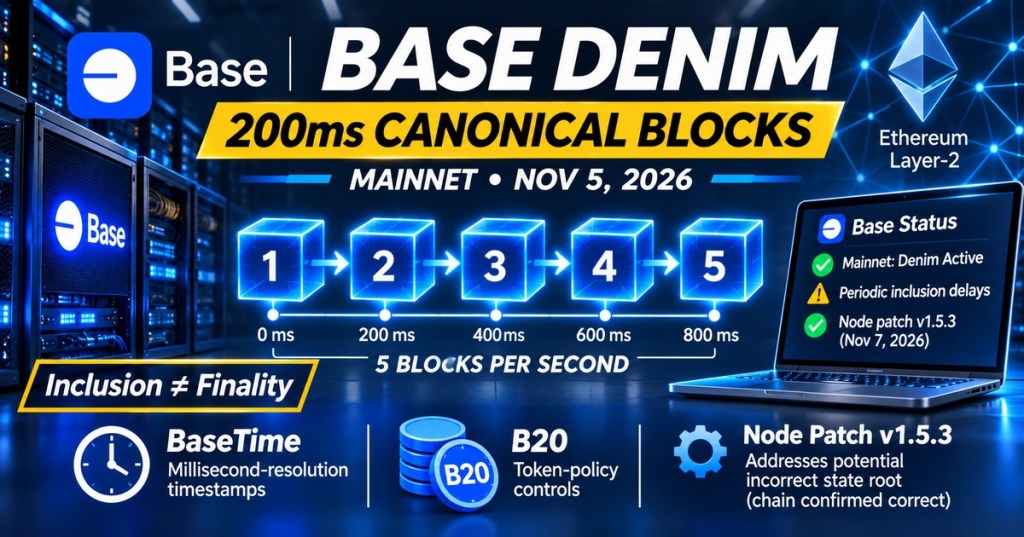
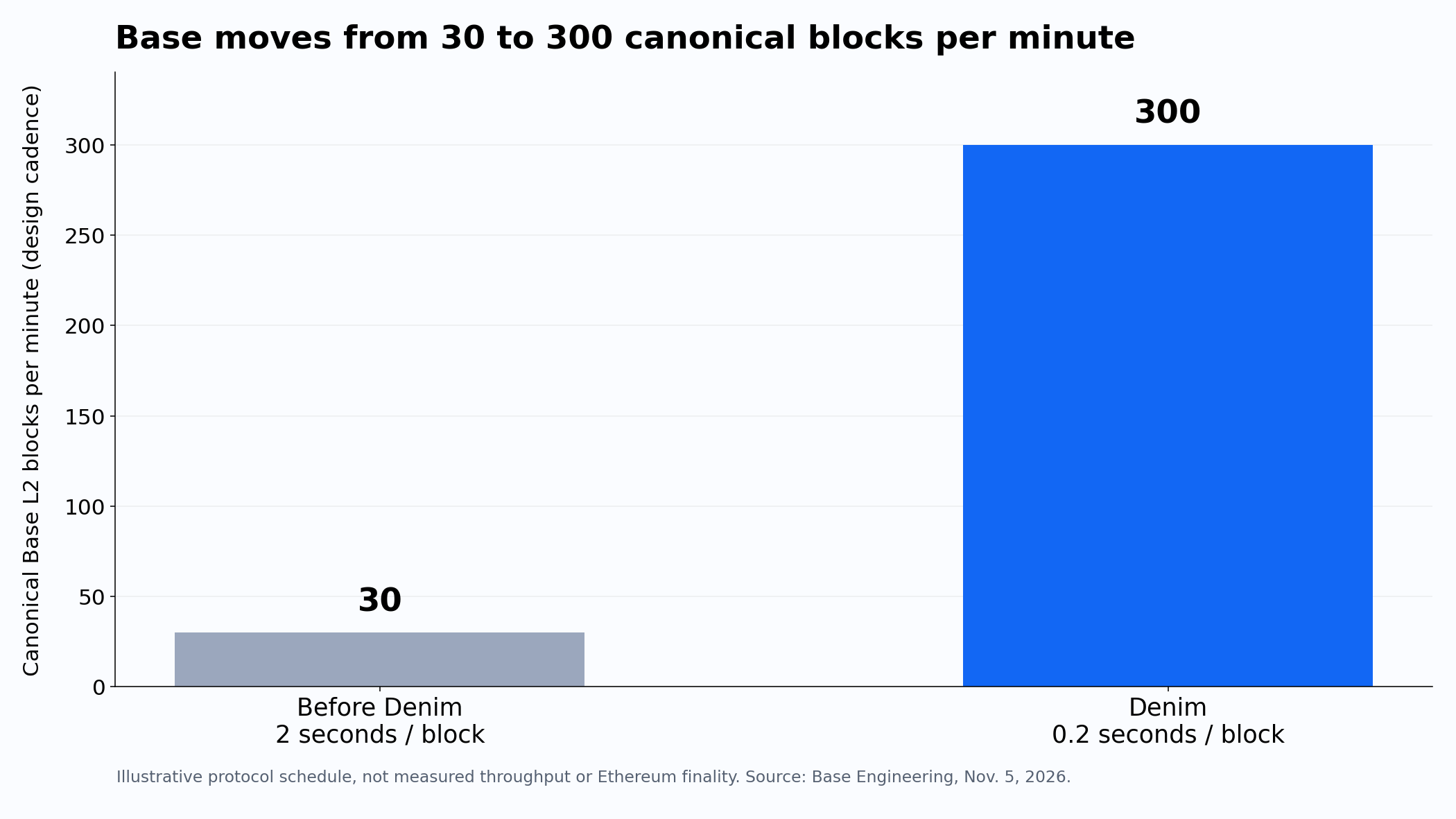
Coinbase-incubated Ethereum layer-2 network Base activated its Denim mainnet upgrade on November 5, 2026, at 18:00 UTC, replacing a two-second block schedule with one canonical block every 200 milliseconds. The change yields five complete layer-2 blocks per second instead of one every two seconds, according to the Base engineering announcement. Faster inclusion does not mean final Ethereum settlement in 200 milliseconds.
Before Denim, Base’s Flashblocks system delivered provisional state previews roughly every 200 milliseconds inside a full two-second block. Developers used those previews to show rapid transaction feedback, but the provisional contents could differ from the completed block. Denim retires the separate Flashblocks stream and makes each 200-millisecond update a normal canonical layer-2 block with its own hash and transaction receipts.
Faster blocks require developer migration
The upgrade eliminates the old `newFlashblocks` subscription. Applications can instead consume standard `newHeads` and `logs` subscriptions, with the latest canonical state replacing the former Flashblocks-aware `pending` view. Wallet interfaces, decentralized exchanges and indexers no longer need to reconcile preview streams against completed blocks. Existing applications using specialized Flashblocks APIs need to update their integrations.
A 200-millisecond block interval also differs from another blockchain’s slot terminology or security guarantees. BitcoinVersus.Tech previously reported Solana’s 200-millisecond slot change; the networks have different consensus and settlement models, so equal time intervals do not mean equivalent finality.
Block-number timers can break
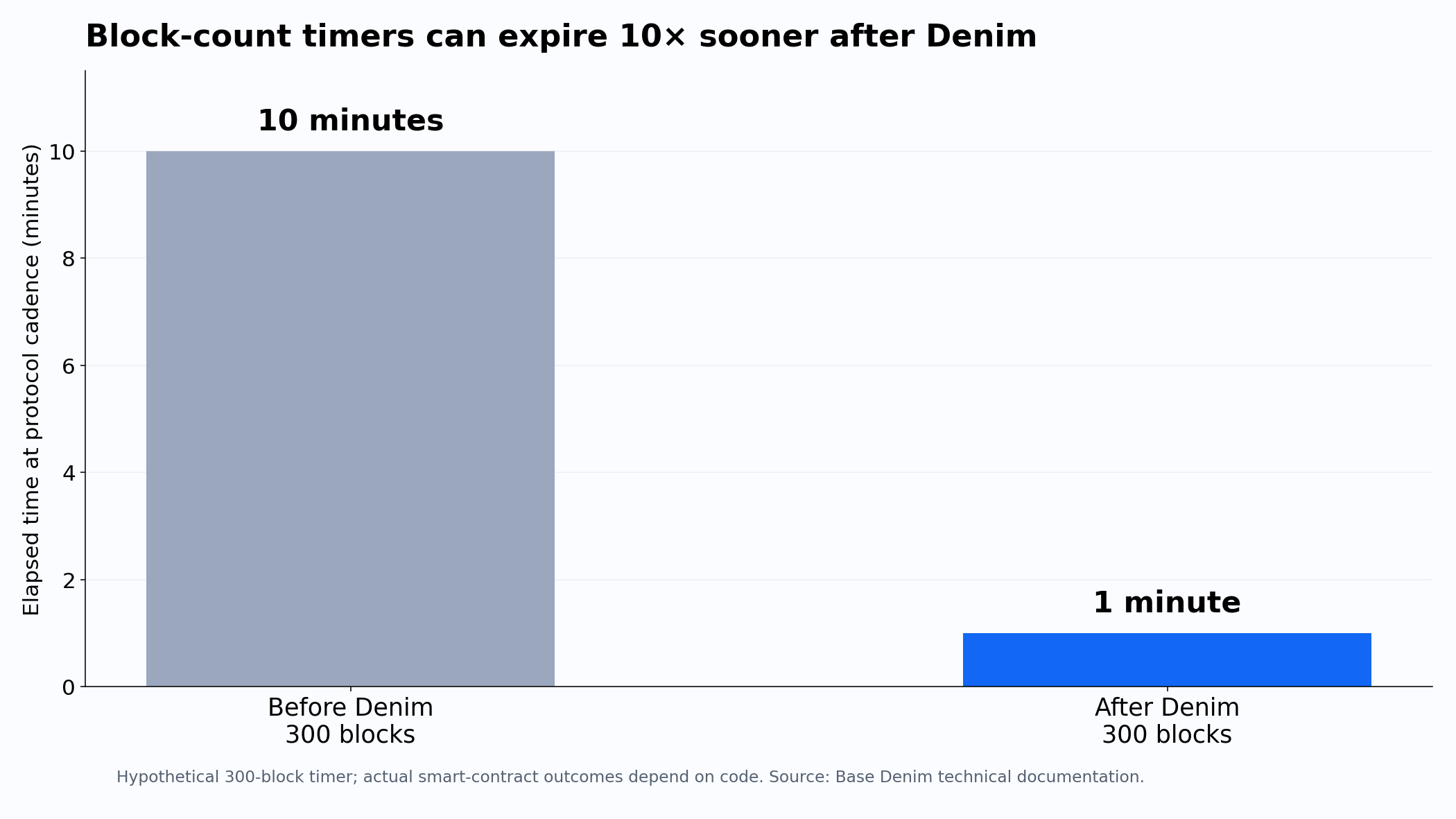
The most immediate smart-contract risk comes from time measured in block counts. A hypothetical 300-block delay formerly represented approximately ten minutes; after Denim, 300 blocks represent about one minute. Timelocks, vesting, voting windows, rate limits and oracle observation buffers can therefore behave differently even when their source code is unchanged. The official upgrade guidance recommends auditing those assumptions.
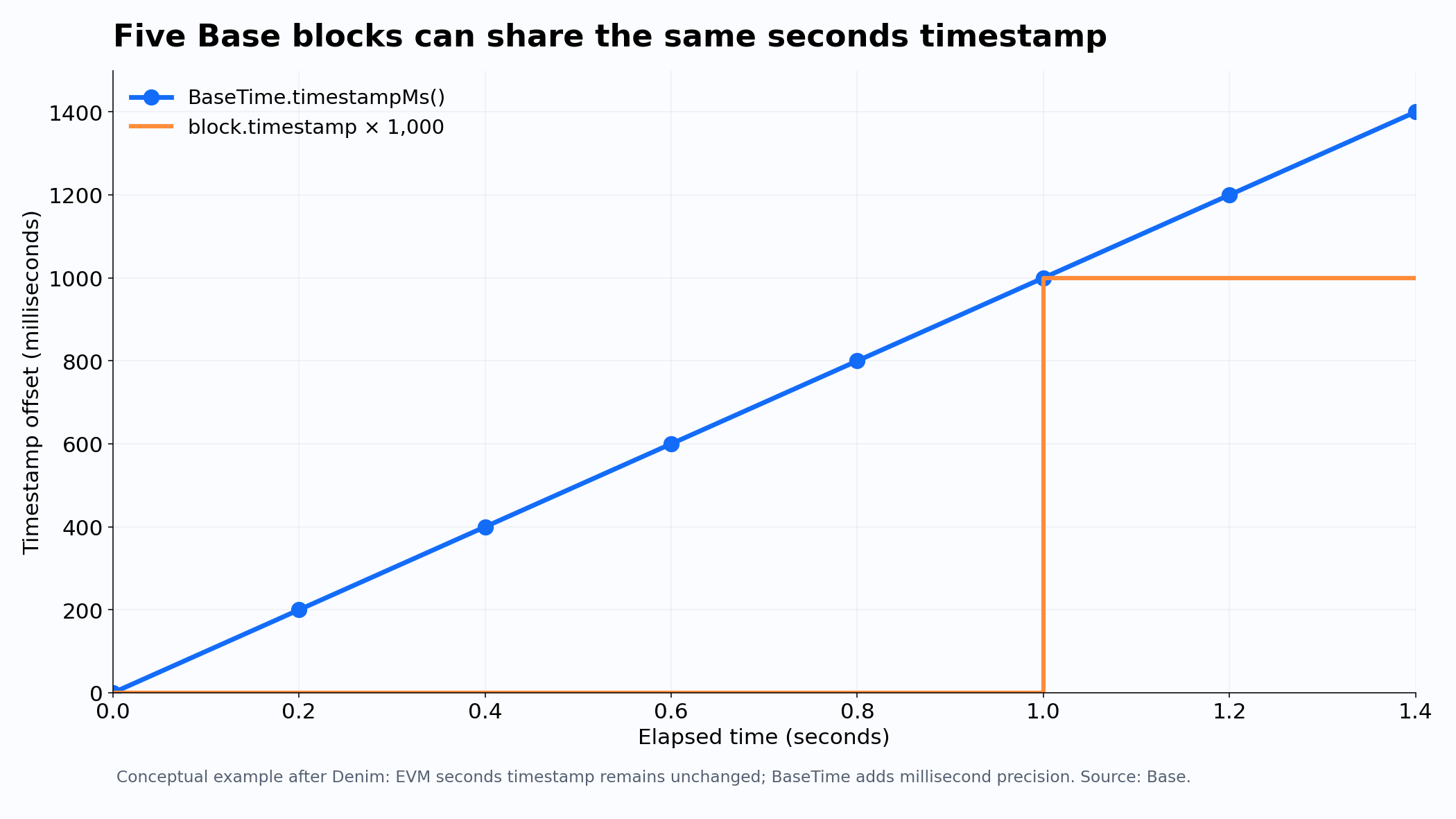
Base preserves ordinary Ethereum Virtual Machine `block.timestamp` at whole-second precision, while the new BaseTime system supplies millisecond-resolution timestamps through a dedicated predeploy and optional RPC fields. Five consecutive blocks can share the same whole-second timestamp. BitcoinVersus.Tech’s EVM and smart-contracts primer provides background on how contracts rely on execution context and state.
Token controls tighten, while operations face scrutiny
Denim also extends Base’s B20 token-policy tools. Issuers can invert reusable allowlists with a `NOT` operation, restrict direct token transfers to authorized initiators when such a policy is enabled, and prevent transfers to a token’s own address. Those are issuer-configurable controls, not blanket restrictions imposed on every wallet. Related developments include tokenized-stock transfer-agent infrastructure and fixed-rate decentralized lending.
Operational performance warrants caution. Base’s official status page reported periodic transaction-inclusion delays and elevated empty-block production following activation, even as block production continued. A separate node-maintenance notice addressed a possible state-root calculation issue: Base reported the actual chain root was correct, users were unaffected, and the v1.5.3 maintenance item was completed November 7 at 16:19 UTC. Node operators were urged to install the patch.
The engineering achievement is a more frequent canonical state update and simpler client integration—not a demonstrated tenfold increase in transaction throughput or a reduction in Ethereum finality time. Real-world benefits depend on application upgrades, transaction demand, node reliability and continued monitoring of inclusion delays.
Editor’s Note: Activation timing, 200ms canonical block design, Flashblocks retirement, BaseTime behavior and B20 policy changes were verified against Base Engineering’s November 5, 2026 announcement, official Denim upgrade documentation and Base’s status and maintenance reports checked November 7. The status page reported inclusion delays after activation and a v1.5.3 state-root safety maintenance item completed November 7. Cadence figures and hypothetical timer examples are calculations based on protocol settings, not measured transactions per second. The 1200 × 630 cover is an editorial illustration; the three charts are original sourced illustrations. Quicknode’s Flashblocks video documents the retired mechanism and is not a demonstration of Denim. WordPress iframe rendering does not independently verify playback, and independent public mobile and desktop visual checks remain outstanding.

To donate 5,000 sats, open the article on a separate display and scan the original QR code with a compatible Bitcoin wallet. On mobile, use another screen or your wallet’s supported image-scanning feature. Verify the destination 3C9o19EH5HSiwEPyCTmEKzxhNCbo2X6TTb before sending.
We volunteer daily to ensure the information on this platform is Verifiably True. If you would like to support the research, please scan QR code.
BitcoinVersus.tech is not a financial advisor. Cryptocurrency technology reporting is provided for informational purposes.


Leave a Reply