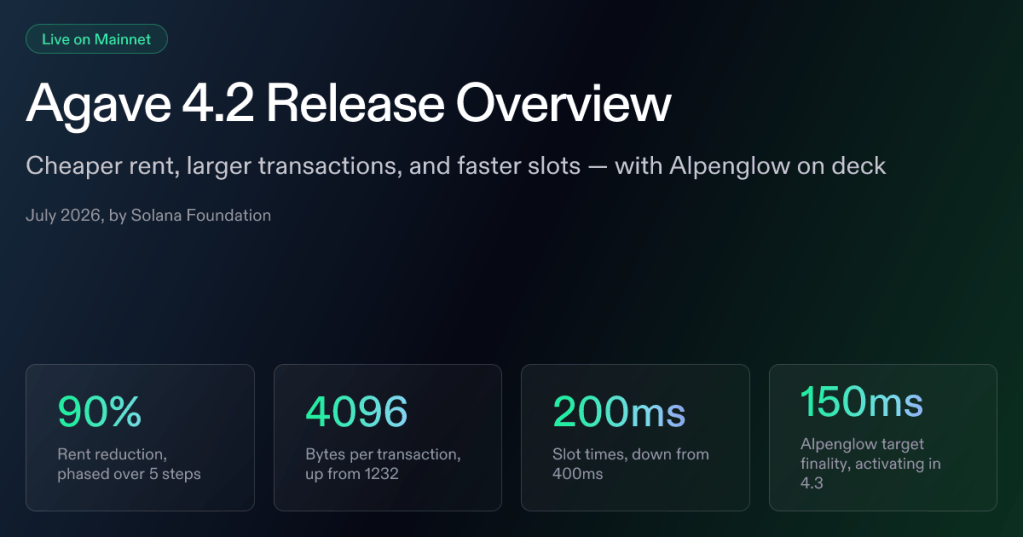
Solana has completed its staged reduction from 400-millisecond slots to a 200-millisecond target on mainnet. The final SIMD-0525 step took effect at epoch 1053 on October 9, 2026, after earlier moves to 350ms, 300ms and 250ms.
Blocks now get a production opportunity about twice as often as under the original 400ms target. That improves cadence and responsiveness, but it does not mean total transaction capacity doubled.
Anza, the team behind the Agave validator client, marked SIMD-0525 complete after the 200ms target went live.
What Changed
The Solana Foundation says all four reductions are now live on mainnet, devnet and testnet. A slot is the window in which a selected validator can produce a block, so reducing slot time gives transactions and state updates more frequent chances to enter the chain.
BitcoinVersus recently covered one example of why latency matters when Fiserv brought bank settlement infrastructure onto Solana.
Throughput Did Not Double
The SIMD-0525 specification scales per-slot work limits down with the shorter slot time. The baseline maximum block compute budget falls from 60 million compute units at 400ms to 30 million at 200ms. Smaller blocks arrive more often, keeping approximate compute capacity per second in the same range.
Leader Windows Are Shorter
Solana still assigns leaders four consecutive slots. At 400ms, that nominal window lasted 1.6 seconds. At 200ms, it lasts 800 milliseconds. The shorter window reduces how long one leader controls block production before the schedule moves on.
Blockhashes Expire in About 30 Seconds
The recent-blockhash window remains roughly 150 blocks, but 150 blocks now pass in about 30 seconds instead of about 60 seconds. Offline signing and delayed submission flows therefore have less wall-clock time before a blockhash becomes stale.
That kind of timing matters as stablecoins move deeper into payment infrastructure.
200ms Is a Target, Not Every Measured Block
Real slot times vary. Shortly after activation, Solana Explorer showed averages around 217–218ms rather than exactly 200ms. That is why skipped-slot rates and sustained real-world performance matter more than the nominal target alone.
Solana Foundation VP of Technology Jacob Creech pointed to Alpenglow as the next major milestone.
Alpenglow Is Next
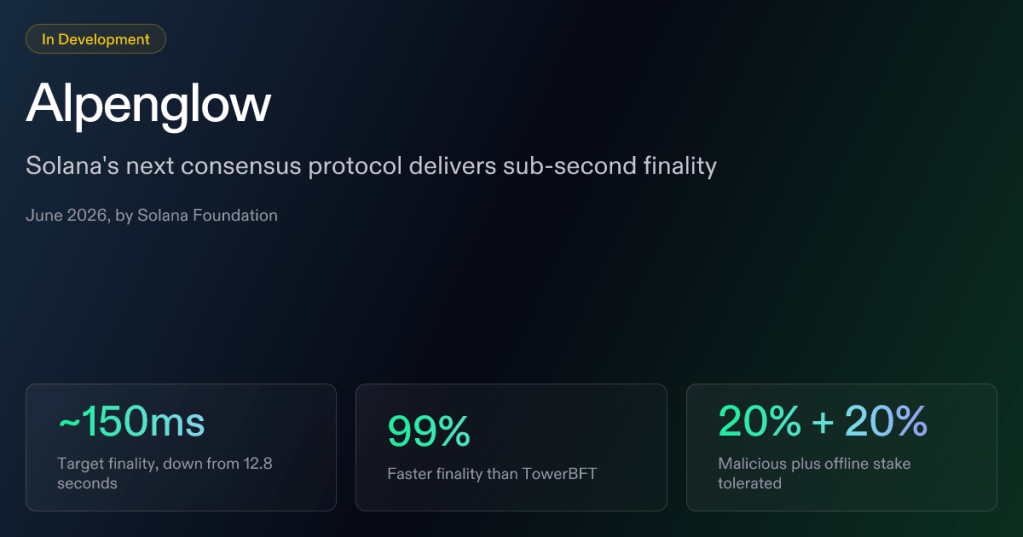
Slot time and finality are different. The 200ms change affects block-production cadence. Alpenglow is a broader consensus redesign targeting roughly 150ms finality under favorable conditions. Its mainnet activation date has not been announced.
Solana’s official presentation introducing Alpenglow explains the consensus redesign expected to follow the slot-time work.
Why It Matters
Faster state updates can matter for exchanges, market makers, oracles and payment systems. BitcoinVersus has also covered Citi and Coinbase connecting stablecoin payments with bank rails, where predictable latency and reliability matter as much as raw throughput.
What Is Confirmed
- The 200ms target is live on Solana mainnet.
- The staged path was 400ms → 350ms → 300ms → 250ms → 200ms.
- A nominal epoch falls from about 48 hours to about 24 hours.
- The four-slot leader window falls from 1.6 seconds to 800ms.
- Blockhash expiry falls from roughly 60 seconds to roughly 30 seconds.
- Per-slot compute limits were reduced, so block frequency doubled without automatically doubling total execution capacity.
- Alpenglow is next, with no announced mainnet date.
The milestone is best understood as a latency upgrade, not a throughput slogan. Solana is producing smaller blocks more frequently while changing the time assumptions applications and validators operate under.
BitcoinVersus.Tech
Editor’s Note: The 200ms figure is a target slot duration. Real measured slot times vary with network conditions. This article separates block cadence from throughput and finality.
We volunteer daily to improve the credibility of the information on this platform. If you would like to support the research, please donate here: 3C9o19EH5HSiwEPyCTmEKzxhNCbo2X6TTb
BitcoinVersus.tech is not a financial advisor. This media platform reports on technical and financial subjects purely for informational purposes.


Leave a Reply