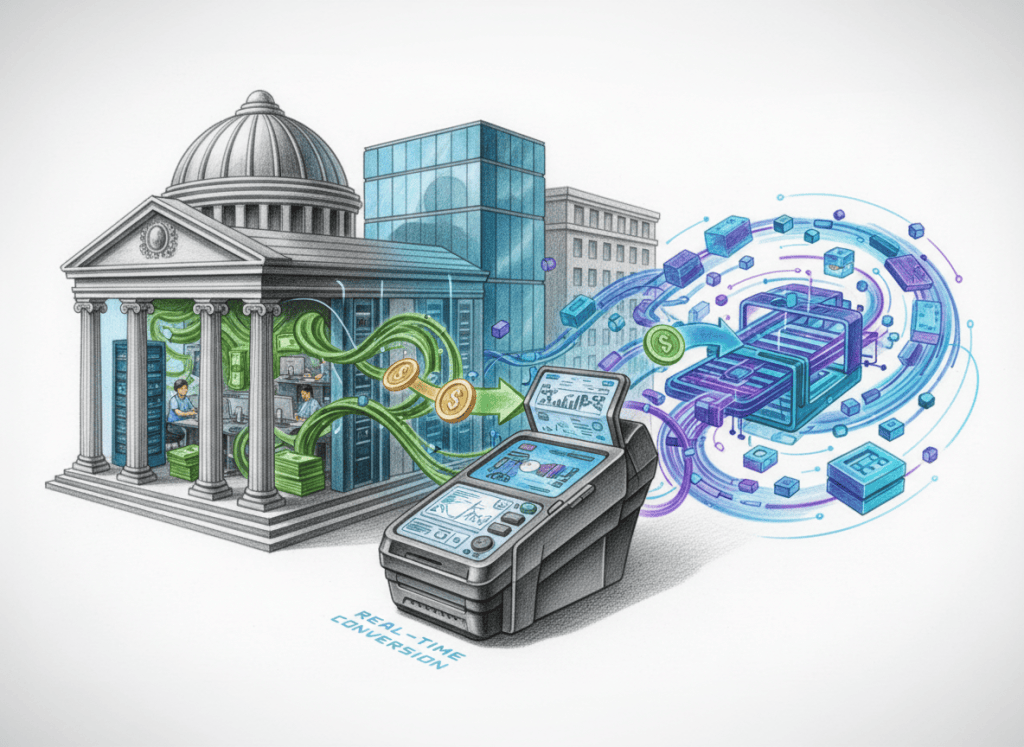
Citi and Coinbase are moving stablecoins closer to ordinary corporate payments by connecting bank-grade fiat infrastructure directly to blockchain payment rails.
The expanded collaboration creates two complementary paths: businesses using Coinbase can receive fiat through Citi-powered virtual accounts that automatically convert incoming funds into stablecoins, while Citi institutional clients can accept stablecoin payments at checkout through Spring by Citi with Coinbase powering the digital-asset side.
The important change is that merchants do not need to hold crypto
According to Citi’s September 28 announcement, Spring by Citi will let institutional clients accept stablecoin payments while Coinbase handles the blockchain payment layer and Citi settles the resulting fiat as the bank of record.
That architecture removes one of the biggest operational barriers to stablecoin adoption. A merchant can accept a digital-dollar payment without building its own custody stack, managing blockchain wallets, or carrying stablecoins on its balance sheet after the transaction.
In the opposite direction, Coinbase Virtual Accounts use Citi’s banking infrastructure to give businesses bank-account-like functionality while automatically converting incoming fiat into stablecoins.
Coinbase describes it as a two-sided infrastructure stack
Coinbase Institutional summarized the structure in an official X post: Citi supplies regulated fiat infrastructure on one side, while Coinbase supplies digital-asset payment rails on the other.
Coinbase Developer Platform provided the implementation view in a second post, emphasizing automatic fiat-to-stablecoin conversion for Coinbase Virtual Accounts and stablecoin acceptance for Citi institutional clients.
This is an expansion, not the beginning of the partnership
The Block’s independent report notes that Citi and Coinbase first announced a collaboration in 2025 around fiat-to-crypto payment infrastructure. The September 2026 expansion turns that earlier relationship into more specific business-facing products.
That distinction matters because financial infrastructure announcements often spend years in pilot mode. Here, the companies are describing concrete account and merchant-payment functions rather than a vague exploration of blockchain technology.
Stablecoins are being absorbed into conventional finance
BitcoinVersus has been tracking the same convergence from several directions. Fiserv recently brought bank settlement onto Solana through Roughrider Coin, showing how traditional processors are beginning to support tokenized money directly.
Regulators are also defining the boundaries. The Federal Reserve has proposed GENIUS Act stablecoin rules that would shape how issuers and financial institutions operate inside the U.S. market.
And the shift goes beyond payments. The SEC has opened a path for tokenized U.S. stocks to trade onchain, extending the same infrastructure debate into securities.
The competitive advantage may be abstraction
The most important part of the Citi-Coinbase design may be that the end user does not need to understand which rail is moving the money. A business can interact with an account or checkout flow while the underlying system moves between fiat and stablecoins automatically.
That is how payment technology usually becomes mainstream. Consumers did not need to understand card-network clearing, correspondent banking, or automated clearing houses before using them. The infrastructure disappeared behind the interface.
Stablecoins are becoming a back-end option, not a separate financial world
The Citi-Coinbase expansion suggests that stablecoin adoption may happen less through companies abandoning banks and more through banks quietly integrating blockchain settlement underneath familiar financial products.
If that model scales, the distinction between “crypto payments” and “bank payments” becomes less useful. The customer may see one interface while regulated bank rails and blockchain rails cooperate behind it.
BitcoinVersus.Tech
Advertisement
Editor’s Note
We volunteer daily to ensure the credibility of the information on this platform is Verifiably True.
If you would like to support to help further secure the integrity of our research initiatives, please donate here: 3C9o19EH5HSiwEPyCTmEKzxhNCbo2X6TTb
BitcoinVersus.tech is not a financial advisor. This media platform reports on financial subjects purely for informational purposes.


Leave a Reply