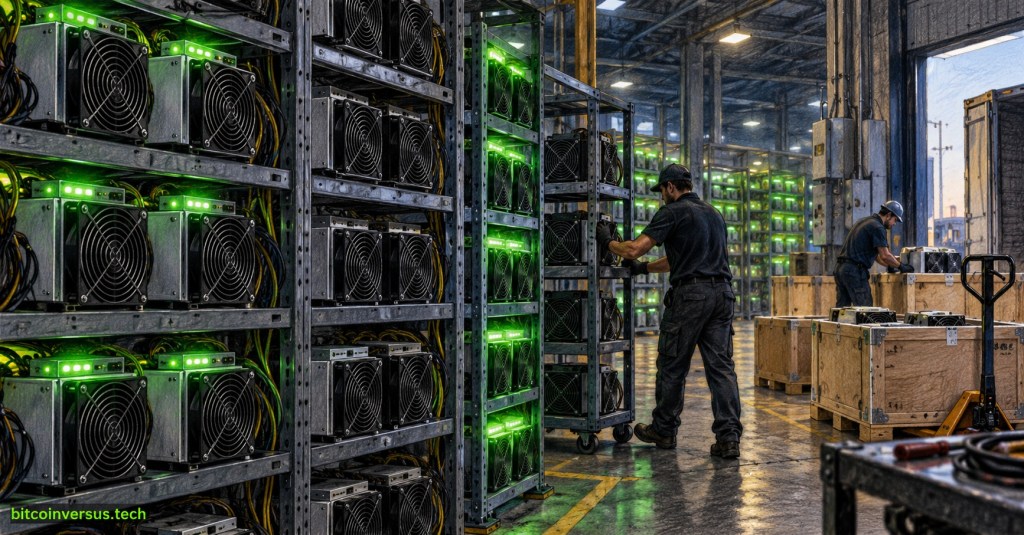
Crypto Blockchain Industries says 150 Antminer S21+ Bitcoin miners at its Missouri site were unable to operate during September 2026, produced no Bitcoin, and will likely need to be relocated. The October 8 disclosure gives the outage unusual weight because it separates the cost of electricity from the cost of lost uptime: CBI says it is not paying power for the idle machines, but the fleet is also generating no mining revenue while it sits offline.
The incident is a useful reminder that a modern ASIC miner can be perfectly valuable hardware and still be economically stranded when the surrounding site, power, hosting, or infrastructure cannot keep it hashing. For a mining business, uptime is not a side metric. It is the bridge between purchased hashrate and realized revenue.
What CBI Reported
In its October 8 mining update, CBI said a technical problem prevented 150 S21+ servers from operating at its Missouri site during September. The company did not identify the failed component, the exact duration of the outage, a repair completion date, or a confirmed destination for the machines. It did say relocation is likely.
That last detail matters. A pure machine-level failure might point toward hashboards, power supplies, control boards, thermal sensors, firmware, or networking. BitcoinVersus has separate repair guides covering Bitmain control boards and miner power supplies. CBI’s statement, however, does not say the 150 units themselves are defective. Because relocation is being considered, the operational problem may sit elsewhere in the hosting chain. The company has not provided enough detail to say more.
Zero Power Cost Does Not Mean Zero Outage Cost
CBI says it does not pay electricity for the offline machines. That protects the company from burning power on idle hardware, but it does not restore the missing Bitcoin production. Mining economics are ultimately driven by how much useful hashrate reaches the network, how long that hashrate stays online, and the revenue earned per unit of compute.
That is why hashprice and uptime belong in the same operational conversation. A machine can have competitive joules per terahash and still produce nothing during an outage. BitcoinVersus’ latest efficiency explainer made the same broader point from another angle: an ASIC’s J/TH is not the same as the site’s realized efficiency once cooling, electrical distribution, networking, downtime, and supporting infrastructure are included.
Grid Restrictions Were Already Pressuring the Month
The 150-machine outage was not CBI’s only September constraint. The company also said its Bitcoin-denominated mining return was lower than in August because access to the power grid was periodically restricted. That creates two different forms of lost production: planned or externally imposed power limitations, and a technical problem that left a specific group of miners unable to operate.
For operators, the distinction is important. Curtailment can be economically rational when power prices spike or grid programs compensate flexible load. Unplanned downtime is different: it removes revenue without necessarily delivering a corresponding market benefit. Earlier BitcoinVersus coverage of firmware-triggered mining pauses showed how even short interruptions matter when multiplied across a fleet. A month-long or relocation-scale disruption is a much larger operational event.
CBI Still Reports a Cash Mining Yield Above 16%
Despite the restrictions and outage, CBI says its annualized mining yield was above 16% as Bitcoin traded above $80,000. The company calculates that figure on a cash basis by comparing mining gross margin—Bitcoin received minus the monthly electricity bill—with the amount invested in the servers. It explicitly excludes accounting depreciation and the eventual resale value of the machines.
That definition matters. It is not the same thing as a fully loaded return on capital after depreciation, site overhead, financing, repair labor, logistics, and every other business expense. BitcoinVersus has covered this sensitivity before in Blockware’s mining-profit analysis and in its later report on slowing ASIC efficiency gains. The closer hardware performance gets across competing fleets, the more uptime, hosting quality, and power execution matter.
The Buyback Makes Mining Uptime a Capital-Allocation Issue
CBI also said it will allocate at least 25% of Bitcoin-mining profits to a share-repurchase program beginning October 12. The formal program section sets limits that convert to roughly $1.12 per share and about $1.12 million total at the October 8 EUR/USD rate. The program is scheduled to run through March 31, 2027, subject to blackout periods around financial reporting.
The company’s English release contains an internal inconsistency: an earlier bullet says the maximum purchase price is $1 per share, while the formal program language later uses a euro-denominated ceiling. BitcoinVersus therefore treats the formal program text as the controlling description and converts it to USD here rather than presenting the earlier bullet as settled. ASIC.tools independently flagged the same month-and-currency inconsistencies in its review of the filing.
Why Relocation Is the Next Number to Watch
CBI’s mining business operates through a long-term relationship with Blockware Solutions. Moving 150 machines is therefore not just a trucking exercise. A relocation can require new rack or shelf positions, electrical capacity, network addressing, pool configuration, firmware validation, airflow or cooling checks, commissioning, and post-move acceptance testing before a fleet returns to stable production.
Those layers are why rack-and-stack discipline and Stratum connectivity matter even in a story that begins with an apparent hardware outage. A miner only earns when power, cooling, firmware, networking, pool communication, and the physical site all work together.
What Comes Next
The next meaningful update is not CBI’s share price. It is whether the 150 S21+ miners return to service, where they are relocated, how long the transition takes, and whether the company identifies the original technical cause. Until then, the safest reading is narrow: the fleet was offline during September, it produced no Bitcoin while offline, CBI did not pay electricity for those machines, and management now expects relocation may be necessary.
For mining operators, the broader lesson is straightforward. Buying efficient ASICs creates potential hashrate. Keeping them powered, connected, cooled, monitored, and repairable turns that potential into Bitcoin.
BitcoinVersus.Tech
Editor’s Note: CBI did not disclose the specific technical fault affecting the 150 S21+ miners. BitcoinVersus has not inferred a failed component. USD equivalents for the buyback limits use the October 8, 2026 EUR/USD rate and are approximate.
We volunteer daily to improve the credibility of the information on this platform. If you would like to support the research, please donate here: 3C9o19EH5HSiwEPyCTmEKzxhNCbo2X6TTb
BitcoinVersus.tech is not a financial advisor. This media platform reports on technical and financial subjects purely for informational purposes.


Leave a comment