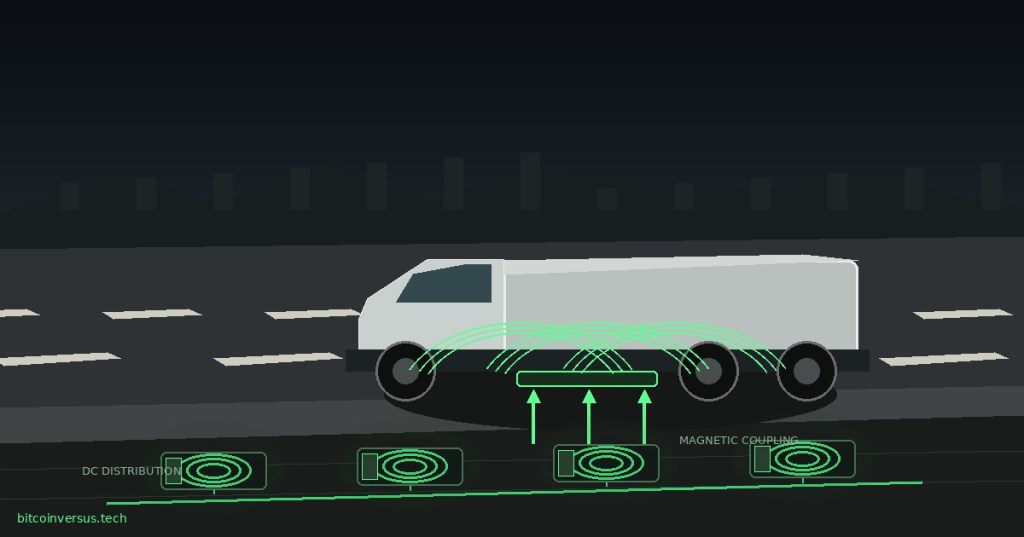
Honda wants part of the highway to become the charger. Honda R&D, Taisei and Taisei Rotec have developed the underlying technology for a dynamic wireless power transfer road system that can send electricity into an electric vehicle while it is moving, with future verification planned at power levels of up to 150 kW for large commercial vehicles.
The companies plan to begin public-road demonstration testing from Japan’s fiscal 2027 onward, meaning from April 1, 2027 at the earliest. The project adds a new option to the wider electric-vehicle charging problem: instead of making a truck stop beside a charger, put power electronics and transmitter coils beneath the road and move energy into the vehicle as it drives.
The road becomes part of the power system
Honda describes three main pieces. A ground-based DC power supply feeds a DC distribution network. Multiple ground assembly, or GA, units are embedded in the pavement. A vehicle assembly, or VA, receiver mounted underneath the EV captures power from the magnetic field generated by the road.
Each company owns a different part of that stack. Taisei is developing the responsive DC power supply. Honda is developing the DC-distribution GA system and vehicle-side receiver. Taisei Rotec is working on the road-construction methods needed to install the equipment into pavement that still has to behave like a road.
That last point is easy to underestimate. A charging road is simultaneously an electrical system, a civil-engineering structure and a piece of transportation infrastructure. Honda says the pavement and embedded hardware are being designed around large commercial vehicles with gross vehicle weights of roughly 20 tonnes.
Honda is putting the inverter inside each road unit
The most technically interesting part of Honda’s design is the ground assembly. Each GA unit integrates an inverter and a transmitter coil into one embedded dynamic-wireless-power-transfer module. A DC distribution architecture then links multiple modules along the roadway.
Honda calls this the world’s first publicly disclosed DWPT unit to integrate the inverter and coil in this way, but the footnote matters: that “world first” is based on Honda’s own research and is limited to this specific integrated-unit architecture as of the end of September 2026. Dynamic road charging itself is not new.
The reason to distribute DC and perform conversion close to individual coils is practical as much as electrical. Honda says the approach simplifies wiring in embedded sections, reduces component and installation work, and supports milling-and-embedding construction so the system can be added to existing pavement or incorporated into future resurfacing.
The next tests are about durability, leakage and 150 kW operation
Honda, Taisei and Taisei Rotec are moving from component development toward harsher road tests. Beginning in late 2026, the group plans a new test roadway at the Taisei Group’s T-FIELD/TAMRA facility. Honda says the program will include a durability test equivalent to one million wheel loads using a 49 kN load per wheel, wireless-transfer testing and evaluation of electromagnetic-field leakage countermeasures.
The companies then want to verify operation at power output levels of up to 150 kW for large commercial EVs and test whether power transfer remains reliable at high vehicle speeds. From fiscal 2027, they are also scheduled to participate in the Tateyama Project on the Tateyama Expressway in Chiba with NEXCO East.
Those tests are critical because a laboratory charger has a cooperative target. A highway coil does not. Vehicle speed, lateral position, ground clearance, pavement temperature, water, debris, repeated axle loads and coil alignment all become part of the power-transfer problem.
Purdue already showed why trucks are the hard case
Honda is entering a field that already has serious real-road demonstrations. In March 2026, Purdue University reported that a quarter-mile test section in Indiana transferred 190 kW to a heavy-duty electric truck traveling at 65 mph. Purdue described it as the first U.S. roadway to wirelessly charge a heavy-duty electric truck at highway speed.
The Purdue result is useful context for Honda’s 150 kW target. It shows that highway-speed magnetic charging at truck-scale power is physically achievable, while Honda’s project is concentrating on a different systems problem: packaging the power electronics into road modules, simplifying DC distribution, making the installation upgradeable and proving that the pavement survives long-term commercial traffic.
Why fleets could make more sense than passenger cars first
Honda says it initially sees dynamic wireless charging as especially useful for logistics and transportation. That makes sense economically even before a passenger car use case is proven. Freight routes are repetitive, vehicles accumulate many miles, charging downtime has an operating cost and a relatively small number of electrified road segments could serve a large number of fleet vehicles.
It also changes the battery-sizing question. Purdue researchers argue that reliable in-motion charging could let some trucks carry smaller batteries, reducing battery mass and freeing capacity for cargo. That is the same basic tradeoff behind many emerging charging strategies: BitcoinVersus.Tech recently covered Xos using mobile charging hubs to avoid waiting for permanent infrastructure and Germany treating EV batteries as grid assets through vehicle-to-grid rules.
Dynamic charging pushes that idea further. The vehicle, road and grid stop being separate systems. Power availability becomes part of route planning, road maintenance and fleet scheduling.
The unanswered question is cost
The engineering is only half of the story. Reuters reported that a Honda engineer declined to compare the system’s cost with a conventional high-speed charging network, saying economic viability still needs to be assessed.
That may ultimately decide where dynamic charging is practical. Electrifying every road would require enormous construction and grid investment. Electrifying selected freight corridors, ports, bus routes or steep high-utilization segments is a much narrower proposition. The winning deployment model may therefore look less like “every highway becomes a charger” and more like strategically powered lanes where utilization is high enough to justify the infrastructure.
Battery technology will also keep moving. Higher energy density can reduce the need for road charging, while faster charging can reduce the penalty of stopping. BitcoinVersus.Tech’s look at why battery energy density remains a hard constraint for electric aircraft shows the broader engineering tension: infrastructure can compensate for battery limits, but infrastructure has its own cost, weight and maintenance burden.
What comes next
The next milestones are concrete. Honda’s partners need to show that embedded modules survive heavy traffic, electromagnetic leakage stays within acceptable limits, 150 kW transfer is stable, high-speed alignment remains reliable and the construction method can be maintained without turning every repair into a major road closure.
If those tests work, the Tateyama Expressway demonstration will move Honda’s design from a controlled test track toward the messier environment that matters: a real public road carrying real vehicles. The technical question is no longer whether electricity can cross an air gap into a moving truck. The harder question is whether the road, vehicle and power system can do it reliably enough—and cheaply enough—to become infrastructure.
Editor’s Note
We volunteer daily to ensure the credibility of the information on this platform is Verifiably True. If you would like to support our research initiatives, donations can be sent to: 3C9o19EH5HSiwEPyCTmEKzxhNCbo2X6TTb
BitcoinVersus.tech is not a financial advisor. This media platform reports on financial and technology subjects purely for informational purposes.


Leave a comment