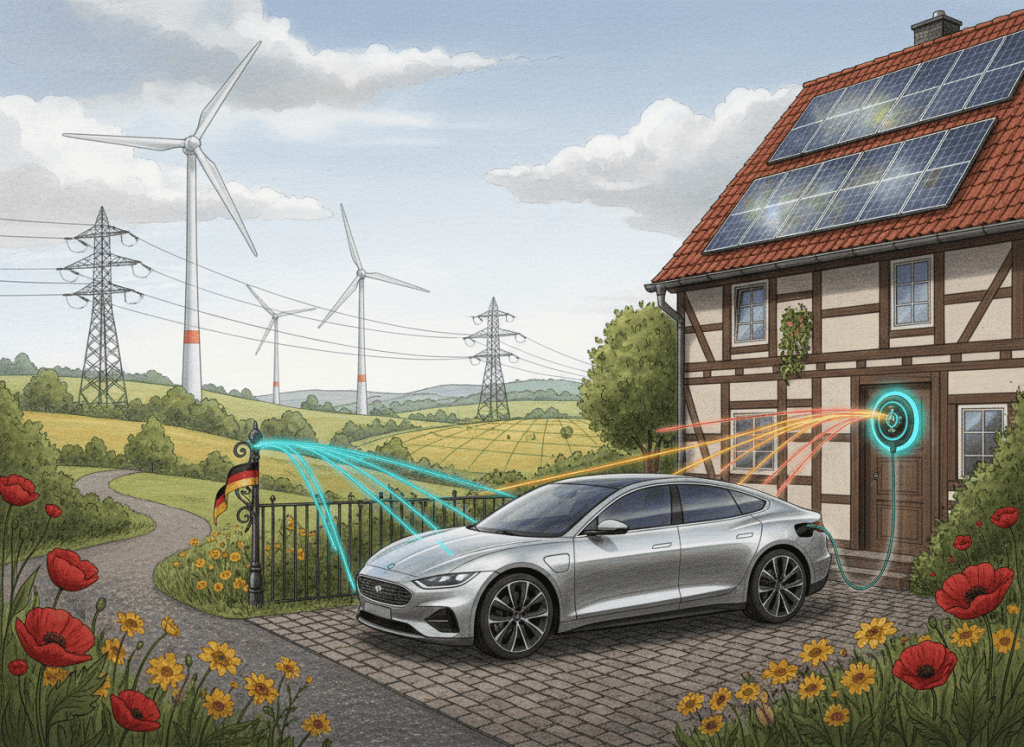
Germany has taken a major step toward turning parked electric cars into working pieces of the power grid. New market-integration rules from the Bundesnetzagentur create a clearer path for batteries and bidirectional charging points to move electricity in both directions without losing the treatment available to eligible renewable power.
Reuters reported that the October 1 decision allows EV owners to use vehicle batteries to supply their homes or send electricity back into the grid. Germany’s auto-industry association, the VDA, called the removal of double charges for electricity a crucial step toward a mass market and said simpler metering is still important for broad adoption in its official MiSpeL statement.
The car battery becomes grid infrastructure
Vehicle-to-grid, or V2G, flips the normal EV relationship with electricity. Instead of only consuming power, a compatible car can charge when electricity is plentiful or inexpensive and discharge later when a home or the wider grid needs it. That turns millions of parked batteries into a potential distributed storage fleet rather than idle hardware.
The basic concept has been discussed for years. In a widely shared V2G discussion on X, energy-system researchers highlighted how electric cars could act as buffer storage for the grid. Germany’s new rules matter because regulation and metering have been among the barriers separating that technical possibility from routine commercial use.
Why the rule change matters
A flexible battery is most valuable when it can respond to changing grid conditions. An EV can absorb surplus solar or wind generation, support a home during expensive periods and potentially return electricity when system demand is high. The same flexibility increasingly defines stationary storage, including the large projects covered in BitcoinVersus.Tech’s report on Energy Vault’s eight-hour Stoney Creek battery.
The bigger story is convergence. Cars, home chargers, smart meters, tariffs and utility software are becoming parts of one energy system. That mirrors the broader push to treat flexible electrical loads as grid assets, an idea also explored in our coverage of Crusoe’s plan to make AI data centers grid assets.
The grid is becoming more distributed
Germany’s move does not instantly make every EV a power plant. Compatible vehicles, bidirectional chargers, communications standards, smart meters and market products still have to line up. But removing regulatory friction changes the economics of deploying that stack.
It also expands the meaning of energy storage. A grid increasingly supported by stationary batteries such as the systems discussed in our Tesla energy-storage coverage could eventually gain another storage layer from vehicles already purchased primarily for transportation.
If Germany can make metering, tariffs and interoperability simple enough for ordinary drivers, V2G stops being primarily a demonstration technology. The important shift is not that an EV battery can send power backward — engineers have known that for years. It is that the rules are beginning to treat that capability as something the electricity market can actually use.
BitcoinVersus.Tech
Advertisement
Editor’s Note
BitcoinVersus.Tech follows the intersection of energy, computing, infrastructure and open technology.
If you value independent technology reporting, consider supporting BitcoinVersus.Tech with a Bitcoin donation: 3C9o19EH5HSiwEPyCTmEKzxhNCbo2X6TTb
BitcoinVersus.tech is not a financial advisor. This media platform reports on financial subjects purely for informational purposes.


Leave a Reply