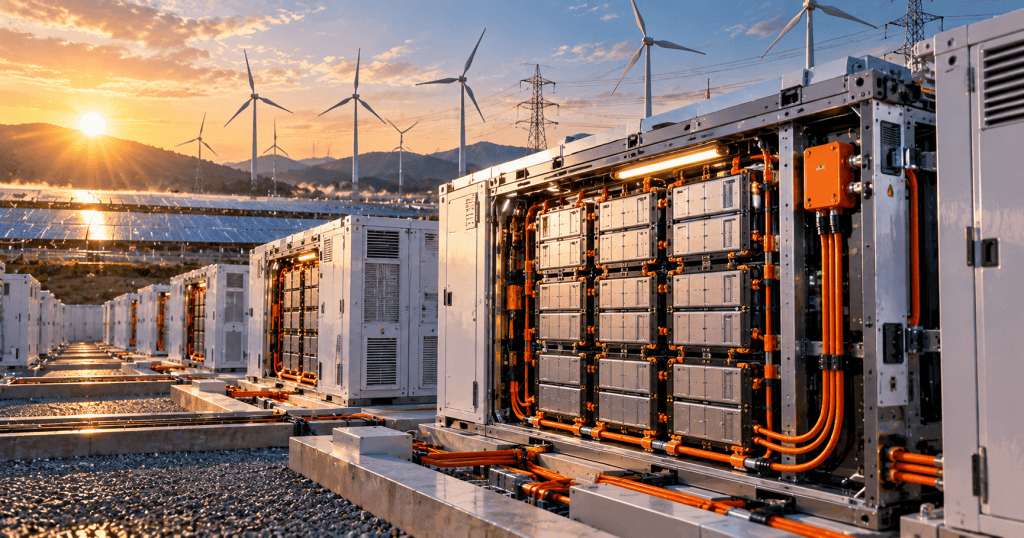
AI data centers are usually described as giant new loads that utilities have to somehow feed. Crusoe is pushing a different model: move the compute closer to the energy, then make the data center behave more like a flexible grid asset than a passive consumer.
In a September 28 energy infrastructure post, Crusoe described what it calls an “across-the-meter” architecture for AI campuses. The model combines co-located wind, solar, battery storage, and grid connections so compute can absorb energy that might otherwise be curtailed while still maintaining firm power for AI workloads.
Crusoe summarized the idea in a September 28 X post: bring compute to places where abundant energy already exists, rather than trying to move every electron long distances to traditional data-center hubs.
Curtailment Is Stranded Compute Fuel
Wind and solar farms sometimes produce more electricity than local demand and transmission infrastructure can absorb. When that happens, operators may have to curtail generation even though the equipment is capable of producing more power.
That problem is getting larger as renewable capacity grows faster than transmission in some regions. S&P Global reported that renewable curtailment across six major U.S. wholesale markets reached 23.8 million MWh through July 2026, up about 17.5% from the same period a year earlier.
Crusoe’s approach treats some of that constrained generation as a location signal. Instead of waiting for new long-distance transmission, a data center can be built near the generation source and convert electrons into computation locally.
Across the Meter Means the Campus Can Move Both Ways
The interesting part is that the campus is not simply disconnected from the grid. Crusoe describes a multi-resource design in which on-site renewables and batteries serve the AI load first, while the grid can supply incremental power when generation is insufficient.
When local generation exceeds campus demand, the excess can move in the other direction and flow back onto the grid rather than being curtailed. That makes the electrical boundary around the data center more dynamic.
BitcoinVersus.Tech recently covered Huawei’s grid-interactive AI data-center architecture, which reflects the same broader shift: data-center power systems are beginning to interact with utility infrastructure more intelligently instead of operating as isolated loads.
Batteries Become Part of the Compute Architecture
Battery storage is what helps connect variable renewable generation to a workload that wants stable power around the clock. A battery can absorb short periods of excess generation, discharge during ramps or grid events, and smooth the transition between local generation and grid supply.
That does not mean batteries replace the grid or eliminate backup generation. It means the energy stack becomes another layer of the AI system: generation, storage, grid import, grid export, and compute all have to be coordinated.
BitcoinVersus.Tech has already tracked this trend at hyperscale in xAI’s large Megapack installation behind Colossus 2. The more power-hungry AI campuses become, the more valuable fast-response storage becomes for smoothing demand and protecting the local electrical system.
The Data Center Starts Looking Like a Power Plant Control Problem
Once a campus has wind, solar, batteries, utility connections, backup generation, and highly variable compute demand, power orchestration becomes a software problem as much as an electrical one.
Operators have to decide when to charge batteries, when to discharge them, when to import from the grid, when to export surplus generation, and how much compute can be shifted without violating service requirements.
That same convergence is visible in projects combining utility-scale solar and storage. BitcoinVersus.Tech recently covered Linxon, Hitachi Energy, and FTC Solar pairing solar generation with battery infrastructure, the kind of electrical stack that increasingly sits beside large compute campuses.
Moving Data Can Be Easier Than Moving Power
Crusoe’s core argument is simple: high-capacity fiber can move data over long distances more easily than the grid can always move equivalent amounts of electrical power to where traditional data centers are located.
That flips the usual siting question. Instead of asking where a data center should be built and then searching for enough power, the operator starts with regions that already have abundant energy and asks whether the compute can be placed there.
The tradeoff is that remote energy-rich locations need networking, fiber diversity, cooling infrastructure, maintenance access, workforce, and enough grid support to keep the campus reliable during periods of low local generation.
AI Factories May Become Grid Assets
The most important part of Crusoe’s proposal is the idea that a data center does not have to behave like a fixed block of demand.
If the campus can absorb otherwise-curtailed generation, charge storage when supply is abundant, reduce grid draw when the system is stressed, and export surplus power when possible, then the electrical relationship becomes bidirectional.
That does not solve every data-center power problem. New generation, transmission, substations, cooling, batteries, and grid upgrades are still expensive and take time. But it changes the design target from “find enough power for the load” to “build compute as part of the energy system.”
As AI campuses move toward gigawatt scale, that distinction could become increasingly important. The next generation of data centers may compete not only on GPUs, networking, and cooling, but on how intelligently they can interact with the power around them.
BitcoinVersus.Tech
Advertisement
Editor’s Note:
We volunteer daily to ensure the credibility of the information on this platform is Verifiably True. If you would like to support our research initiatives, please donate here: 3C9o19EH5HSiwEPyCTmEKzxhNCbo2X6TTb
BitcoinVersus.tech is not a financial advisor. This media platform reports on financial subjects purely for informational purposes.


Leave a Reply