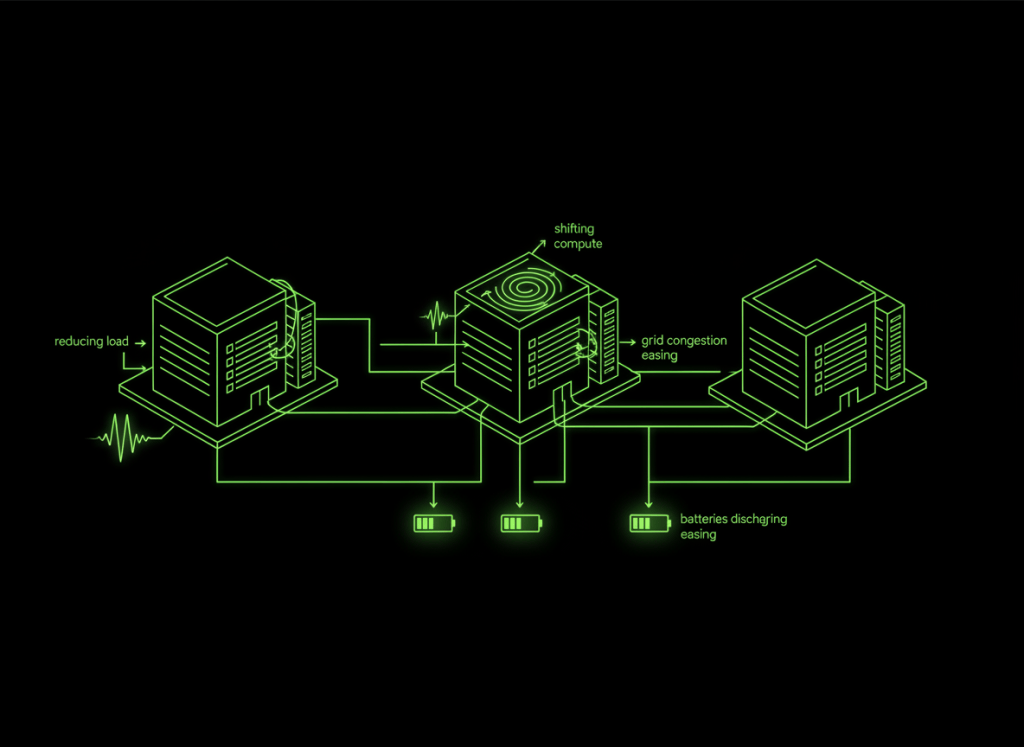
The next way to fit more AI onto the power grid may be to stop treating data centers like loads that can never move.
Google, NVIDIA and Emerald AI have launched the AI Energy Management Alliance, a coalition built around a simple idea: large AI data centers should be able to reduce, shift or temporarily reshape their electricity demand when the grid is constrained.
The target is up to 100 GW of additional grid capacity
In NVIDIA’s September 16 launch announcement, the alliance says flexible data centers can shift computing workloads, discharge storage, use paired generation or respond to grid contingencies instead of behaving like permanently flat loads.
The alliance argues that measurable flexibility could let utilities connect large AI facilities faster while making better use of infrastructure that already exists. Its broader goal is to create performance-based rules around response speed, duration, predictability and emergency behavior rather than prescribing one specific hardware or software stack.
Emerald AI founder and CEO Varun Sivaram announced the coalition in an X post, naming Google and NVIDIA as fellow founders and listing launch members spanning AI, utilities, power producers and grid technology.
Demand response is old. Applying it to AI factories is the new part
Utilities have used demand response for decades. Large industrial customers agree to reduce electricity consumption during stressed periods in exchange for compensation or better commercial terms.
AI infrastructure changes the mechanics. Some compute jobs can be delayed, shifted geographically or paused without shutting down an entire physical production line. Battery systems can also absorb short-duration grid events, while paired generation can reduce what a facility draws from the utility at critical moments.
TechCrunch reported that the alliance believes those techniques could create room for as much as 100 GW of additional data-center capacity on the existing grid. Anthropic is among the launch partners, alongside utilities and power companies including AES, Constellation, National Grid and NRG Energy.
The important word is “verifiable”
A data center promising to reduce load is not the same thing as a data center that can prove it will respond when the grid is under stress. That is why the alliance is emphasizing standardized technical requirements, operating data and measurable performance commitments.
The proposed model would define obligations before a facility connects: how quickly it can curtail, how long it can sustain that response, what happens during a contingency and what data the operator shares with the utility or grid operator.
Flexible compute could become an interconnection advantage
The incentive is straightforward. AI developers are increasingly waiting years for power, while utilities are being asked to build generation, substations and transmission around enormous projected loads.
If a data center can credibly cap its grid draw during a handful of stressed hours, utilities may be able to connect it without designing every piece of infrastructure around the facility’s theoretical maximum demand.
That idea connects directly with BitcoinVersus.Tech’s recent coverage of Crusoe arguing that AI data centers can become grid assets, Infineon and Skeleton using supercapacitors to absorb AI load spikes, and Project Star pairing dedicated generation with a 5 GW Texas AI campus.
This does not eliminate the need for new power
Flexible demand can improve grid utilization, but it does not make generation, transmission or substations unnecessary. AI campuses still consume enormous amounts of electricity, and not every workload can be interrupted at the exact moment the grid needs relief.
The more realistic promise is narrower: a facility that can behave like a controllable resource may be easier and cheaper to connect than one that insists on drawing its peak allocation every hour of the year.
AI infrastructure is learning to negotiate with the grid
The AI Energy Management Alliance is ultimately trying to turn flexibility into something utilities can value, measure and contract around.
If that framework works, the data center of the future will not simply ask, “How many megawatts can I get?” It will also answer a second question: “What can I give back when the grid needs help?”
BitcoinVersus.Tech
Advertisement
Editor’s Note
We volunteer daily to ensure the credibility of the information on this platform is Verifiably True. If you would like to support to help further secure the integrity of our research initiatives, please donate here: 3C9o19EH5HSiwEPyCTmEKzxhNCbo2X6TTb
BitcoinVersus.tech is not a financial advisor. This media platform reports on financial subjects purely for informational purposes.


Leave a Reply