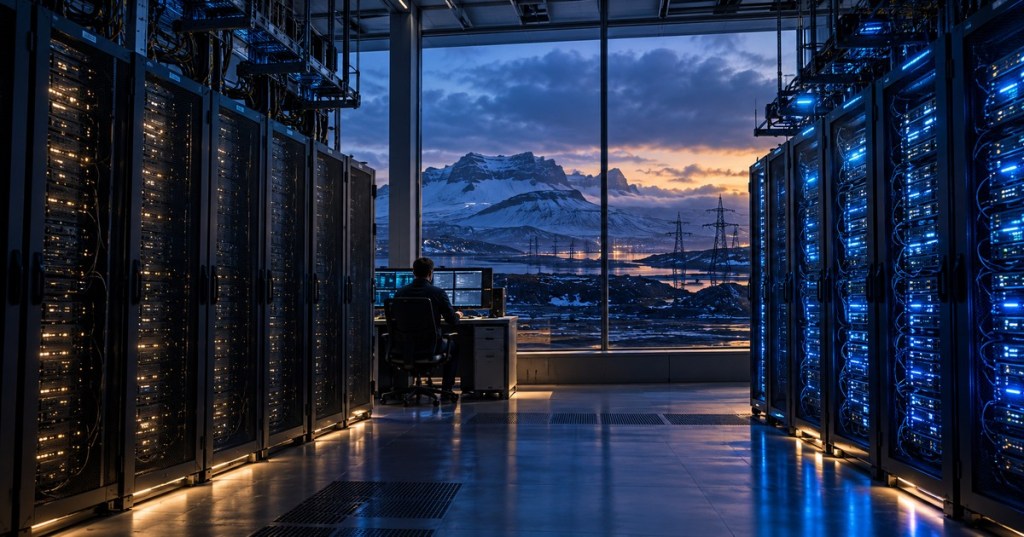
ICELAND, October 23, 2026 — Emerald AI says it briefly lowered electricity demand from AI server racks at Nscale’s Iceland facility by about 25% for 30 minutes, using its Conductor software alongside NVIDIA DSX power management. Announced at NVIDIA GTC Berlin on October 21, the pilot tested how an AI data center could respond to a utility-style request to reduce its load.
What the 25% Result Actually Measures
According to Emerald AI’s October 21 announcement, the racks reduced their instantaneous power draw, maintained the lower level for half an hour, and resumed normal operation. The event followed parameters consistent with EPRI Flex MOSAIC Class B. It used a simulated grid-demand signal; the company did not report an actual Icelandic utility dispatch.
That distinction matters: a 25% temporary power reduction is not a 25% permanent improvement in data-center energy efficiency. It does not by itself establish annual electricity savings, a lower facility-wide PUE, or unchanged performance for every workload. Public details do not specify the tested rack count or the starting rack load.
How the Power Controls Work
Emerald Conductor coordinates workload decisions with NVIDIA’s DSX controls so electrical demand can fall for a defined interval. In practice, lower-priority computations may have flexibility to slow or shift while time-sensitive inference services need tighter performance protection. Actual service levels depend on workload, policy and the available compute headroom.
NVIDIA’s separate Nscale case study reports a 49.2% rise in aggregate inference throughput within the existing provisioned power budget and an increase in managed GPU count from 140 to 192. Those capacity-utilization figures are a separate evaluation from the 30-minute grid-response event, so the percentages must not be combined.
Related video: nasscom explains Emerald AI’s earlier Arizona grid-flexibility test. It is background context, not footage of the Iceland pilot.
Why Bitcoin Mining Operators Will Recognize the Approach
Bitcoin miners have long treated electricity demand as a controllable operating variable: curtailment can be preferable when the grid is constrained or electricity prices rise. AI computing adds a different challenge because customers may depend on latency, availability and contracted throughput. The common engineering principle is dispatchable demand, not identical service requirements.
BitcoinVersus.Tech previously examined the Google, NVIDIA and Emerald AI flexible-load alliance, the grid delays affecting Nscale’s planned 50 MW UK project, and Texas power-demand rules for Bitcoin miners. Together, these stories show how power access, not simply chip availability, can shape computing investment.
Related social discussion: r/energy readers debated an earlier Emerald AI and NVIDIA grid-response demonstration in March. Their comments are opinion, not independent validation of the Iceland results.
What Needs to Be Proven Next
Longer tests, utility-supervised dispatches, published workload-performance measurements and deployment across larger numbers of racks would clarify how much reliable demand flexibility this system can offer. The Iceland result is a useful controlled demonstration, while claims about faster grid connections and lower electricity costs remain prospective until utilities and operators document those outcomes.
Key Takeaways
- Emerald AI reported about 25% lower AI-rack power demand for 30 minutes at Nscale’s Iceland facility.
- The trigger resembled a utility request; the announcement did not establish a live grid emergency or annual energy savings.
- Flexible AI workloads may help manage grid peaks, although customer-service requirements differ from Bitcoin mining.
BitcoinVersus.Tech Editor’s Note: We volunteer daily to ensure the credibility of the information on this platform is Verifiably True. If you would like to support to help further secure the integrity of our research initiatives, please donate using the QR code provided

For best QR-code scanning results, please scan this donation code from a desktop or larger screen. Mobile screens may prevent camera recognition.


Leave a Reply