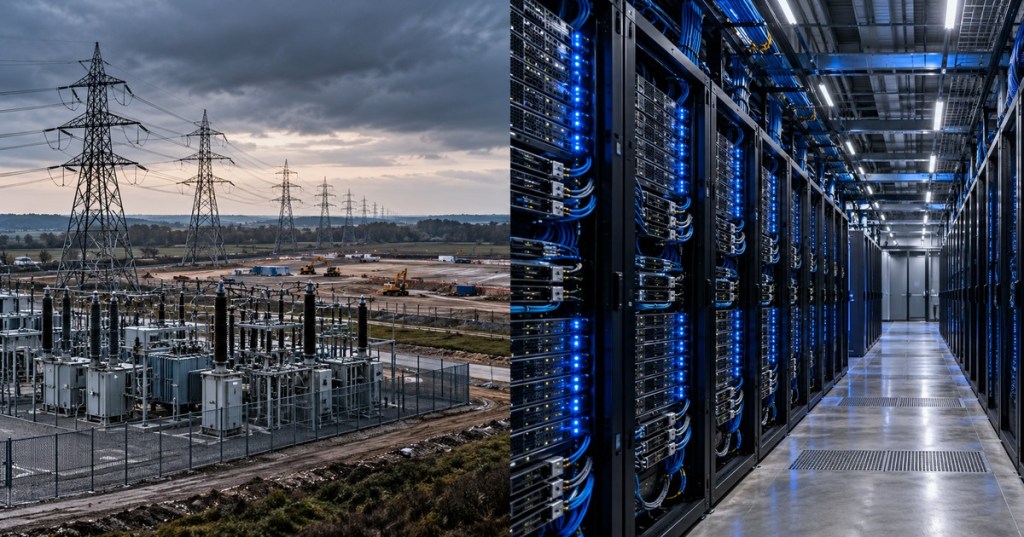
Microsoft has withdrawn as the anchor customer for Nscale’s planned 50-megawatt AI data center in Loughton, Essex, after delays reportedly pushed its electricity-grid connection into the 2030s. The October 19 confirmation concerns one UK location—not the companies’ broader partnership—and shows why securing a power connection can matter as much as acquiring GPUs.
The Site Was Designed for 23,040 GPUs
Nscale’s September 16, 2025 announcement described a 50 MW campus expandable to 90 MW, with 23,040 Nvidia GB300 GPUs expected in the first quarter of 2027 to support Microsoft Azure services. Reuters reported that grid officials now expect sufficient power only in the 2030s. Microsoft said its wider cooperation with Nscale continues, while Nscale said it is examining alternative energy supplies and other UK sites.
James Titcomb, who reported the original withdrawal, posted the October 18 development on X.
An independent topical video about the Nscale grid delay; the publisher discloses AI-generated narration and visuals.
What Bitcoin Mining Has to Do With It
Nscale grew out of Arkon Energy, which developed Bitcoin mining infrastructure. Its move toward AI computing illustrates how expertise in electrical systems, cooling, land and industrial data-center development can transfer between industries. BitcoinVersus.Tech previously covered Nscale’s proposed New York IPO and its $3.36 billion capital raise.
Yet business models differ. Some Bitcoin mines can curtail electrical load when power is constrained, while an AI cloud customer may require contractually specified availability and a firm delivery date. Read our analysis of Bitcoin mining as a flexible grid resource and our explainer on off-grid data centers for more on those engineering trade-offs.
The UK Connection Queue
British regulator Ofgem said in July that data-center applications accounted for about 73 GW in the electricity-connection queue. That figure describes requested future capacity, not operating facilities. Ofgem proposed commitment fees and project milestones to reduce speculative requests that can slow projects ready to connect.
Market discussion of the original 50 MW plan and the grid connection delay.
Public discussion of the UK’s data-center electricity challenge; reader comments are opinion, not independent verification.
What Happens Next?
The unresolved question is whether Nscale can secure dependable alternative power at Loughton—or find another anchor tenant. Neither outcome is confirmed. The immediate lesson is that planned GPU capacity and contracted computing capacity are not the same thing as electricity delivered to a working data center.
Key Takeaways
- Microsoft exited the Loughton site agreement, not the wider Nscale relationship.
- The original project envisioned 50 MW of capacity and 23,040 GPUs.
- Grid-connection availability remains a key AI infrastructure constraint.
BitcoinVersus.Tech Editor’s Note: We volunteer daily to ensure the credibility of the information on this platform is Verifiably True. If you would like to support to help further secure the integrity of our research initiatives, please donate using the QR code provided

For best QR-code scanning results, please scan this donation code from a desktop or larger screen. Mobile screens may prevent camera recognition.


Leave a Reply