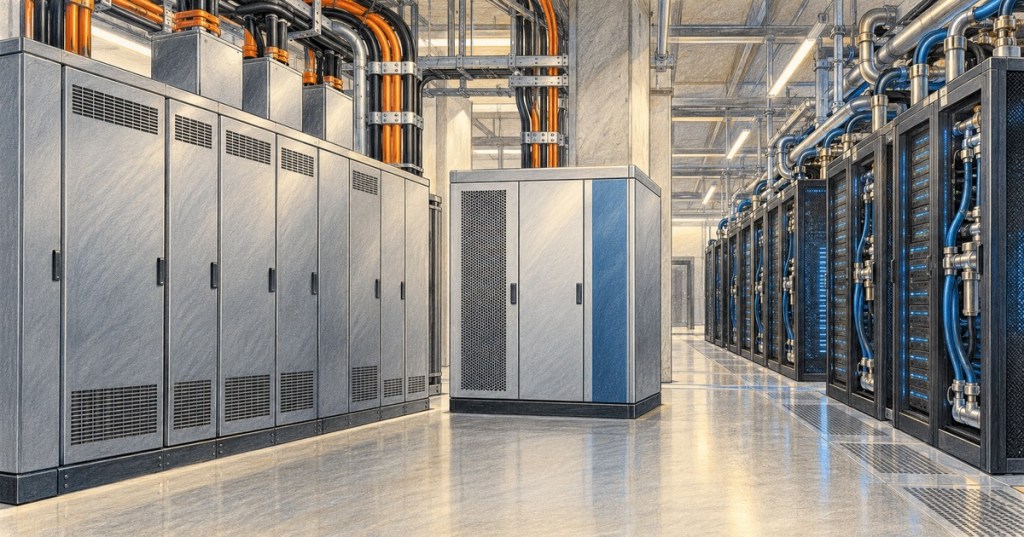
An AI data center needs more than enough electricity averaged over a day. Its power system also has to handle fast changes in demand. Infineon and Skeleton Technologies are targeting both problems through a September 2 agreement covering solid-state transformers and supercapacitor-based power buffers.
According to Infineon’s announcement, the companies signed a memorandum of understanding to explore and develop power architectures from the grid to the computing hardware. The planned work combines Infineon’s power semiconductors with Skeleton’s conversion systems and supercapacitors. It is a development agreement, not proof of a finished installation.
Conversion and buffering do different jobs
The transformer work targets conversion from medium-voltage alternating current to higher-voltage direct current using Infineon’s CoolSiC silicon-carbide devices. A separate strand pairs CoolGaN gallium-nitride devices with Skeleton’s supercapacitors for peak shaving.
Think of two separate jobs: a converter changes the electrical supply into the form the load needs; an energy buffer supplies or absorbs power during a change in demand. Combining them may help a facility handle bursts without sizing every upstream component solely around those bursts. Whether that works depends on the burst’s size, duration and repetition.
Independent Data Center Dynamics reporting identifies the memorandum as non-binding. It also describes Skeleton’s high-power storage as designed to respond to sharp load fluctuations in under a millisecond. That response figure describes the company’s system capability; it is not a published measurement of a jointly deployed Infineon–Skeleton installation.
A sidecar is not a substitute for unlimited energy
Fast response and long runtime are different specifications. A buffer can deliver substantial power briefly while storing far less energy than a system intended to sustain an entire facility through a long outage. Operators therefore need both a power rating and an energy or runtime rating before judging what it can support.
That makes this agreement distinct from Infineon and Eaton’s transformer-platform collaboration. Here, local storage and peak shaving are part of the development scope alongside conversion.
The transformer still needs a complete system
For visual background, SemiVision’s earlier SST overview on X illustrates the power-conversion concept. It predates this agreement and is included as explanatory context, rather than evidence that the new systems have shipped.
Conversion hardware is only one part of the electrical chain. Our report on SolarEdge and Infineon’s DC fault-protection work addresses a separate requirement: isolating faults. Storage does not remove the need for coordinated protection, suitable conductors and control systems.
Likewise, the one-megawatt SST tested on a live utility feeder shows why operating evidence matters. A collaboration announcement, a component test and a complete system running on a grid answer different questions.
What would make the agreement measurable?
The next useful evidence would be a defined system architecture, measured conversion efficiency across load levels, buffer power and usable energy, response during representative AI workloads, and validation of protection and recovery. Those results would let operators evaluate the proposal against their own electrical demands.
The engineering opportunity is to treat conversion and short-duration storage as a coordinated system. The September agreement establishes that direction. Its practical value will become clearer when the partners publish operating data.
BitcoinVersus.Tech
Advertisement
Editor’s Note
We volunteer daily to ensure the credibility of the information on this platform is Verifiably True. This report distinguishes announced development plans from verified deployments. The featured cover is an original AI-generated editorial illustration of data-center power infrastructure, not a photograph of either company’s equipment.
If you would like to support our research initiatives, please donate Bitcoin to: 3C9o19EH5HSiwEPyCTmEKzxhNCbo2X6TTb.
BitcoinVersus.tech is not a financial advisor. This media platform reports on financial subjects purely for informational purposes.


Leave a Reply