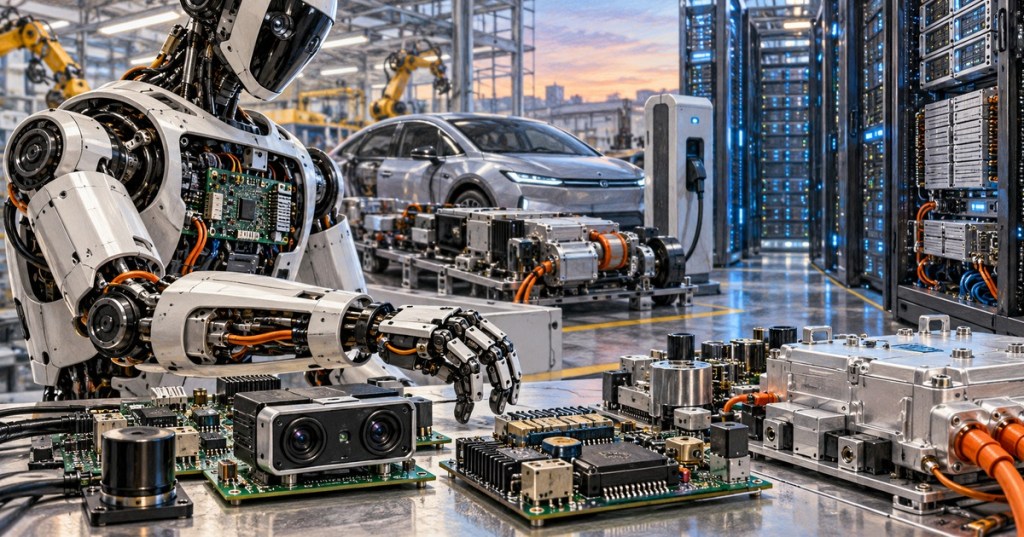
Infineon is using electronica 2026 to make a broad semiconductor pitch for Physical AI: chips and system designs that connect sensing, local AI, motor control, cybersecurity and power electronics across robots, vehicles and AI infrastructure.
The October 14 announcement says Infineon will demonstrate a live robotics application, edge-AI systems and a dexterous robotic-hand solution at the November 10–13 trade show in Munich. The company says its semiconductor stack covers the chain from perception and secure connectivity through compute, motor control and power. That fits the same shift toward hardware-level Physical AI described in our earlier coverage of GlobalFoundries’ FDX Fusion platform.
A recent robotics discussion points to Infineon as part of the semiconductor and embedded foundation underneath Physical AI systems.
One of the more concrete robotics demonstrations is a smart actuator using GaN motor control across seven degrees of freedom. Infineon also plans sensing demonstrations for robotic perception and dexterous hands. For vehicles, the company will preview a next-generation automotive microcontroller platform based on RISC-V for software-defined vehicles and other Physical AI systems.
The data-center side is equally important. Infineon’s event preview lists single- and three-phase power-supply boards, battery backup units using partial-power conversion with efficiency above 99%, intermediate-bus converters, eFuses, hot-swap controllers and solid-state power-distribution hardware. The company also says silicon, silicon carbide and gallium nitride devices can reduce losses in liquid-cooling pumps, fans and compressors. BitcoinVersus.Tech recently covered Infineon’s 27 kW three-phase AI server PSU and its supercapacitor work for AI load spikes.
Infineon’s COMPUTEX keynote explains its grid-to-core-to-Physical-AI power strategy, including Si, SiC and GaN devices.
The larger point is not that one new chip suddenly creates Physical AI. Infineon is showing how many semiconductor layers have to work together before autonomous machines can reliably sense, decide and act in the real world. electronica 2026 should provide a clearer look at which of those pieces are ready for deployment and which remain demonstrations.
BitcoinVersus.Tech Editor’s Note:
We volunteer daily to ensure the credibility of the information on this platform is Verifiably True. If you would like to support to help further secure the integrity of our research initiatives, please donate using the QR code provided

For best QR-code scanning results, please scan this donation code from a desktop or larger screen. Mobile screens may prevent camera recognition.


Leave a Reply