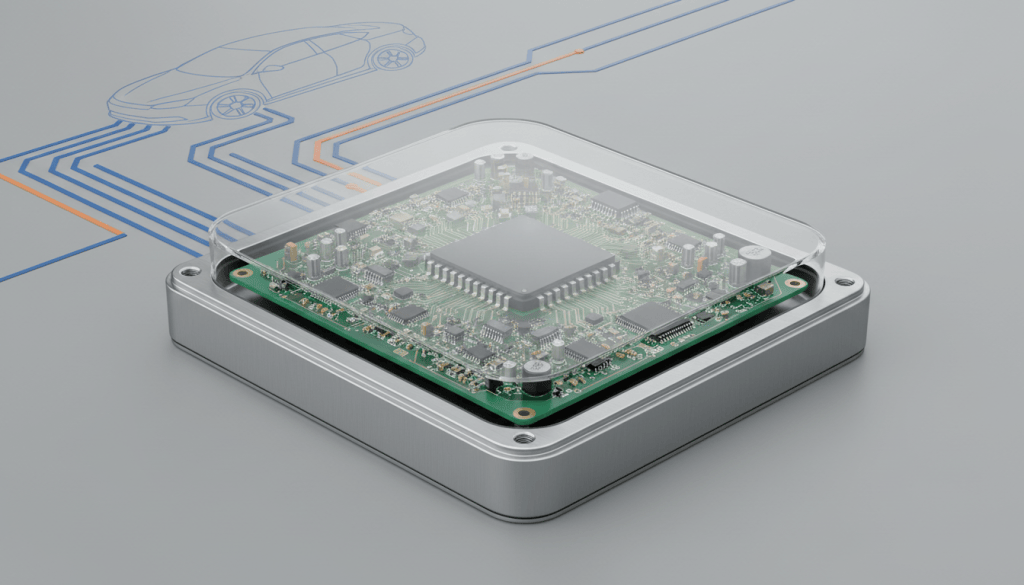
Infineon Technologies announced AURIX RC1 on November 4, introducing its first automotive microcontroller platform based on the open RISC-V instruction set. The company intends to show the family concept at the electronica trade fair in Munich from November 10 to 13 and targets initial engineering samples in the first half of 2027. The announcement advances the company’s previously outlined Physical AI strategy with a named chip architecture and a development timetable.
A microcontroller combines processor cores, memory and interfaces to perform embedded control tasks. Automotive controllers must respond predictably to events such as braking, battery faults and sensor signals. RISC-V supplies an open instruction set architecture, rather than a finished processor design. Chipmakers can build differentiated implementations while using a shared software foundation.
One platform across vehicle systems
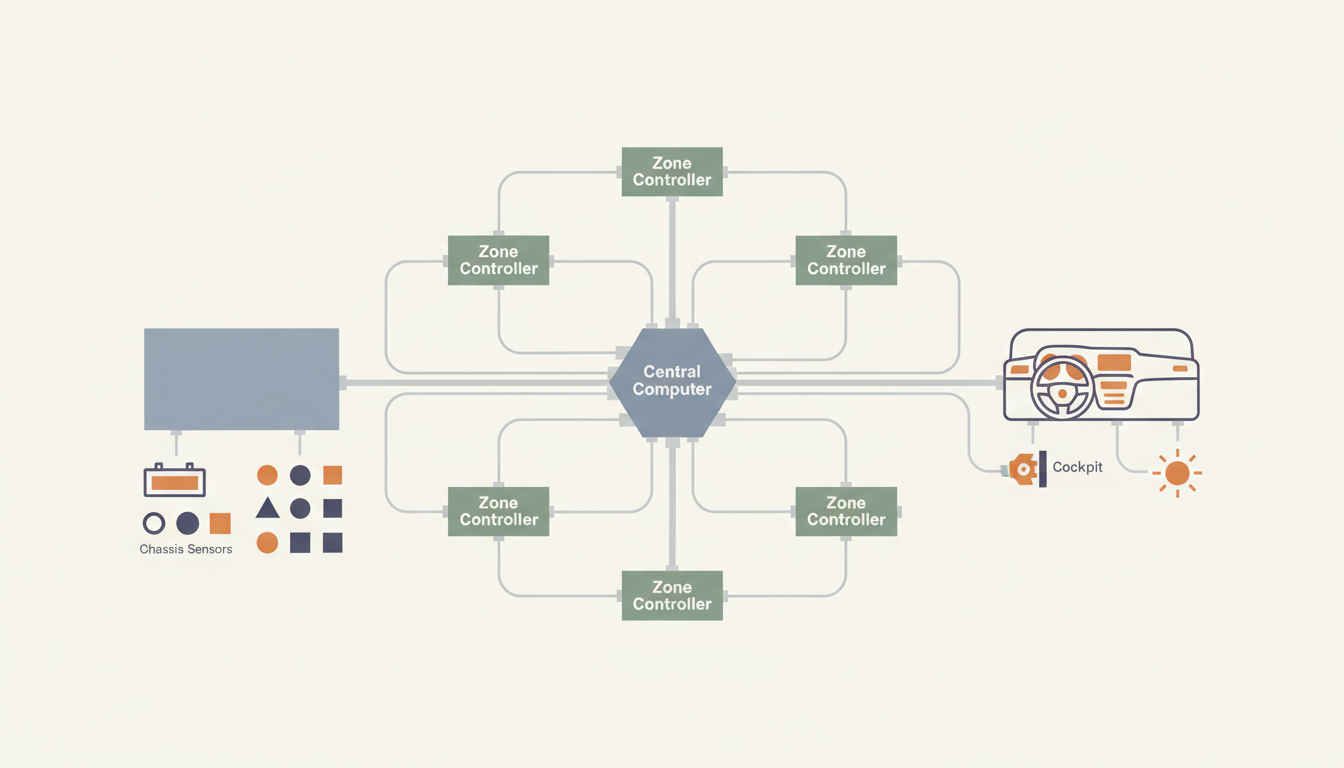
Infineon says the AURIX RC1 family will span body, chassis, powertrain, battery management, cockpit and safety-management functions. A common platform could help engineers reuse tools and software across separate vehicle domains. The company also plans hybrid devices combining microcontroller capabilities with 64-bit microprocessor functions as automakers consolidate computing into central and zonal architectures.
Selected configurations are planned to offer as many as 12 32-bit processing cores, up to 40 megabytes of embedded memory and a parallel processing unit for edge AI. The figures are announced design targets for a product family, not measurements from commercially shipping silicon. An earlier AUTOSAR integration effort illustrates how software compatibility can influence automotive controller selection alongside raw hardware specifications.
Networking, safety and security
AURIX RC1 is designed to support applications up to Automotive Safety Integrity Level D, the highest integrity level in the ISO 26262 automotive functional-safety framework. Infineon also identifies ISO/SAE 21434 cybersecurity engineering, crypto-agility and preparation for post-quantum cryptography as design priorities. Such capabilities require validation in finished devices and complete vehicle systems; a platform announcement alone does not establish a certified vehicle implementation.
The family is planned to support CAN XL, 10BASE-T1S and multi-gigabit Ethernet. Selected devices will integrate Ethernet switching and hardware-assisted routing, potentially reducing external components. Networking capabilities matter as manufacturers expand sensor and control traffic; industrial deterministic networking faces related requirements for bounded latency and dependable communication.
Development risks remain
Infineon is pairing the architecture with its DRIVECORE software ecosystem, including AUTOSAR, safety and security software. The company expects the shared architecture to reduce migration work. Actual benefits will depend on compiler maturity, tool qualification, device pricing, power consumption, application-specific performance and automaker testing. No independently measured RC1 benchmark or volume production date accompanied the announcement.
The move also differs from Infineon’s gallium nitride manufacturing expansion: GaN power components manage electrical energy, while AURIX controllers execute computation and real-time control. Both can be important in electrified vehicles, but they address distinct engineering functions.
Infineon’s November 4 announcement identifies first-half 2027 sampling as the next concrete milestone. Production availability, customer adoption and verified performance will determine whether the proposed consolidation benefits reach deployed vehicles.
BitcoinVersus.Tech Editor’s Note: We volunteer daily to ensure the credibility of the information on this platform is Verifiably True. If you would like to support to help further secure the integrity of our research initiatives, please donate using the QR code provided.

For best QR-code scanning results, scan from a desktop or larger screen. Verify the receiving address 3C9o19EH5HSiwEPyCTmEKzxhNCbo2X6TTb before sending.
Disclaimer: BitcoinVersus.Tech is not a financial advisor. This media platform reports on financial subjects purely for informational purposes.


Leave a Reply