PROCESSORS | NOVEMBER 25, 2026
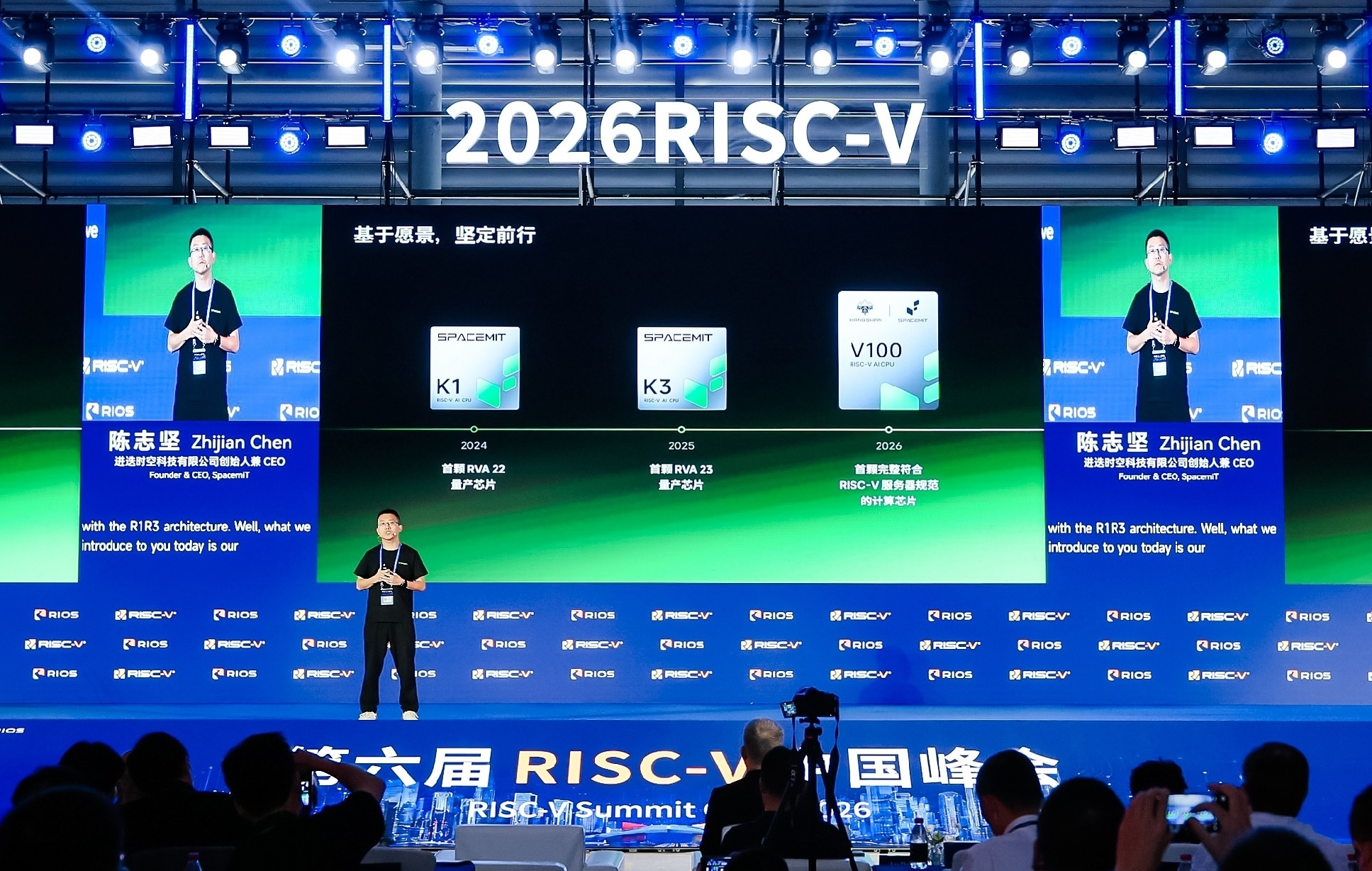
A new processor from SpacemiT expands the range of architectures available to server designers. Introduced at the RISC-V Summit China in October, the V100 combines 46 CPU cores with eight DDR5 memory channels and high-speed peripheral connectivity. The October 20 manufacturer announcement describes server platforms aimed at conventional computing, accelerator-hosting and storage workloads.
RISC-V is an openly specified instruction set architecture. A processor designer may implement compatible hardware without adopting a particular vendor’s microarchitecture. The distinction matters because multiple companies can develop independent CPU designs while sharing compilers, operating systems and applications.
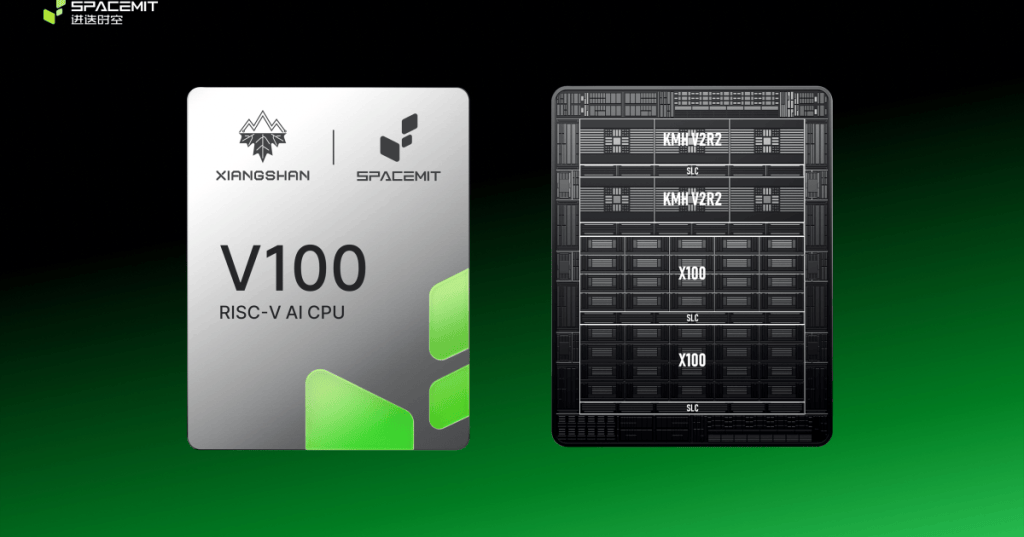
Two different core designs in one processor
The V100 product specifications identify two core types: six XiangShan Kunminghu V2R2 cores running at up to 2.1 GHz and 40 SpacemiT X100 cores running at up to 2.4 GHz. The heterogeneous layout also incorporates 64 MB of system-level cache.
Higher clock frequency alone does not establish which core completes more work. Instruction scheduling, execution resources, cache behavior and workload dependencies affect throughput. A scheduler must account for differences between core types when assigning latency-sensitive or parallel tasks.
The processor can be deployed in a dual-socket configuration, giving a system 92 cores. Cache coherence allows participating processors to maintain a consistent view of shared memory, but cross-socket traffic can introduce additional latency. Applications that distribute memory allocations intelligently may benefit from keeping data near the cores that use it.
A server designed to move data
Each socket provides eight DDR5 channels and 52 PCIe 5.0 lanes. Independent reporting by Phoronix identifies DDR5-4800 memory and a 12 nm manufacturing process. Eight channels running at 4,800 million transfers per second with a 64-bit data width yield a theoretical combined bandwidth of 307.2 GB/s, excluding protocol and workload effects. Measured application bandwidth will generally be lower.
SpacemiT’s G5201 accelerator server accommodates eight double-width accelerator cards, according to the launch announcement. A server can distribute accelerator connections using PCIe switches; physical card capacity does not imply that every device receives an independent full-width connection directly to one CPU.
For historical context, RISC-V International published the following report from its 2025 North American summit featuring SpacemiT. The video predates the October V100 launch.
Linux compatibility is as important as silicon
SpacemiT claims compatibility with the RVA23 profile and server boot specifications, along with upstream Linux KVM virtualization support. Standardized boot interfaces and upstream drivers can reduce the engineering work needed to deploy a different processor family. Compatibility still requires application binaries, firmware, device drivers and management software to be tested together.
Earlier BitcoinVersus.Tech coverage examined AMD ROCm on a SiFive RISC-V server, NUVACORE’s instruction-set-independent design strategy, Infineon’s automotive RISC-V platform and enterprise Linux security and management. Together, those developments illustrate the relationship between processor diversity and software portability.
The competitive test
The V100 introduces another option for server procurement, but the launch does not establish parity with contemporary Xeon, EPYC or Arm server processors. Buyers need independent measurements of workload throughput, power consumption at the wall, latency, memory bandwidth and total ownership cost. The meaningful milestone is a server-oriented RISC-V implementation with standard interfaces, rather than proof of industry-leading performance.
We volunteer daily to ensure the credibility of the information on this platform is Verifiably True. If you would like to support to help further secure the integrity of our research initiative, please scan the QR code below.



Leave a Reply