PROCESSORS | NOVEMBER 25, 2026
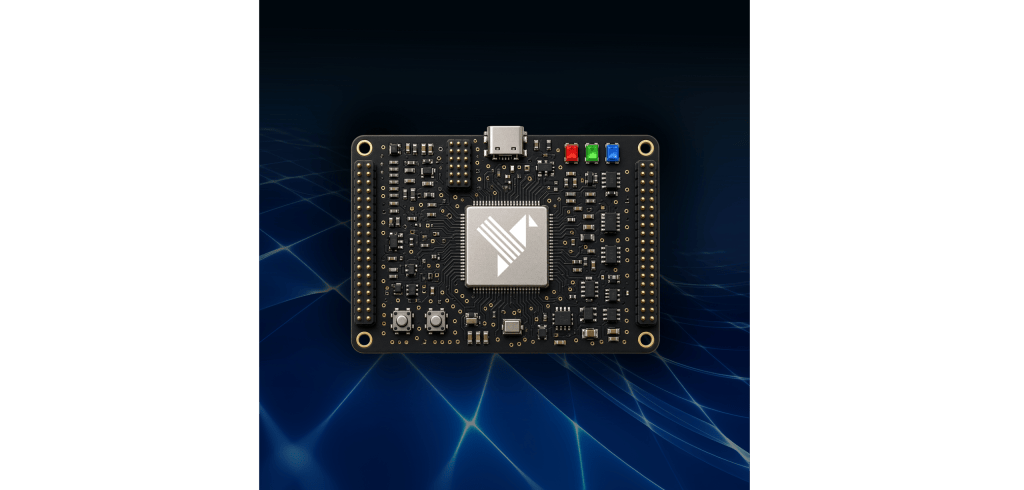
A robot’s central computer can decide where an arm should move, but every joint must translate that decision into controlled physical motion. MIPS, a GlobalFoundries company, is targeting the latter problem with its Actus reference platform, detailed on November 9 at electronica 2026. The platform combines real-time RISC-V processing, motor-control acceleration and industrial networking for compact actuators.
The development offers a contrast with efforts to increase AI inference performance in large central processors. At the joint, predictable timing, electrical efficiency and reliable coordination can matter more than peak arithmetic throughput. A November 24 report from the IoT M2M Council highlights the integration of intelligence and control within the actuator itself.
A processor for the control loop
Actus pairs two Atlas M8500 real-time microcontrollers with specialized arithmetic hardware. The RISC-V instruction set defines the software-visible operations, while the implementation determines how quickly and predictably the hardware handles events. Hardware multithreading allows an implementation to respond to separate execution streams without relying entirely on operating-system context switches.
Motor drives frequently use field-oriented control, a method that converts measured phase currents into a rotating reference frame. The resulting components allow a controller to regulate torque and magnetic flux. Repeated coordinate transformations involve trigonometric functions, making acceleration of those operations useful in a tight control loop.
MIPS reports more than a sixteenfold advantage for its trigonometric acceleration over standard trigonometric libraries in the cited motor-control workload. That figure describes a particular mathematical comparison, not a sixteenfold increase in complete robot speed or a measured reduction in total system energy.
Timing and intelligence in the joint
The Actus product description identifies a 512-bit ARC VPX vector coprocessor alongside the M8500 architecture. Vector processing enables multiple numeric elements to be processed together, supporting signal analysis and embedded inference. For example, a joint could use vibration measurements to help identify mechanical wear without transmitting every raw sensor sample to the central computer.
The motor-control circuitry includes high-resolution pulse-width modulation and analog-to-digital conversion. PWM adjusts the duty cycle of switching signals in a motor drive; finer timing control can improve regulation when supported by an appropriate power stage and feedback system. MIPS describes PWM resolution in the 100-picosecond class, which should not be confused with the response time of the complete mechanical system.
A network of coordinated actuators
Time-Sensitive Networking over gigabit Ethernet is another part of the platform. TSN provides mechanisms for predictable traffic delivery, allowing motion commands and feedback to share a network under configured timing constraints. Coordinated motion still depends on system-wide scheduling, clock synchronization and the implementation of each node.
BitcoinVersus.Tech has examined related architectures in Renesas’ industrial motor-control processor, Lattice and NXP’s FPGA-assisted robotics design, and Infineon’s automotive RISC-V platform. Each addresses different combinations of real-time processing, connectivity and application software.
From reference hardware to production
Actus uses GlobalFoundries’ FDX process technology, linking the processor design to the manufacturing ecosystem behind the company’s recent semiconductor expansion. The platform also supports security and functional-safety development. Support for safety requirements is not equivalent to certification of a finished robot.
The announcement describes a reference platform and development pathway, not verified mass deployment. Production evaluations should measure worst-case control latency, thermal performance, fault recovery, sustained energy consumption and the behavior of networked actuators under load. A successful design would make individual joints more capable while allowing the central AI processor to concentrate on higher-level decisions.
We volunteer daily to ensure the credibility of the information on this platform is Verifiably True. If you would like to support to help further secure the integrity of our research initiative, please scan the QR code below.



Leave a Reply