SpaceX has crossed a regulatory milestone in its effort to build artificial intelligence infrastructure in orbit. On November 25, 2026, Reuters reported that the Federal Communications Commission authorized its Starmind constellation of up to one million spacecraft. Our breaking news coverage examined the decision. A separate engineering question now deserves attention: how much launch infrastructure would a computing fleet of that scale require?
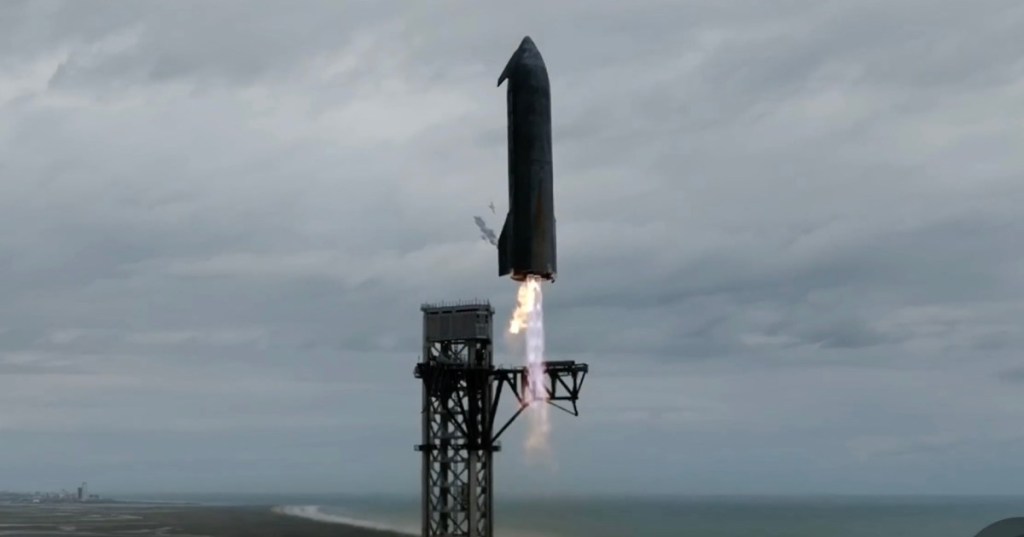
SpaceX’s May 2026 registration statement outlines a long-term objective of deploying 100 GW of orbital computing capacity annually. The goal is not a binding schedule, a commissioned power rating or a requirement imposed by the FCC. Featured photograph: a SpaceX November 2026 Flight 15 webcast frame illustrating Starship recovery operations.
Archived Space.com coverage of Starship Flight 14 on September 28, 2026. The mission carried broadband satellites, not Starmind computing modules.
Compute power per kilogram becomes a launch constraint
A terrestrial data center can receive server racks by truck. An orbital computing module must carry its processors, solar arrays, radiators, communications equipment, propulsion and structural hardware into space. The relevant system metric is therefore not simply processor efficiency. It is usable compute power per unit of launched mass, combined with the payload actually delivered into the required orbit.
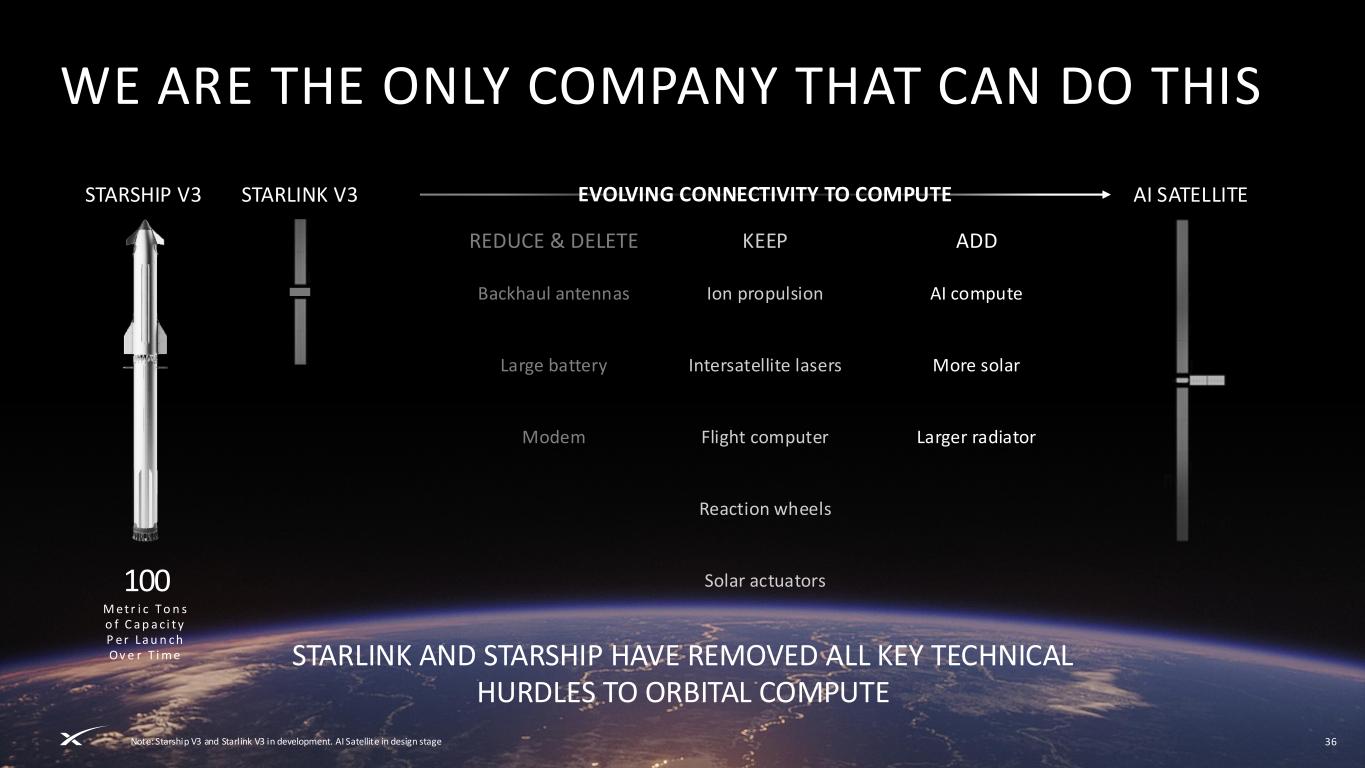
SpaceX’s registration statement uses a planning assumption of approximately 100 kW of compute power per metric ton and targets 100 metric tons of payload per Starship V3 launch. Multiplication yields 10 MW of compute capacity per fully utilized flight. Under those assumptions, installing 1 GW would require 100 launches, while installing 100 GW would require approximately 10,000 launches. That equals about 27.4 launches per day if accomplished in one non-leap year.
Sensitivity to payload and satellite design
At fixed compute density of 100 kW per metric ton, the following scenarios show how payload capacity changes the launch requirement. Values assume fully allocated payload mass and exclude failed missions, replacement satellites and deployment overhead.
| Payload per flight (t) | Compute per flight (MW) | Flights for 100 GW |
|---|---|---|
| 50 | 5 | 20,000 |
| 100 | 10 | 10,000 |
| 200 | 20 | 5,000 |
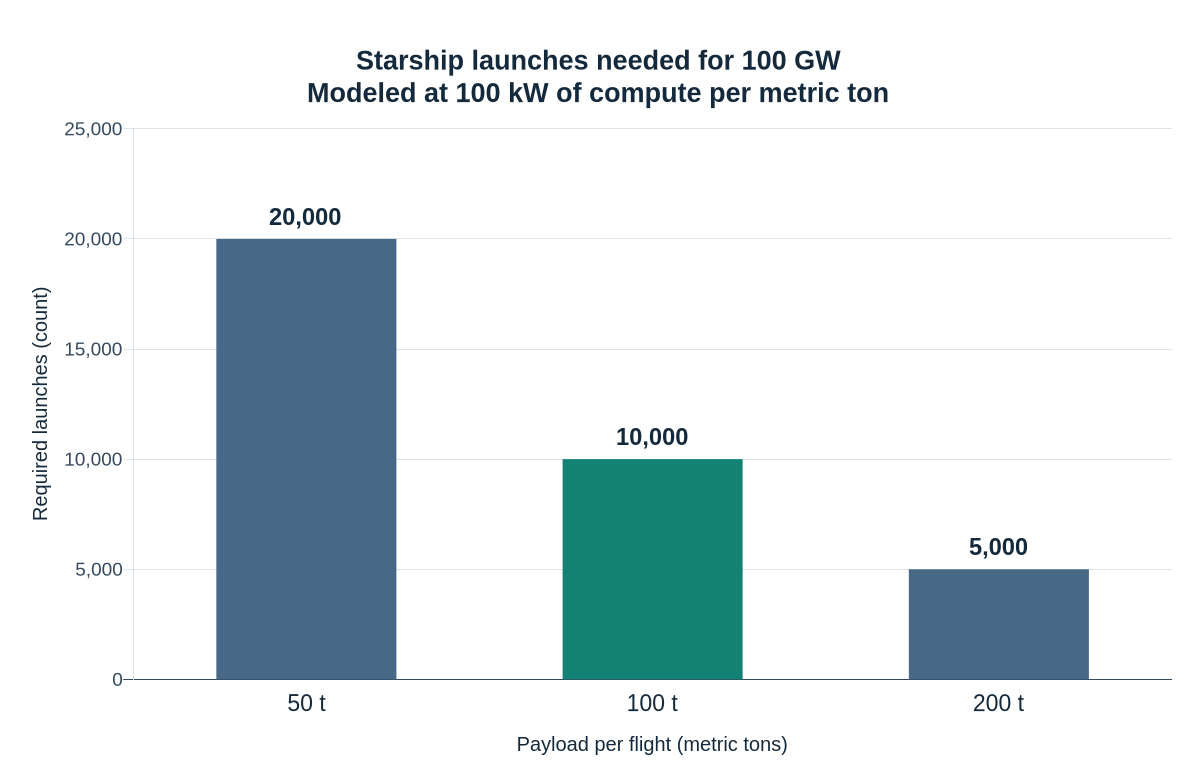
The conservative 50-ton scenario illustrates why initial spacecraft may require considerably more flights than a mature platform. Increasing payload mass or computing power density reduces the required cadence, but neither improvement can be assumed before demonstration.
From rocket demonstrations to industrial throughput
SpaceX’s third-quarter results record Starship Flight 14 delivering 26 Starlink V3 broadband satellites. The company also disclosed plans for a Louisiana spaceport targeting its first launch in 2029. Neither achievement establishes a sustained Starmind deployment rate. Launch pad turnaround, fleet availability, ground support, propellant supply and satellite production must scale together.
Earlier orbital data center concept video reposted on YouTube illustrates the proposed architecture; it is not footage of an operational compute constellation.
Another constraint is equipment retirement. With a hypothetical five-year service life, a mature million-satellite fleet would require 200,000 replacements annually just to maintain its population. Actual service life has not been established. Thermal control, discussed in our orbital cooling analysis, and communication reliability will also influence usable output.
Earlier Starmind timelines and Google’s competing orbital AI plans show how rapidly interest is growing. Regulatory approval enables the next stage, but launch economics, verified power density and repeatable deployment rates will determine whether orbital compute becomes competitive with Earth-based infrastructure.
We volunteer daily to ensure the credibility of the information on this platform is Verifiably True. If you would like to support to help further secure the integrity of our research initiative, please scan the QR code below.



Leave a Reply